

SKU: PP102488
Polyurethane bushing engine Honda Dio 1988-1992, 28-22-10 мм
In stock15 pcs.$6.73Log in as dealer

Polyurethane bushing engine Honda Dio 1988-1992, 28-22-10 мм
In stock15 pcs.Polyurethane bushing engine Honda Dio 1990-1996, 28-22-10 мм
In stock15 pcs.Polyurethane bushing engine Honda Dio 1994-2004, 28-22-10 мм
In stock15 pcs.Polyurethane bushing engine Honda Giorno 1992-2000, 28-22-10 мм
In stock15 pcs.Polyurethane bushing engine Honda Lead 1996-, 28-22-10 мм
In stock15 pcs.Polyurethane bushing engine Honda Tact 1993-, 28-22-10 мм
In stock15 pcs.Polyurethane bushing engine Honda Topic 1995-2004, 28-22-10 мм
In stock15 pcs.Polyurethane bushing engine Suzuki Inch Up Sport 2000-2009, 28-22-10 мм
In stock15 pcs.Polyurethane bushing engine Suzuki Lets 1996-, 28-22-10 мм
In stock15 pcs.Polyurethane bushing engine Suzuki Mollet 1998-2004, 28-22-10 мм
In stock15 pcs.Polyurethane bushing engine Suzuki Sepia 1993-, 28-22-10 мм
In stock15 pcs.Polyurethane bushing engine Suzuki Sepia ZZ 1983-1993, 28-22-10 мм
In stock15 pcs.Polyurethane bushing engine Suzuki Street Magic 1996-, 28-22-10 мм
In stock15 pcs.
Polyurethane bushing rear engine mount Chevrolet Aveo 2002-2011 SMALL
In stock15 pcs.
Polyurethane cushion engine rear Ford Fiesta 1989-1997 1.25L REPLACEABLE Small BUSHING
In stock15 pcs.Polyurethane cushion engine rear Ford Fiesta 1995-2002 1.25L REPLACEABLE Small BUSHING
In stock15 pcs.Polyurethane cushion engine rear Ford Fiesta 2002-2008 1.25L REPLACEABLE Small BUSHING
In stock15 pcs.Polyurethane cushion engine rear Ford Fiesta 2008-2017 1.25L REPLACEABLE Small BUSHING
In stock15 pcs.Polyurethane cushion engine rear Ford Ka 1996-2008 1.25L REPLACEABLE Small BUSHING
In stock15 pcs.Polyurethane cushion engine rear Ford Puma 1997-2002 1.25L REPLACEABLE Small BUSHING
In stock15 pcs.
Polyurethane engine cushion Honda Civic 2005-2011 REMOVABLE bushing
In stock15 pcs.
Polyurethane engine cushion Honda Civic VIII 2005-2011 REMOVABLE bushing
In stock15 pcs.
Polyurethane engine cushion Honda Cr-v 2006-2011 2.0L REMOVABLE bushing
In stock15 pcs.
Polyurethane engine cushion Honda Cr-v 2006-2011 2.4L REMOVABLE bushing
In stock15 pcs.
Polyurethane engine cushion Honda Cr-v 2006-2011 REMOVABLE bushing
In stock15 pcs.
Polyurethane engine cushion Honda Fr-v 2004-2009 REMOVABLE bushing
In stock15 pcs.
Polyurethane engine cushion right Acura Ilx 2012-2015 REMOVABLE bushing
In stock15 pcs.
Polyurethane engine cushion upper Citroen Cx 1974-1991 REMOVABLE BUSH
In stock15 pcs.
Polyurethane engine mount Acura Legend 1986-1995 REPLACEABLE Small BUSHING
In stock15 pcs.
Polyurethane engine mount Citroen Cx 1974-1991 REMOVABLE big BUSHING
In stock15 pcs.
Polyurethane engine mount Citroen Cx 1974-1991 REPLACEABLE small BUSHING
In stock15 pcs.Polyurethane engine mount Honda Accord 1989-1993 REPLACEABLE Small BUSHING
In stock15 pcs.Polyurethane engine mount Honda Legend 1985-1990 REPLACEABLE Small BUSHING
In stock15 pcs.
Polyurethane engine mount back Audi A3 2012-2020 2,0L REPLACEABLE BUSHING
In stock15 pcs.Polyurethane engine mount back Audi TT 2014-2023 2,0L REPLACEABLE BUSHING
In stock15 pcs.Polyurethane engine mount back Seat Leon 2012-2020 2,0L REPLACEABLE BUSHING
In stock15 pcs.Polyurethane engine mount back Skoda Octavia 2013-2020 2,0L REPLACEABLE BUSHING
In stock15 pcs.Polyurethane engine mount back Skoda Superb 2015- 2,0L REPLACEABLE BUSHING
In stock15 pcs.Polyurethane engine mount back Volkswagen Golf 2012-2020 2,0L REPLACEABLE BUSHING
In stock15 pcs.Polyurethane engine mount back Volkswagen Passat 2014- 2,0L REPLACEABLE BUSHING
In stock15 pcs.Polyurethane engine mount back Volkswagen Touran 2015- 2,0L REPLACEABLE BUSHING
In stock15 pcs.
Polyurethane engine mount left Jeep Grand Cherokee 1998-2004 3.1L one-piece cast REPLACEABLE BUSHING
In stock15 pcs.
Polyurethane engine mount lower Nissan Primastar 2002-2016 REPLACEABLE small BUSHING
In stock15 pcs.Polyurethane engine mount lower Opel Vivaro 2001-2014 REPLACEABLE small BUSHING
In stock15 pcs.Polyurethane engine mount lower Renault Trafic 2001-2014 REPLACEABLE small BUSHING
In stock15 pcs.
Polyurethane engine mount rear Audi A3 1996-2006 SMALL BUSHING
In stock15 pcs.
Polyurethane engine mount rear Chevrolet Lacetti 2003- REPLACEABLE small BUSHING
In stock15 pcs.
Polyurethane engine mount rear Chevrolet Lacetti 2003- REPLACEABLE small BUSHING
In stock15 pcs.Polyurethane engine mount rear Chevrolet Nubira 2003-2009 REPLACEABLE small BUSHING
In stock15 pcs.
Polyurethane engine mount rear Renault Kangoo 1997-2008 REPLACEABLE small BUSHING
In stock15 pcs.Polyurethane engine mount rear Seat Leon 1998-2006 SMALL BUSHING
In stock15 pcs.Polyurethane engine mount rear Seat Toledo 1999-2004 SMALL BUSHING
In stock15 pcs.Polyurethane engine mount rear Skoda Octavia 1996-2010 SMALL BUSHING
In stock15 pcs.Polyurethane engine mount rear Skoda Octavia 2004-2010 SMALL BUSHING
In stock15 pcs.Polyurethane engine mount rear Volkswagen Bora 1998-2005 SMALL BUSHING
In stock15 pcs.Polyurethane engine mount rear Volkswagen Golf 1997-2003 SMALL BUSHING
In stock15 pcs.Polyurethane engine mount rear Volkswagen New Beetle 1998-2010 SMALL BUSHING
In stock15 pcs.
Polyurethane engine mount rear, lower Audi A3 1996-2003 SMALL BUSHING
In stock15 pcs.Polyurethane engine mount rear, lower Audi A3 2003-2012 SMALL BUSHING
In stock15 pcs.Polyurethane engine mount rear, lower Audi A3 2012-2020 SMALL BUSHING
In stock15 pcs.Polyurethane engine mount rear, lower Audi TT 1998-2006 SMALL BUSHING
In stock15 pcs.Polyurethane engine mount rear, lower Audi TT 2006-2014 SMALL BUSHING
In stock15 pcs.Polyurethane engine mount rear, lower Audi TT 2014-2023 SMALL BUSHING
In stock15 pcs.Polyurethane engine mount rear, lower Audi TT 2014-2023 SMALL BUSHING
In stock15 pcs.Polyurethane engine mount rear, lower Seat Leon 1998-2006 SMALL BUSHING
In stock15 pcs.Polyurethane engine mount rear, lower Seat Leon 2005-2012 SMALL BUSHING
In stock15 pcs.Polyurethane engine mount rear, lower Seat Leon 2012-2020 SMALL BUSHING
In stock15 pcs.Polyurethane engine mount rear, lower Seat Toledo 1991-1999 SMALL BUSHING
In stock15 pcs.Polyurethane engine mount rear, lower Seat Toledo 1999-2004 SMALL BUSHING
In stock15 pcs.Polyurethane engine mount rear, lower Seat Toledo 2004-2009 SMALL BUSHING
In stock15 pcs.Polyurethane engine mount rear, lower Seat Toledo 2005-2012 SMALL BUSHING
In stock15 pcs.Polyurethane engine mount rear, lower Seat Toledo 2012- SMALL BUSHING
In stock15 pcs.Polyurethane engine mount rear, lower Skoda Octavia 1959-1971 SMALL BUSHING
In stock15 pcs.Polyurethane engine mount rear, lower Skoda Octavia 1996-2010 SMALL BUSHING
In stock15 pcs.Polyurethane engine mount rear, lower Skoda Octavia 2004-2010 SMALL BUSHING
In stock15 pcs.Polyurethane engine mount rear, lower Skoda Octavia 2013- SMALL BUSHING
In stock15 pcs.Polyurethane engine mount rear, lower Volkswagen Bora 1998-2005 SMALL BUSHING
In stock15 pcs.Polyurethane engine mount rear, lower Volkswagen Bora 2007- SMALL BUSHING
In stock15 pcs.Polyurethane engine mount rear, lower Volkswagen Golf 1974-1983 SMALL BUSHING
In stock15 pcs.Polyurethane engine mount rear, lower Volkswagen Golf 1983-1992 SMALL BUSHING
In stock15 pcs.Polyurethane engine mount rear, lower Volkswagen Golf 1991-1998 SMALL BUSHING
In stock15 pcs.Polyurethane engine mount rear, lower Volkswagen Golf 1997-2003 SMALL BUSHING
In stock15 pcs.Polyurethane engine mount rear, lower Volkswagen Golf 2003-2006 SMALL BUSHING
In stock15 pcs.Polyurethane engine mount rear, lower Volkswagen Golf 2003-2008 SMALL BUSHING
In stock15 pcs.Polyurethane engine mount rear, lower Volkswagen Golf 2006-2008 SMALL BUSHING
In stock15 pcs.Polyurethane engine mount rear, lower Volkswagen Golf 2008-2012 SMALL BUSHING
In stock15 pcs.Polyurethane engine mount rear, lower Volkswagen Golf 2012-2020 SMALL BUSHING
In stock15 pcs.Polyurethane engine mount rear, lower Volkswagen New Beetle 1998-2010 SMALL BUSHING
In stock15 pcs.Polyurethane engine mount rear, lower Volkswagen Polo 1981-1994 SMALL BUSHING
In stock15 pcs.Polyurethane engine mount rear, lower Volkswagen Polo 1994-2001 SMALL BUSHING
In stock15 pcs.
Polyurethane engine mount right upper Lexus Es 2001-2006 3.0 REPLACEABLE Small BUSHING
In stock15 pcs.
Polyurethane engine mount right upper Lexus Es 2001-2006 REPLACEABLE Small BUSHING
In stock15 pcs.
Polyurethane engine mount right upper Toyota Alphard 2002-2008 REPLACEABLE Small BUSHING
In stock15 pcs.Polyurethane engine mount right upper Toyota Camry 2001-2006 3.0 REPLACEABLE Small BUSHING
In stock15 pcs.Polyurethane engine mount right upper Toyota Camry 2001-2006 REPLACEABLE Small BUSHING
In stock15 pcs.Polyurethane engine mount right upper Toyota Harrier 2003-2013 REPLACEABLE Small BUSHING
In stock15 pcs.Polyurethane engine mount right upper Toyota Highlander 2000-2008 REPLACEABLE Small BUSHING
In stock15 pcs.
Polyurethane engine mount right upper Toyota Highlander 2008-2013 REPLACEABLE Small BUSHING
In stock15 pcs.
Polyurethane engine mount right upper Toyota Highlander 2008-2013 REPLACEABLE Small BUSHING HARDNESS
In stock15 pcs.Polyurethane engine mount right upper Toyota Previa 2000-2006 REPLACEABLE Small BUSHING
In stock15 pcs.
Polyurethane engine mount right upper Toyota Sienna 2003-2009 REPLACEABLE Small BUSHING
In stock15 pcs.Polyurethane engine mount right upper Toyota Solara 2003-2009 3.0 REPLACEABLE Small BUSHING
In stock15 pcs.Polyurethane engine mount right upper Toyota Solara 2003-2009 REPLACEABLE Small BUSHING
In stock15 pcs.Polyurethane engine mount right upper Toyota Venza 2008-2017 REPLACEABLE Small BUSHING
In stock15 pcs.Polyurethane engine mount right upper Toyota Venza 2008-2017 REPLACEABLE Small BUSHING HARDNESS
In stock15 pcs.
Polyurethane engine mounting lower Nissan Primastar 2002-2016 REPLACEABLE small BUSHING
In stock15 pcs.Polyurethane engine mounting lower Opel Vivaro 2001-2014 REPLACEABLE small BUSHING
In stock15 pcs.Polyurethane engine mounting lower Renault Trafic 2001-2014 REPLACEABLE small BUSHING
In stock15 pcs.
Polyurethane front engine mount Audi A3 2012-2020 REPLACEABLE BUSHING
In stock15 pcs.Polyurethane front engine mount Audi A3 2020- REPLACEABLE BUSHING
In stock15 pcs.Polyurethane front engine mount Audi Q2 2016- REPLACEABLE BUSHING
In stock15 pcs.Polyurethane front engine mount Audi Q3 2019- REPLACEABLE BUSHING
In stock15 pcs.Polyurethane front engine mount Audi TT 2014-2023 REPLACEABLE BUSHING
In stock15 pcs.
Polyurethane front engine mount Jeep Grand Cherokee 1993-1998 one-piece cast REPLACEABLE BUSHING
In stock15 pcs.Polyurethane front engine mount Jeep Grand Cherokee 1998-2004 one-piece cast REPLACEABLE BUSHING
In stock15 pcs.Polyurethane front engine mount Jeep Grand Cherokee 2005-2010 one-piece cast REPLACEABLE BUSHING
In stock15 pcs.
Polyurethane front engine mount Renault Clio 1998-2005 REPLACEABLE small BUSHING
In stock15 pcs.Polyurethane front engine mount Renault Espace 2002- REPLACEABLE small BUSHING
In stock15 pcs.Polyurethane front engine mount Renault Laguna 2001-2007 REPLACEABLE small BUSHING
In stock15 pcs.Polyurethane front engine mount Renault Vel Satis REPLACEABLE small BUSHING
In stock15 pcs.Polyurethane front engine mount Seat Ateca 2016- REPLACEABLE BUSHING
In stock15 pcs.Polyurethane front engine mount Seat Leon 2012-2020 REPLACEABLE BUSHING
In stock15 pcs.Polyurethane front engine mount Seat Leon 2020- REPLACEABLE BUSHING
In stock15 pcs.Polyurethane front engine mount Seat Tarraco 2018- REPLACEABLE BUSHING
In stock15 pcs.Polyurethane front engine mount Skoda Karoq 2018- REPLACEABLE BUSHING
In stock15 pcs.Polyurethane front engine mount Skoda Kodiaq 2017- REPLACEABLE BUSHING
In stock15 pcs.Polyurethane front engine mount Skoda Octavia 2013-2020 REPLACEABLE BUSHING
In stock15 pcs.Polyurethane front engine mount Skoda Octavia 2020- REPLACEABLE BUSHING
In stock15 pcs.Polyurethane front engine mount Skoda Superb 2015- REPLACEABLE BUSHING
In stock15 pcs.
Polyurethane front engine mount VAZ 2110-2112 1995-2014 SMALL BUSHING
In stock15 pcs.Polyurethane front engine mount VAZ 2170 2007-2018 SMALL BUSHING
In stock15 pcs.Polyurethane front engine mount Volkswagen Arteon 2017- REPLACEABLE BUSHING
In stock15 pcs.Polyurethane front engine mount Volkswagen Caddy 2015- REPLACEABLE BUSHING
In stock15 pcs.Polyurethane front engine mount Volkswagen Golf 2012-2020 REPLACEABLE BUSHING
In stock15 pcs.Polyurethane front engine mount Volkswagen Golf 2020- REPLACEABLE BUSHING
In stock15 pcs.Polyurethane front engine mount Volkswagen Jetta 2018- REPLACEABLE BUSHING
In stock15 pcs.Polyurethane front engine mount Volkswagen Passat 2014- REPLACEABLE BUSHING
In stock15 pcs.Polyurethane front engine mount Volkswagen Santana 2012- REPLACEABLE BUSHING
In stock15 pcs.Polyurethane front engine mount Volkswagen T-Roc 2017- REPLACEABLE BUSHING
In stock15 pcs.Polyurethane front engine mount Volkswagen Tiguan 2015- REPLACEABLE BUSHING
In stock15 pcs.Polyurethane front engine mount Volkswagen Touran 2015- REPLACEABLE BUSHING
In stock15 pcs.Polyurethane front engine mount Volkswagen Variant 2014- REPLACEABLE BUSHING
In stock15 pcs.
Polyurethane front engine mount left Honda Hr-v 1998-2006 REPLACEABLE small BUSHING
In stock15 pcs.
Polyurethane front engine mount upper Toyota Camry 2006-2011 2.4L REPLACEABLE Small BUSHING
In stock15 pcs.
Polyurethane front engine mount upper Toyota Camry 2006-2011 2.4L REPLACEABLE Small BUSHING HARDNESS
In stock15 pcs.
Polyurethane front engine mount upper Toyota Camry 2006-2011 2.5 USA REPLACEABLE Small BUSHING
In stock15 pcs.
Polyurethane front engine mount upper Toyota Camry 2006-2011 2.5 USA REPLACEABLE Small BUSHING HARDNESS
In stock15 pcs.
Polyurethane front engine mount upper Toyota Camry 2006-2011 REPLACEABLE Small BUSHING
In stock15 pcs.
Polyurethane front engine mount upper Toyota Camry 2006-2011 REPLACEABLE Small BUSHING HARDNESS
In stock15 pcs.
Polyurethane front engine mount upper Toyota Camry 2011-2017 2,0L REPLACEABLE Small BUSHING
In stock15 pcs.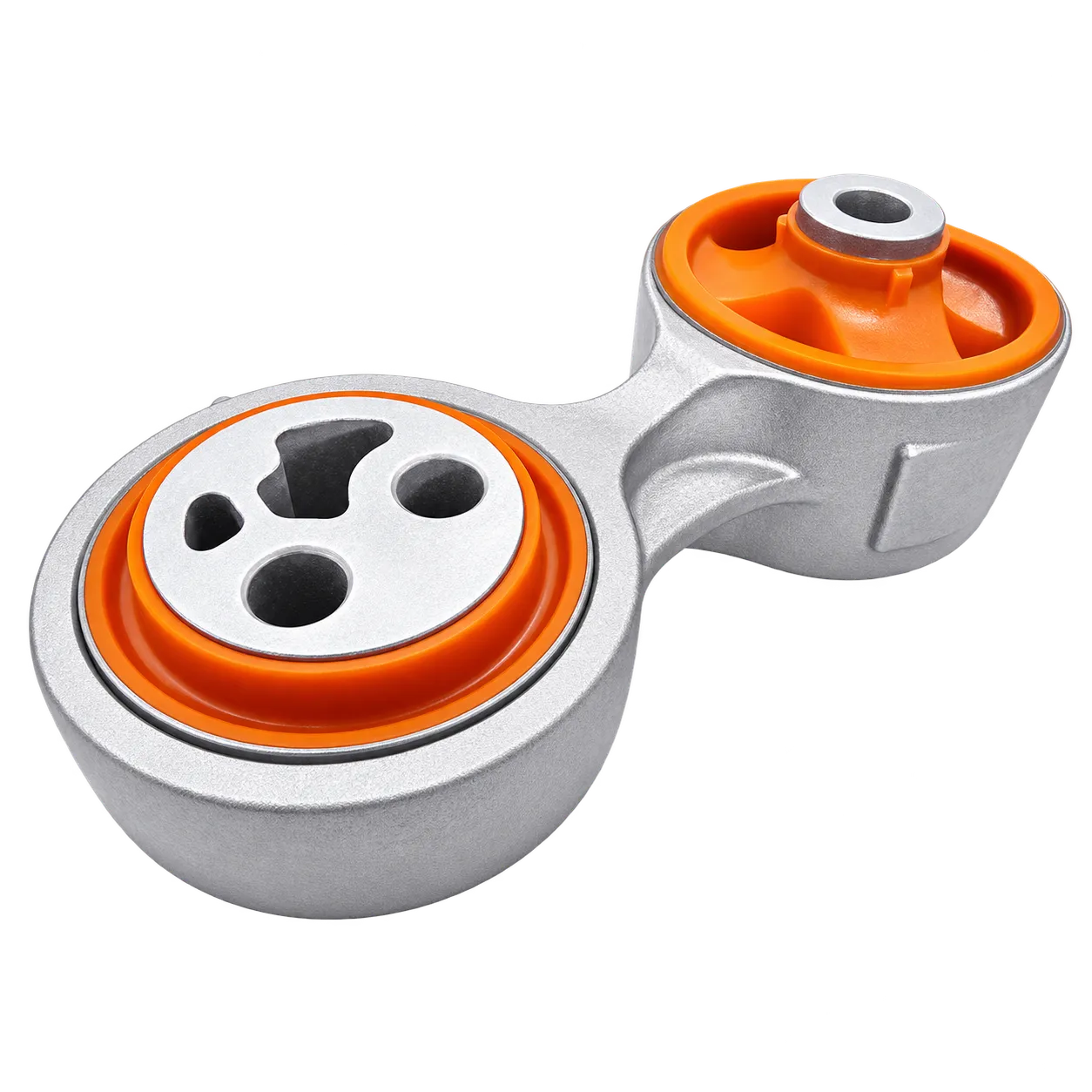
An engine mount is the flexible support through which the powertrain is attached to the body or subframe: it carries the weight of the motor, holds it in its designed position and damps vibration. The same part is also called a motor mount or an engine cushion. PolyPro casts it from polyurethane in its own moulds, for passenger cars, commercial vehicles and special machinery. The rest of the suspension and driveline range is in the catalogue.
An engine mount consists of a metal sleeve or bracket and a flexible element between them. The flexible section deforms under the weight of the motor and under torque reaction, absorbing the energy of the oscillation and keeping it from reaching the shell. Some mounts work mainly in compression and others in shear and torsion, which is why their construction differs even within a single vehicle.
In a transverse layout one mount takes the main weight of the assembly, a second balances it, and the lower torque rod controls the rocking that comes with acceleration and braking. Together with the gearbox mount they form one system: when a single part sags, the rest start working at an angle. For that reason the condition of every mounting point is assessed together rather than one at a time.
A worn engine mount first shows itself as vibration at idle that carries into the steering wheel, the gear lever and the floor. A dull knock follows: the assembly manages to shift before the mount stops it.
Check the mount with the vehicle raised: prise it with a bar to feel the play, then have someone load the engine briefly in gear — movement of a few millimetres means the flexible element has given up. Inspect the bracket and the stud thread as well, since metal often cracks after a mount collapses.
A factory engine mount is made from a rubber compound: it is soft and isolates high-frequency vibration well, but it ages from heat, oil, fuel and ozone, and after a few years it takes a permanent set and sags. Polyurethane is denser, barely reacts to oil and fuel, copes better with temperature swings and keeps the height of the mounting point through its whole service life.
In practice a polyurethane mount locates the assembly more firmly: less movement under acceleration, cleaner gear changes, less load on the driveshafts and hoses. The downside is that a little more vibration reaches the shell, which is more noticeable on a passenger car than on a truck or on machinery. That is balanced by the choice of durometer: the Shore value is listed on each product page.
Engine mounts are selected by mounting position, fitting dimensions and design, not by the name of the model. Below are four parameters worth checking before ordering, so the part fits without any reworking.
Work out which mounting point has failed: the upper mount that carries the weight of the assembly, the side mount that balances it, or the lower torque rod that holds the motor against rocking. Each has its own shape and its own load pattern, so they are never interchangeable. The gearbox mount stands apart and is often confused with the engine one, although it works mainly in shear and takes the jolts of gear changes. If the vibration is still there after the engine mount has been replaced, check the gearbox mounting. On a lift the difference shows in the play: the engine mount moves vertically, the gearbox mount lengthways.
Remove the old mount and measure it: overall body size or outer sleeve diameter, height of the flexible section, stud diameter and length, centre-to-centre hole spacing and the inner bush bore. Compare that with the product page, because parts that look identical often differ in height by a few millimetres and the assembly ends up sitting at an angle. If the old part has broken up, work from the bracket and the seat, and for rare machinery order a part made to a drawing, a sample or a worn item, from one piece up. Check left and right mounts separately, as they are not always mirror images.
Durometer is chosen for the load, not on the principle that harder is always better. A car used daily in town takes a softer polyurethane: it stays closer to the factory feel and adds no vibration at idle. A truck, a bus, special machinery, regular towing or an engine with higher torque needs a denser material, otherwise the assembly shifts under drive and loads the driveshafts. The Shore value is listed on each product page, and it is better to keep the same grade across every mounting point. On vehicles that regularly pull away loaded or tow a trailer, a soft grade takes a permanent set quickly.
Mounts differ in construction: a solid polyurethane insert in a metal housing, a mount with a stud, a mount with an inner bush for a through bolt, or a torque rod with two eyes. The factory part may be hydraulic, with a fluid chamber inside; the polyurethane equivalent has no such chamber and works as a plain flexible element, so it damps vibration in a different way. Before ordering, check the fixing type — stud, through bolt or pressed-in bush — because that decides whether the part will go into the standard seat. The photographs and dimensions on the product page show the housing geometry and the seat type.
PolyPro is the manufacturer: its own moulds, its own casting shop, dimensional control on site and sales without intermediaries. Because of that an engine mount comes without a chain of mark-ups, and its geometry follows the drawing from batch to batch. The products carry a warranty. Retail is by the piece — a single mount can be ordered for one mounting point instead of a set. Non-standard parts are made to a drawing, a sample or a worn item, also from one piece up.
Wholesale is intended for workshops, parts shops, fleets and resellers. The partner programme gives bonuses on turnover or on the size of a single order, access to prices and stock levels, and shipment under the partner's own brand. International shipping is available.
They are the same part under two names: engine mount is the catalogue term, while motor mount and engine cushion are the workshop ones. The wider group, which also includes gearbox mounts, differential mounts and damper pulleys, is gathered in the engine and transmission mounts section.
It depends on the layout. On most front-wheel-drive cars there are three or four points for the engine and gearbox together: an upper mount, a side mount and a lower torque rod. Trucks and special machinery use more points. Check the mounting diagram for the specific assembly.
Yes, but a new mount sitting next to worn ones takes the larger share of the load and gives up sooner. If the mileage is the same at every point, replacing the set is more sensible: the assembly sits square, the angle is gone and vibration does not move from one mount to the next.
A polyurethane mount has no fluid chamber, so it works as a plain flexible element: it locates the motor more precisely and cannot leak, but it damps high-frequency vibration differently. On commercial vehicles and in hard service the swap is justified; on a passenger car a softer grade is chosen instead.
Put the vehicle on the handbrake, select a gear and briefly raise the revs while watching the motor. Visible shifting or jumping of the assembly, a knock, or parts touching the body mean the flexible element has failed. Also inspect the mount for cracks and for separation from the sleeve.
For daily driving in town the softer option is the usual choice: it stays closer to the factory level of comfort and adds no vibration at idle. For goods vehicles, towing and engines with higher torque a denser grade is used. The Shore value is listed on each product page.
Yes, retail is by the piece, so one mount can be ordered for a single mounting point without buying a kit. If the item is not in stock, PolyPro makes it to a drawing, a sample or a worn part, also from one piece up. The products carry a warranty and international shipping is available.
Wholesale is available to workshops, parts shops, fleets and resellers. The partner programme gives bonuses on turnover or on the size of a single order, access to prices and stock levels, and shipment under the partner's own brand. Terms are agreed individually.