
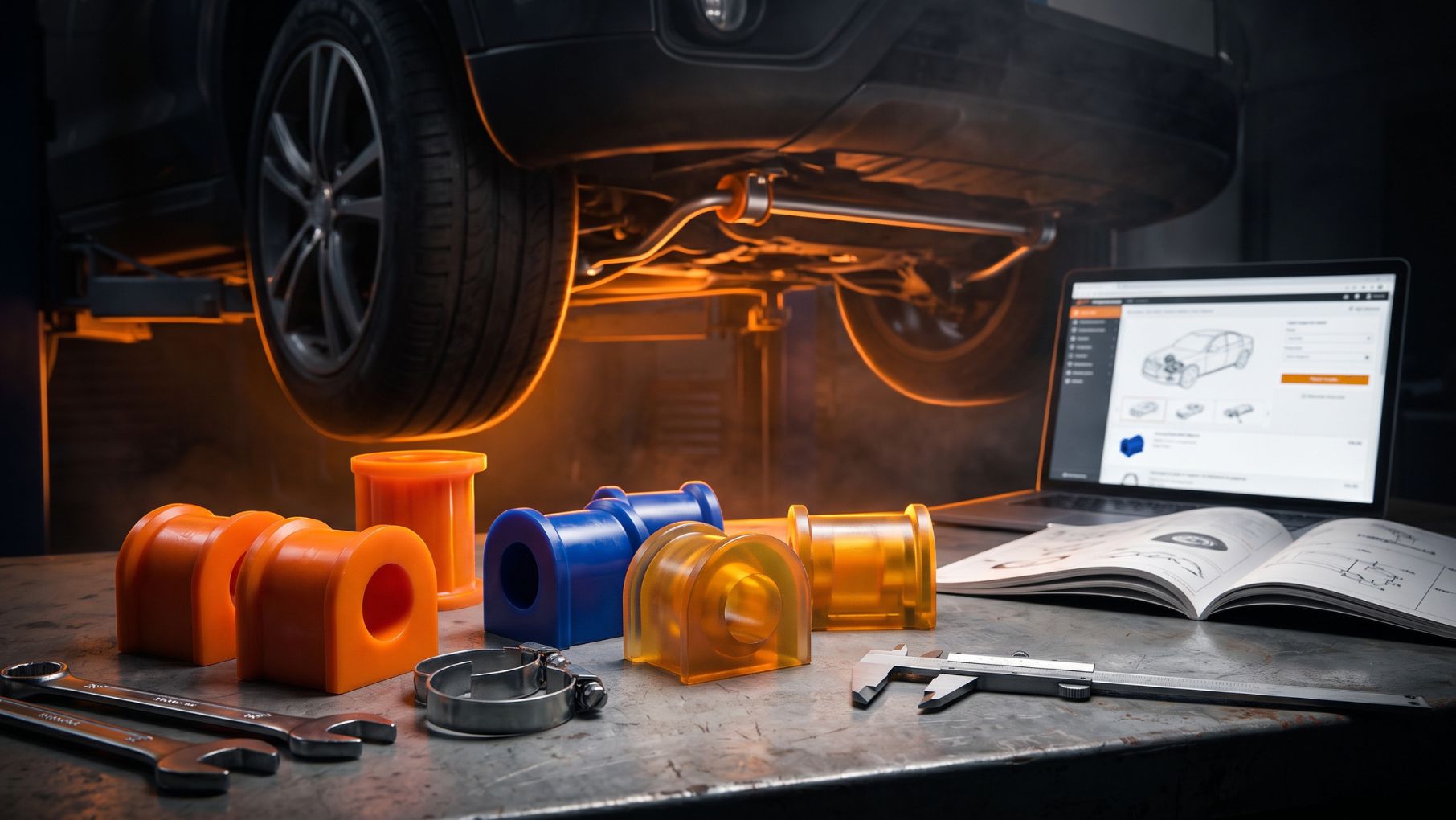
Polyurethane Anti-Roll Bar Bushings: Selection by Vehicle and Diameter
Polyurethane anti-roll bar bushings must be selected according to the vehicle model and variant, installation position, bar diameter and mounting design. The vehicle name alone is not enough: the component must match the specific assembly. Even bushings that look similar may differ in width, profile or fit within the mounting bracket.
Correct selection starts with checking compatibility and ends with verifying dimensions. This is particularly important if the repair history is unknown, the anti-roll bar has been replaced or its surface shows signs of wear. Here is what information you need before ordering, how to measure the diameter and which details to check.
What Anti-Roll Bar Bushings Do
An anti-roll bar, also called a stabiliser bar, resists body roll during cornering. Its bushings support the bar at its mounting points on the body or subframe and allow the connection to function as designed. The flexible material also reduces vibration transmission and prevents direct contact between metal surfaces.
An anti-roll bar mounting bushing should not be confused with an anti-roll bar link. These are different components with different mounting arrangements. When searching, specify that you need the bar bushing that fits beneath the mounting bracket, and identify whether it is for the front or rear axle.
Worn bushings may cause knocking over bumps, squeaking or a gap between the bar and its support. However, noise alone cannot identify the fault. Anti-roll bar links, fasteners and other suspension components can cause similar symptoms. Replacement should therefore be based on inspection findings rather than assumptions about the sound.
Polyurethane or Rubber: What Matters When Choosing?
Polyurethane is used in bushings because its mechanical properties can be tailored to the application. However, the word “polyurethane” alone does not establish a component’s stiffness, comfort or service life. Material formulation, product design, manufacturing quality and suitability for the operating conditions all matter.
Will polyurethane bushings make road imperfections more noticeable? This depends on the specific product. A stiffer mounting may transmit more vibration, but it is inaccurate to assume that all polyurethane components behave identically. For an everyday vehicle, compatibility with its suspension matters more than maximum stiffness.
There is also no universal mileage at which all these bushings need replacement. Bar condition, contamination, loads and installation affect wear. A new bushing will not resolve a damaged bracket or significant corrosion on the mounting surface. Assess the material alongside the design and condition of the entire connection.
How to Select Anti-Roll Bar Bushings by Vehicle
Searching by make and model narrows the options, but it does not replace checking the specific vehicle variant. The year, generation, engine and suspension specification all matter. If the catalogue lists several options, additional information is needed.
Prepare the following details:
-
vehicle make, model, year and VIN;
-
engine capacity and type, plus other specification details where necessary;
-
installation position: front or rear anti-roll bar;
-
original part number, if identified;
-
bar diameter near the mounting point and any signs of wear;
-
photographs of the old bushing, bracket and installation area.
Can you select a bushing using the VIN alone? The VIN helps identify the factory specification, but it does not reveal every change made during previous repairs. If a different anti-roll bar has been fitted, the actual assembly may differ from the catalogue specification. Additional checks are then required.
Start with the PolyPro passenger car parts catalogue, where you can browse by vehicle make. Then check the specific product’s applications, specifications and compatibility with the installed component.
How to Measure the Anti-Roll Bar Diameter
You need the diameter of the metal bar, rather than the outside dimensions of the bushing. Measuring the opening in an old bushing is also unreliable: the material deforms during use, and the contact area wears.
A vernier or digital caliper is a convenient tool for checking the bar. Measure a clean, straight section as close to the bushing as possible, avoiding bends that could distort the result.
After removing the old bushing, inspect the surface directly beneath it. If there is wear, corrosion or an uneven surface, measuring beside the bushing is not enough. Establish whether the bar remains serviceable and whether a new bushing can fit correctly.
Follow this practical checking sequence:
-
clean dirt and deposits from the measurement area;
-
measure the diameter in several directions to identify unevenness;
-
inspect the surface beneath the bushing where accessible;
-
record the actual measurements in millimetres without arbitrary rounding;
-
compare the results with the component manufacturer’s specifications and instructions.
Must the opening in a new bushing exactly match the bar diameter? Not necessarily. The manufacturer may specify an interference fit, and the size in the product name may refer to the anti-roll bar diameter for which the bushing is intended. Follow the stated application rather than relying solely on measurements of the unloaded opening.
Why a Matching Diameter Is Not Enough
The bushing must fit both the bar and the bracket. Height, width, external profile, locating features and split design all matter. Two bushings intended for the same bar diameter may have different mounting profiles and may not be interchangeable.
If the profile is incorrect, the bracket may compress the bushing unevenly or fail to seat properly. Overtightening does not correct incompatibility. It risks damaging the mounting hardware and preventing the assembly from working correctly.
Can you use a smaller bushing to eliminate play? Do not change the size arbitrarily. First identify the cause of the clearance: a worn bushing, a worn bar or damaged mounting hardware. If the manufacturer offers a repair solution, its suitability must be confirmed. Simply choosing the nearest smaller size is not enough.
What to Consider When Replacing Polyurethane Bushings
Before installation, inspect the bar, brackets and fasteners. Dirt, corrosion and damage to contact surfaces can compromise the fit and accelerate wear of the new component.
Do polyurethane anti-roll bar bushings need lubrication? The manufacturer of the specific product determines this. Some designs require a specified lubricant, while others have different installation requirements. For example, instructions for certain bushings specify using the supplied grease, but this requirement should not automatically be applied to all polyurethane components.
Follow the vehicle’s repair documentation and the bushing manufacturer’s instructions for the installation procedure and tightening torque. There is no universal torque setting for every model.
Should both bushings be replaced at the same time? If the bar uses two mounting bushings, inspect both. Replacing them as a pair makes sense when both are of a similar age and show noticeable wear. However, check the package contents before ordering: one product listing may refer to a single bushing rather than a set.
How to Buy the Correct Anti-Roll Bar Bushings
Before buying anti-roll bar bushings, confirm compatibility, size and quantity. Compare prices with the package contents in mind: the price of one component and the price of a complete set are not equivalent offers. Also check whether additional mounting hardware is required and which installation requirements apply.
For help with selection at PolyPro, prepare the vehicle details, part number where available and your measurements. Browse the passenger car parts catalogue to begin your search. If the catalogue information differs from the actual assembly, resolve those differences before ordering.
Correctly selected polyurethane anti-roll bar bushings match the vehicle, bar diameter and mounting geometry. Together, these parameters provide the basis for proper installation and help avoid ordering again because of an incorrect fit.