
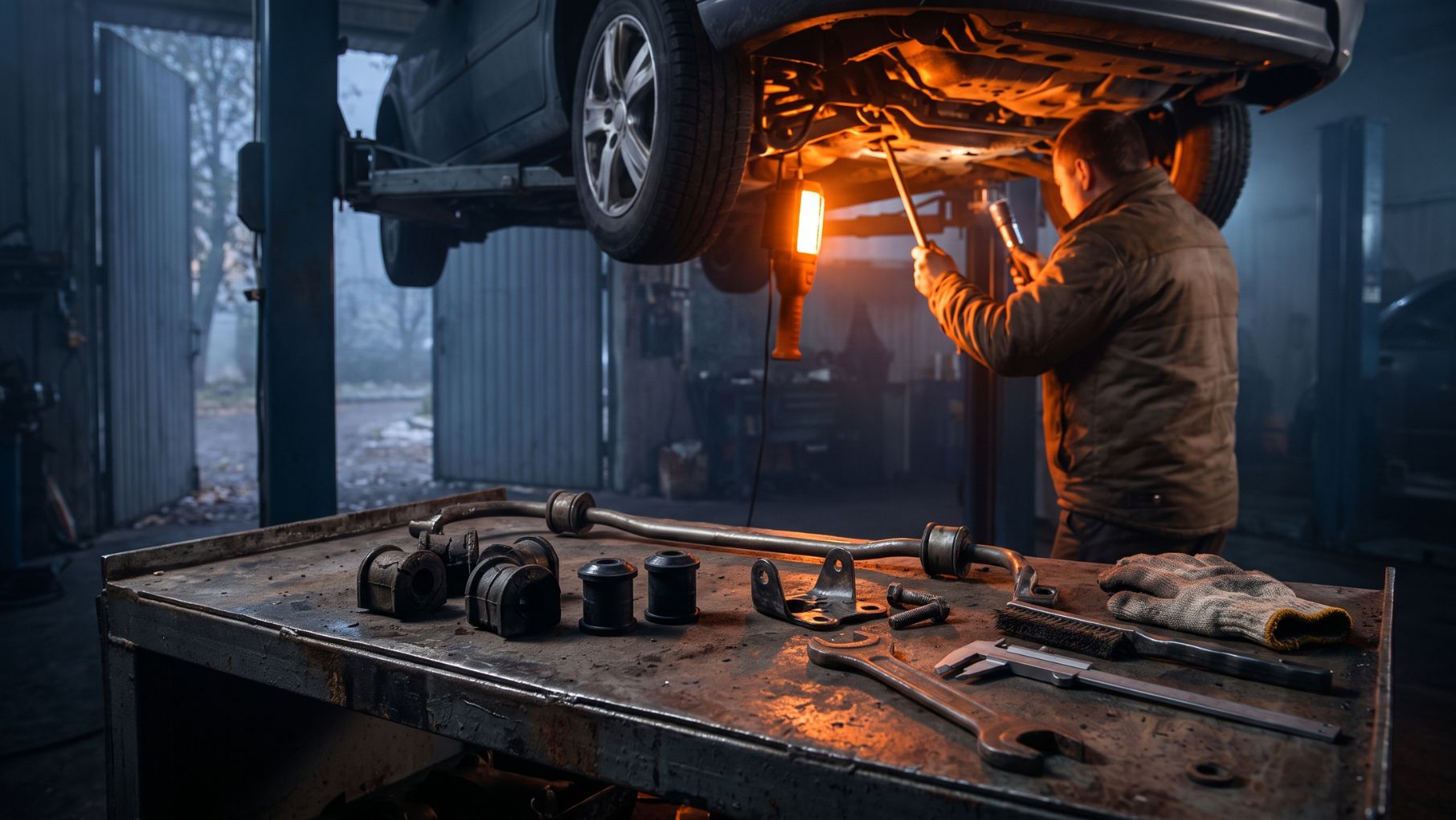
Anti-Roll Bar Bushings: Knocking, Squeaking and Checks Before Cold Weather
A dull knock over bumps and suspension squeaking after a cold night may indicate worn anti-roll bar bushings. These components hold the bar in its mounts while allowing its intended movement and reducing vibration transmission to the body. Worn bushings can cause play and unwanted noise, but the exact cause must be established through a suspension inspection.
Worn anti-roll bar bushings often produce short, dull knocks over uneven surfaces. However, sound alone cannot identify the fault. Anti-roll bar links and other suspension connections can cause similar symptoms, so an inspection is needed before ordering parts.
What Worn Anti-Roll Bar Bushings Sound Like
Drivers typically notice short, dull knocks when travelling over small bumps. The noise may repeat over road joints, cobblestones or uneven sections at low speed. Its volume depends on the vehicle’s design, the extent of wear and the loading conditions.
Noise occurring over bumps helps narrow the search, but it does not identify a single component. Sound also travels through the subframe and body, so the location perceived by the driver may differ from the actual source.
Before an inspection, note the following:
-
whether the knocking comes from the front or rear;
-
whether it occurs only when the vehicle is cold or throughout the journey;
-
whether it appears over small bumps, during cornering or when braking;
-
whether rain changes the sound;
-
whether the noise developed gradually or started immediately after suspension repairs.
This information helps the technician reproduce the symptom. When investigating unwanted noises, we recommend inspecting the suspension as a whole, including the anti-roll bar links, mounting hardware and other possible sources.
Why Anti-Roll Bar Bushings Squeak in Cold Weather
Squeaking and knocking have different causes. Knocking may result from unwanted movement within a worn connection. Squeaking is more commonly associated with friction as the suspension moves.
At low temperatures, rubber components can become less flexible. This may make previously faint noises more noticeable.
However, squeaking that begins in autumn does not prove that the bushings need immediate replacement. Check their condition, size compatibility, the bar surface and installation. If the noise disappears after a few kilometres, this does not confirm that the assembly is serviceable either.
Will Lubrication Help?
There is no universal rule for all bushings. Some designs operate without additional lubrication, while others require a manufacturer-specified lubricant in particular locations. For example, MOOG offers bushings that do not require lubrication, while the instructions for certain Powerflex polyurethane bushings specify using the supplied grease.
Avoid applying an arbitrary lubricant simply to silence the noise. Even if the squeaking temporarily disappears, lubrication will not restore a worn bore or eliminate play. Follow the maintenance instructions for the specific component.
Signs of Faulty Anti-Roll Bar Bushings
The strongest evidence comes from matching the symptoms to an identified defect. During inspection, look for tears, significant deformation, displaced bushings and unwanted movement of the bar within its mounts.
Surface cracks alone do not necessarily explain the knocking. Conversely, a bushing that appears intact may have a worn inner surface hidden beneath the bracket.
Inspect the mounting hardware and the bar separately. A loose or damaged bracket, corrosion or wear at the contact area can prevent even a new bushing from working correctly. If the mounting surface is damaged, replacing the bushing alone may not produce the expected result.
A noticeable deterioration in handling should not automatically be attributed to the bushings. It requires an inspection of the entire suspension and steering system.
How to Check Anti-Roll Bar Bushings Before Cold Weather
The inspection starts by confirming the reported symptom. The technician needs to hear the noise under the conditions in which the driver notices it. The vehicle is then inspected using suitable equipment.
Limit your own checks to recording the noise and carrying out an accessible external inspection. Working beneath a vehicle supported only by a jack is dangerous.
Inspecting the Bushings and Mounting Hardware
Check both mounting points on the same anti-roll bar. Assess the material’s condition, the position of the bushings beneath their brackets, the bolts and any signs of unwanted movement.
Not every split in a bushing is damage. Many bushings have an intentional split that allows installation around the bar. Its shape and the manufacturer’s documentation help distinguish it from a tear.
Checking for Play
The technician checks for movement of the bar within its mount that produces a knock or indicates an incorrect fit. The suspension position and the procedure for the specific model must be taken into account.
Loading on the anti-roll bar can affect how play appears. Arbitrarily moving the bar or checking only one side may therefore fail to provide a reliable result.
Checking Nearby Components
Alongside the bushings, inspect the anti-roll bar links, control arm bushings, ball joints and shock absorber mounts. If the knocking began after repairs, check that the installed parts are correct and that the required installation procedure was followed.
The inspection should produce a specific finding about the source of the noise. An assumption based on an audio recording or a written description is insufficient.
How Many Anti-Roll Bar Bushings Does a Car Have?
In a common arrangement, one anti-roll bar has two mounting bushings. If separate anti-roll bars are fitted at the front and rear, there are usually four of these bushings.
However, this is not a universal count for every vehicle. Some models have no separate rear anti-roll bar, while the mounting design and whether the bushings can be replaced separately depend on the assembly. Check the catalogue for the specific vehicle to establish the exact quantity.
Rubber components used in some anti-roll bar link mountings may also be called bushings. Distinguish these from the mounting bushings supporting the bar itself to ensure that you order the correct parts.
How to Select a Replacement Bushing After Inspection
Once the fault is confirmed, identify the exact component required. A single vehicle model may use anti-roll bars of different diameters, so make and year alone are sometimes insufficient.
Do not determine the required size solely from the opening in the old bushing, as wear may have changed its dimensions.
Use the PolyPro passenger car parts catalogue to move from the inspection findings to finding a replacement. Start with the vehicle make, then check the applications listed for the specific product.
If you need a non-standard component, PolyPro also has a custom-made products section. Confirm separately whether your particular component can be manufactured and what information is required.
An inspection before cold weather helps identify the cause of noise and select a suitable replacement. A reliable result depends on more than new bushings: the bar must also be serviceable, the fit correct and the installation completed according to the manufacturer’s requirements.