


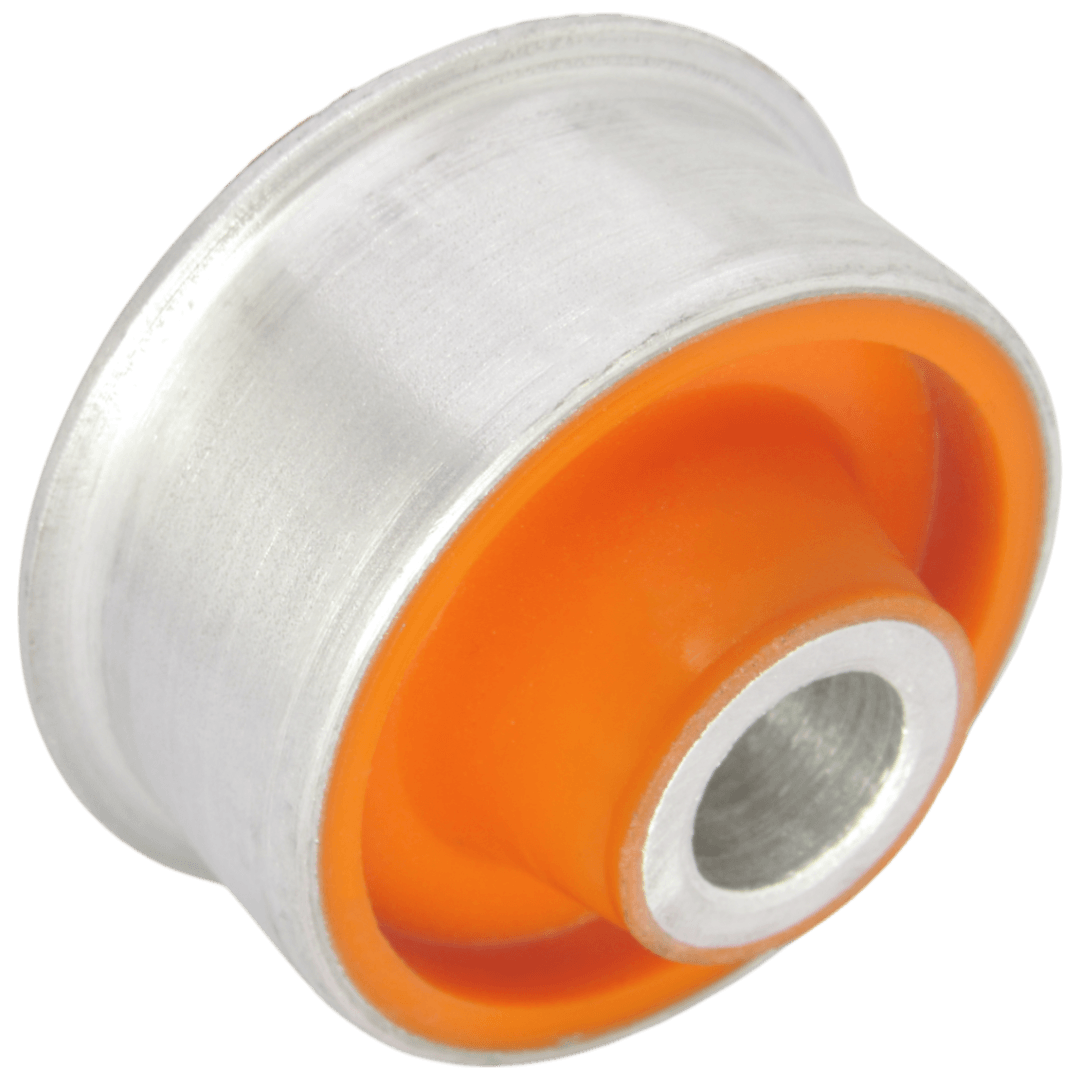
Flanged Bushings with Outer Shell
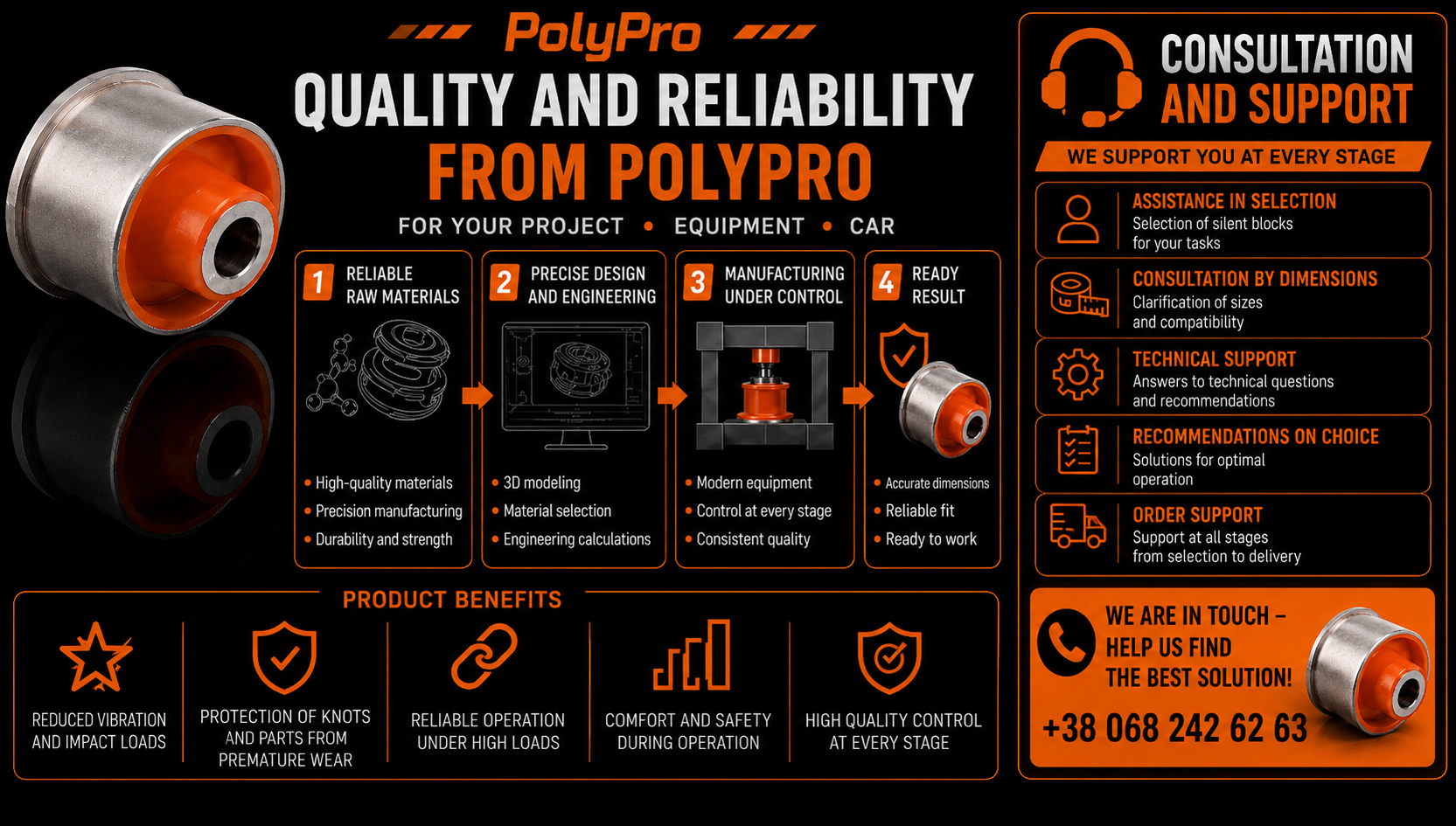
Flanged bushings differ from the plain design by one feature: a lip on one end of the outer steel shell. That lip seats against the bracket face, so it fixes press-fit depth and carries axial load instead of passing it to the wall of the bore. PolyPro molds flange-type bushings in-house for body mounts, cab mounts and frame supports; the rest of the range is in our polyurethane parts catalog.
What the Flange Actually Does
This is the same urethane element in a steel sleeve, only with a lip on one end. It does three jobs. First, it is a stop: the part enters the bore to the designed depth and cannot be driven deeper, so installation is repeatable. Second, it carries axial load — the face works in compression and sends force along the bolt axis into the bracket, not into the thin wall of the hole. Third, it spaces the mating parts apart.
So the design belongs where a joint is loaded along the bolt axis, not only in torsion: frame mounts and body mounts on body-on-frame vehicles, cab mounts on trucks, platform supports on vans. There the body presses down continuously and is thrown upward over bumps — without a flange the element would pull out of the bore.
Symptoms of a Worn Flanged Bushing
Wear starts at the flange, the thinnest part of the design. A rubber lip flattens under body weight, cracks at the transition radius and shears off; the shell drops into the bore and the body settles.
Signs It Is Time to Replace Them
- the body or cab has settled and panel gaps are uneven;
- a dull thud through the body when pulling away, braking and crossing speed bumps;
- droning and vibration at speed that wheel balancing does not fix;
- a sheared lip on the bracket face, material squeezed past the shell;
- rust streaks around the shell: the part turns or has axial play.
How to Check the Mount Yourself
Inspect from underneath on a lift and compare stack height at every mounting point: a smaller gap means that mount has collapsed. On a good part the flange face is flat and covers the edge of the bore; on a worn one a crack runs around it. Then pry along the bolt axis — axial play means the flange no longer acts as a stop. On frame vehicles, leaf spring bushings usually wear out at the same time, so it is worth replacing both in one job.
Rubber vs Polyurethane in a Flanged Bushing
A rubber flange works in the worst mode for rubber: constant static compression under vehicle weight plus impact loading. Rubber creeps — the lip flattens, loses thickness and lets the mount settle before any crack appears. Then it delaminates from oil and salt, tears away from the shell, and metal contacts metal between body and frame. Polyurethane in the same geometry holds static load without permanent set: no creep under sustained compression, no swelling in oil, no hardening in the cold. It lasts 100,000–150,000 km, three to five times longer than the rubber original — which matters here, because replacing a frame or cab mount means lifting the body.
How to Choose Flange-Type Bushings
By Dimensions
Two extra measurements come on top of the usual three — outer shell diameter, bolt-hole diameter and sleeve height: you also need flange diameter and flange thickness. The flange must overlap the hole in the bracket, or the lip is pushed through under load. Flange thickness sets final stack height — a thinner one drops the joint below stock. Sleeve height is measured separately and must match bracket thickness.
When You Need a Flange and When You Do Not
No lip and a straight sleeve means a bushing with outer shell without a flange, held by interference alone. A flange belongs where the design has an axial stop: without it the part pulls into the bore and the mount settles, and a needless flange blocks seating depth.
No sleeve, urethane straight into the arm bore: bushing without outer shell. A flat bonded plate for bolt-through mounting, not a sleeve, is a bushing with inner plate.
By Durometer
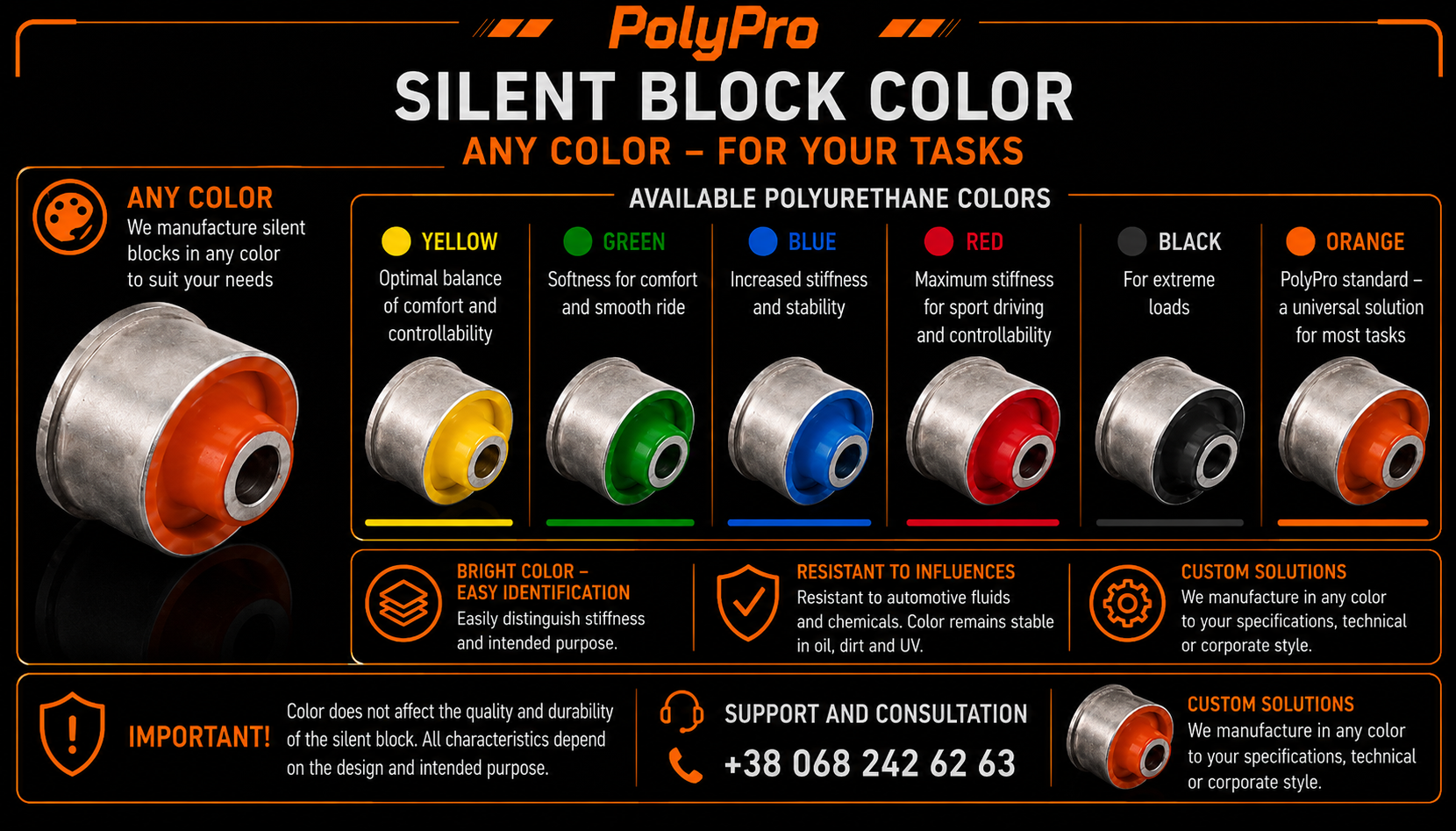
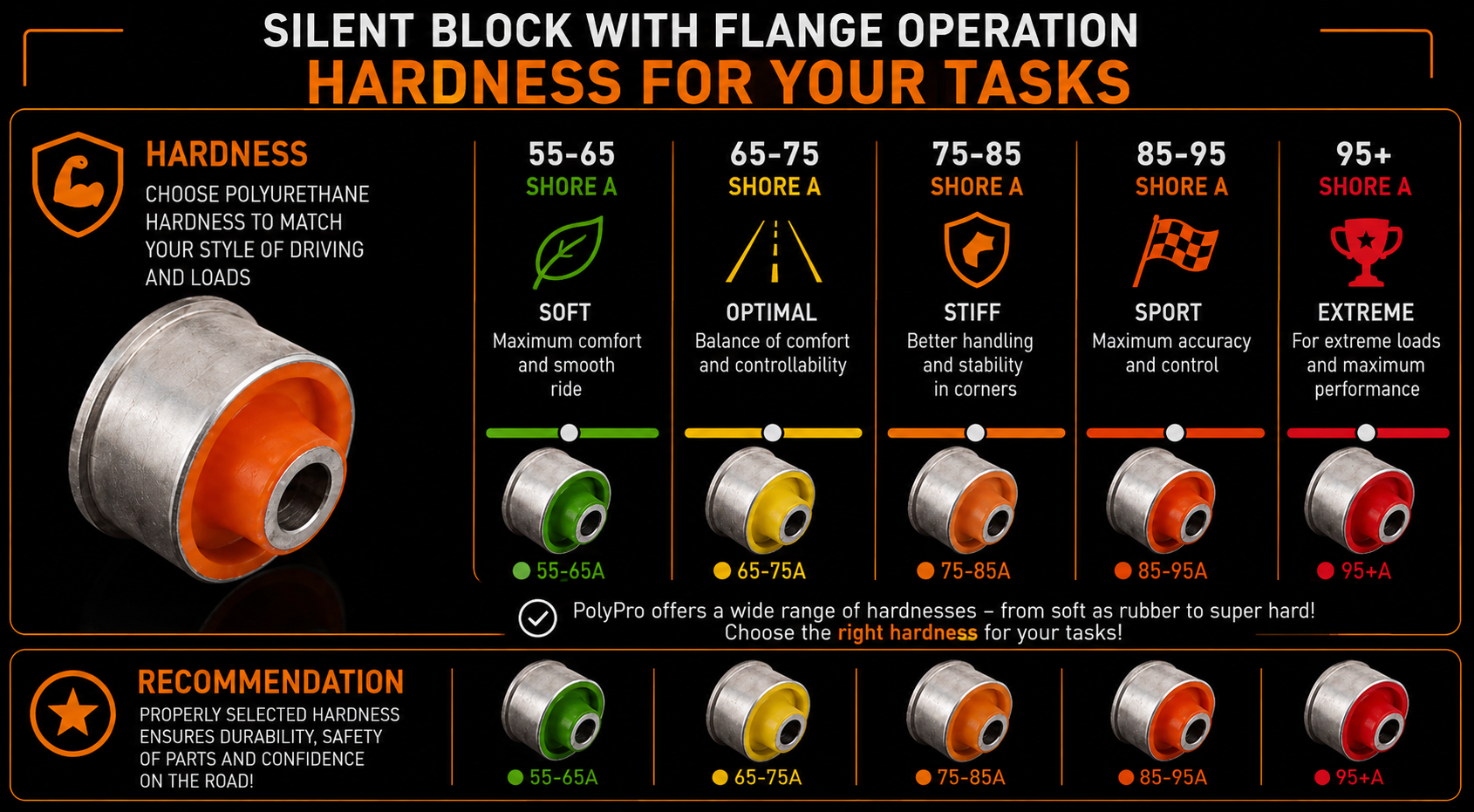
For street use choose the standard grade. For trucks, loaded vans and equipment that tows or works off-road choose the stiffer grade — soft urethane settles under body weight. The stiffer grade also passes more road noise into the body.
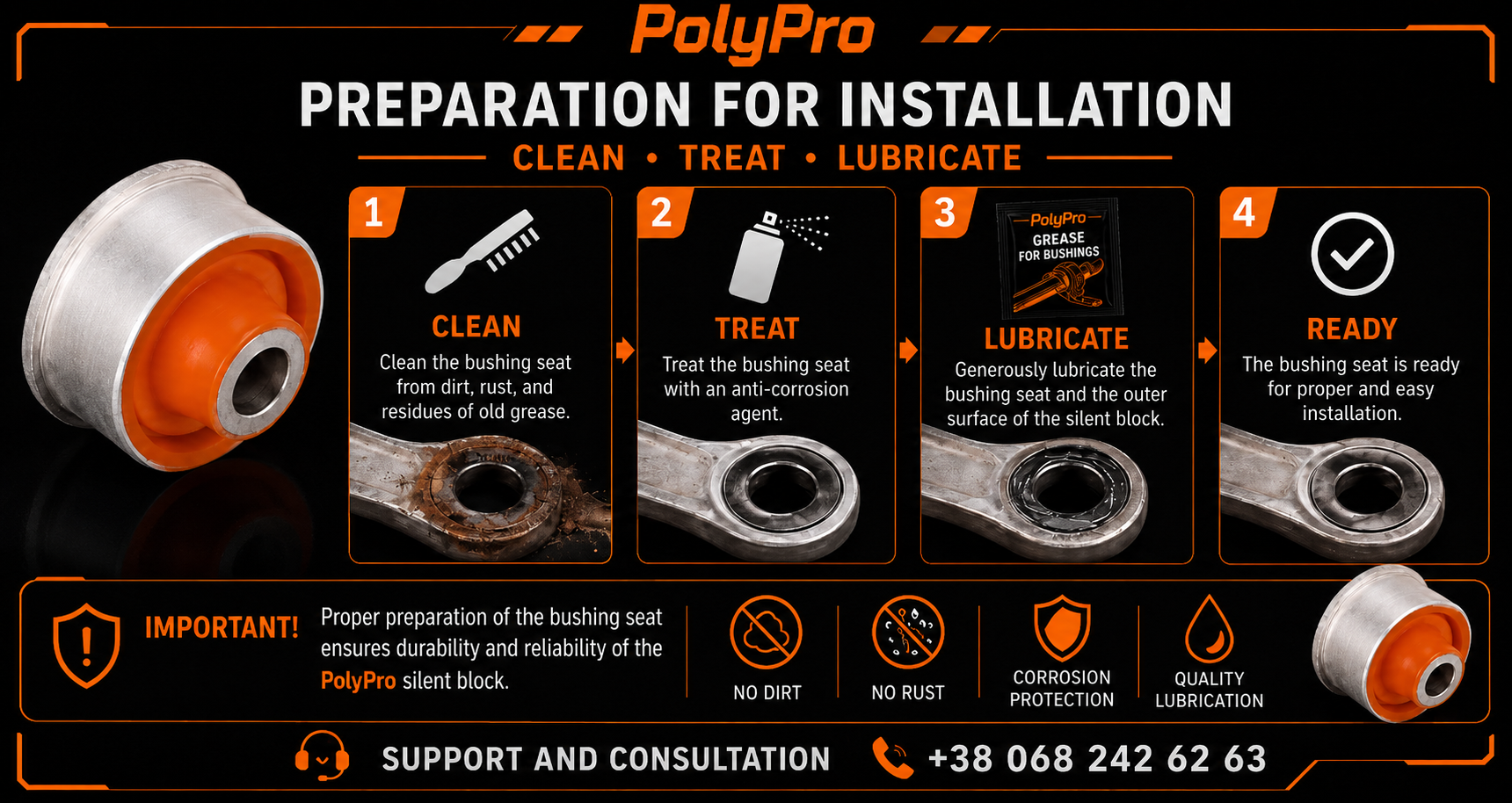
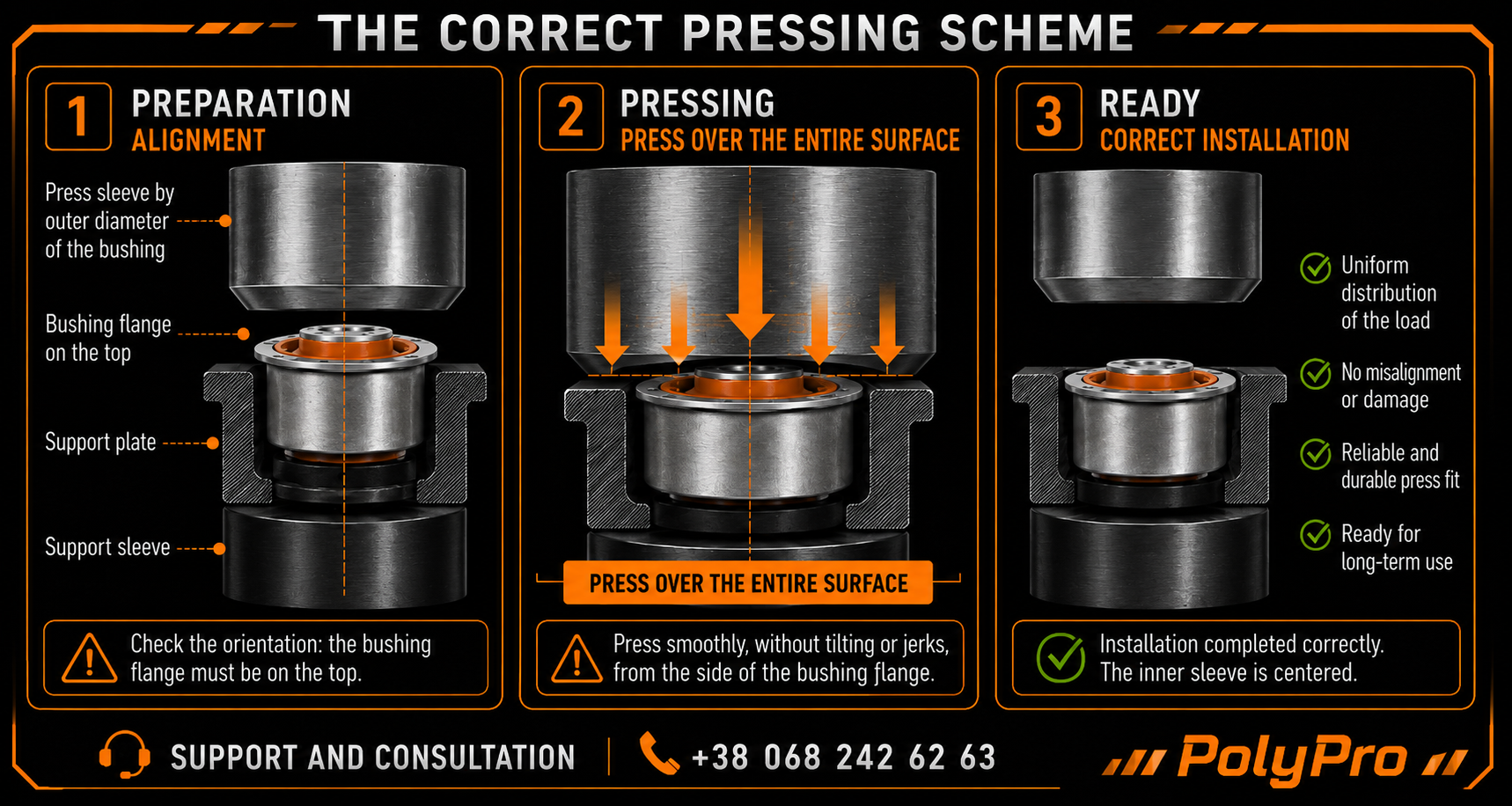
Shore hardness is on every product page; all points in one joint take one grade, since mixed grades load one side harder. Grade does not change the shell dimensions, so press-fit preparation is the same.
Product Photos
Why Buy Flanged Bushings from PolyPro — Wholesale and Retail
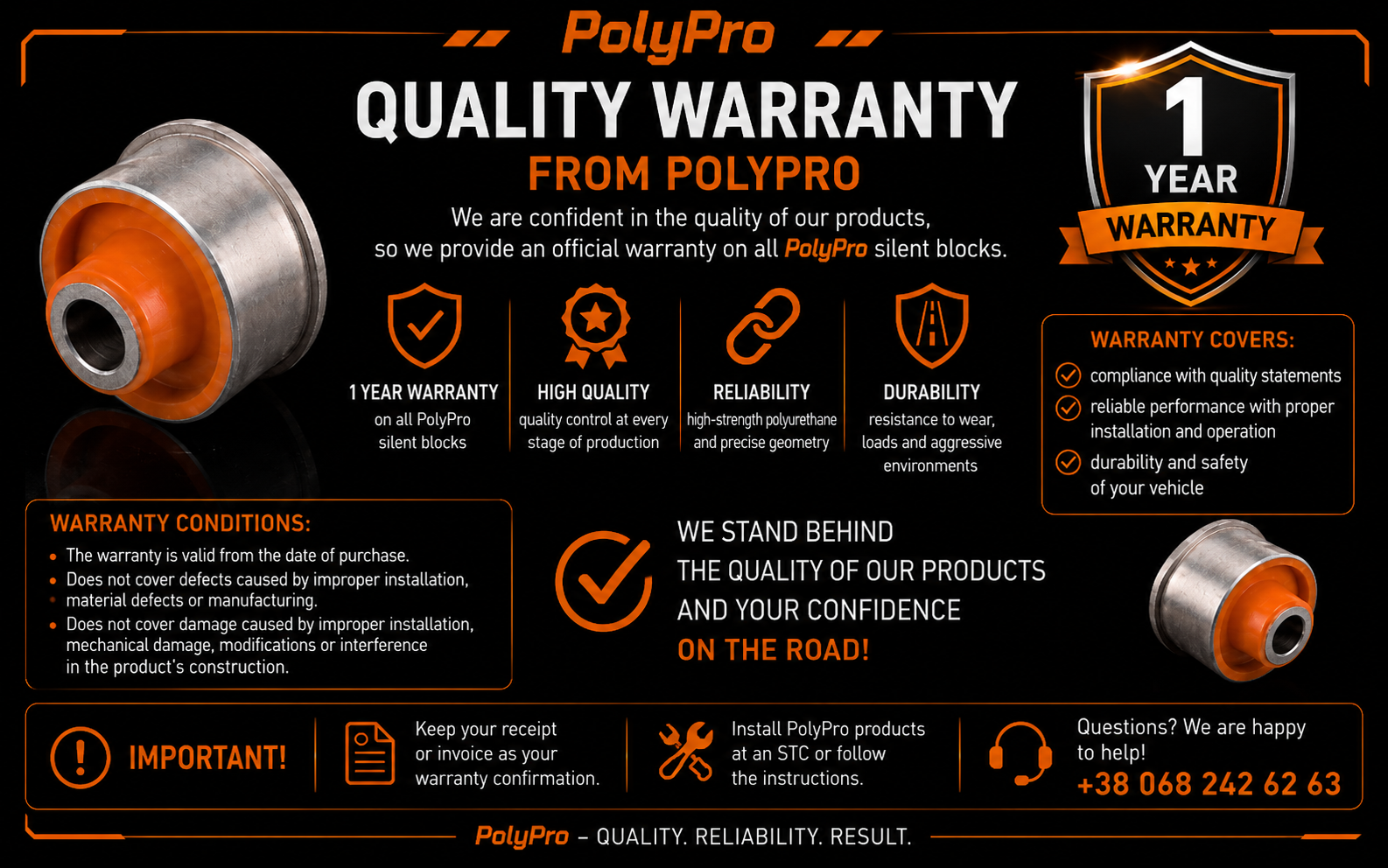
Flanged sizes often have no off-the-shelf equivalent: dimensions are set by the frame or cab bracket. PolyPro has its own molds and casting line, so we take these as custom polyurethane bushings made to order — from a drawing, a sample or the worn part, from one piece. Standard sizes are in stock: one bushing at retail, batches for shops and fleets via the partner program. Every part ships with a warranty and installation grease.
Frequently asked questions
What is the difference between a flanged bushing and a plain outer-shell bushing?
The lip on one end of the outer shell. It seats against the bracket, sets press-fit depth and carries axial load, while a plain bushing is held by press-fit interference alone and works in torsion. Use the flanged version in joints where the body or cab presses on the mount along the bolt axis: body mounts, cab mounts and frame supports.
Where are flange-type bushings used?
Mostly on body-on-frame vehicles: body mounts and frame mounts on trucks and SUVs, cab mounts, platform supports and bracket seats on vans. What these joints share is constant axial load from vehicle weight plus impact loading over bumps, which the flange takes on its face area.
Can I fit a bushing without a flange in place of a flanged one?
No. Without the axial stop the element gradually pulls into the bore, stack height drops and the body or cab settles. All axial load then moves onto the bolt and the bracket threads. If there is a witness mark from a lip on the bracket, the flanged version is what the joint was designed for.
Can you make a flanged bushing to my dimensions?
Yes. PolyPro makes bushings and non-standard polyurethane parts to order from a drawing, a sample or the worn component, starting at one piece. For flanged parts this is the usual case, because dimensions are set by a specific frame and no mass-produced equivalent exists. Send measurements or a photo of the part next to a ruler.
Do polyurethane bushings squeak, and what grease should be used?
Squeaking comes from a dry interface, not from the material. Use silicone or a dedicated polyurethane installation grease on the flange face, the sleeve and the inner tube; PolyPro ships grease with the parts. Avoid petroleum-based grease — it is harmless to our urethane but attacks nearby rubber components.
Do you sell flanged bushings one at a time?
Yes. Retail orders start at a single piece, whether the size is a stock one or poured to order. That matters for flange types, since a bracket often takes just one or two of them. Send a photo of the part next to a ruler, or a drawing of the joint, and we confirm the size before production.
How does volume supply work for truck fleets and repair shops?
Fleets, repair shops, parts stores and resellers buy straight from the plant, so a repeat batch comes out of the same mold and the same formulation as the first one. The partner program sets out bonuses on turnover or on the volume of a single order, access to prices, stock and shipping dates, and shipment under the partner's brand.