

SKU: PP104247
Upper limiter of bushing rear subframe Subaru Forester 2008-2012
In stock15 pcs.$12.76Log in as dealer

Upper limiter of bushing rear subframe Subaru Forester 2008-2012
In stock15 pcs.Upper limiter of bushing rear subframe Subaru Impreza 2007-2011
In stock15 pcs.Upper limiter of bushing rear subframe Subaru Legacy 2009-2014
In stock15 pcs.Upper limiter of bushing rear subframe Subaru Tribeca 2005-2014
In stock15 pcs.
Polyurethane bump stop of the front shock absorber Geely Mk 2006-2014
In stock15 pcs.
Polyurethane bump stop of the rear shock absorber Geely Mk 2006-2014
In stock15 pcs.
Polyurethane bump stop of the rear shock absorber Mercedes-Benz 202 1993-2001
In stock15 pcs.Polyurethane bump stop of the rear shock absorber Mercedes-Benz 203 2000-2007
In stock15 pcs.Polyurethane bump stop of the rear shock absorber Mercedes-Benz 208 1997-2002
In stock15 pcs.Polyurethane bump stop of the rear shock absorber Mercedes-Benz 210 1995-2002
In stock15 pcs.
Polyurethane bumper John Deere 1072
In stock15 pcs.Polyurethane bumper John Deere 1075
In stock15 pcs.Polyurethane bumper John Deere 1075 HY/4
In stock15 pcs.Polyurethane bumper John Deere 1085
In stock15 pcs.Polyurethane bumper John Deere 1085 HY/4
In stock15 pcs.Polyurethane bumper John Deere 1165
In stock15 pcs.Polyurethane bumper John Deere 1166
In stock15 pcs.Polyurethane bumper John Deere 1166 HY/4
In stock15 pcs.Polyurethane bumper John Deere 1170
In stock15 pcs.Polyurethane bumper John Deere 1174
In stock15 pcs.Polyurethane bumper John Deere 1174 HY/4
In stock15 pcs.Polyurethane bumper John Deere 1175
In stock15 pcs.Polyurethane bumper John Deere 1175 H
In stock15 pcs.Polyurethane bumper John Deere 1177
In stock15 pcs.Polyurethane bumper John Deere 1177 HY/4
In stock15 pcs.Polyurethane bumper John Deere 1185
In stock15 pcs.Polyurethane bumper John Deere 1188
In stock15 pcs.Polyurethane bumper John Deere 1450
In stock15 pcs.Polyurethane bumper John Deere 1450 CWS
In stock15 pcs.Polyurethane bumper John Deere 1450 WTS
In stock15 pcs.Polyurethane bumper John Deere 1470
In stock15 pcs.Polyurethane bumper John Deere 1550
In stock15 pcs.Polyurethane bumper John Deere 1550 CWS
In stock15 pcs.Polyurethane bumper John Deere 1550 CWS
In stock15 pcs.Polyurethane bumper John Deere 1550 WTS
In stock15 pcs.Polyurethane bumper John Deere 1570
In stock15 pcs.Polyurethane bumper John Deere 3518 CTS
In stock15 pcs.Polyurethane bumper John Deere 4425
In stock15 pcs.Polyurethane bumper John Deere 4435
In stock15 pcs.Polyurethane bumper John Deere 6200
In stock15 pcs.Polyurethane bumper John Deere 6300
In stock15 pcs.Polyurethane bumper John Deere 7100
In stock15 pcs.Polyurethane bumper John Deere 7500
In stock15 pcs.Polyurethane bumper John Deere 7700
In stock15 pcs.Polyurethane bumper John Deere 8500 H
In stock15 pcs.Polyurethane bumper John Deere 8700
In stock15 pcs.Polyurethane bumper John Deere 985
In stock15 pcs.Polyurethane bumper John Deere 985 HYDRO/4
In stock15 pcs.Polyurethane bumper John Deere C230
In stock15 pcs.Polyurethane bumper John Deere W210
In stock15 pcs.Polyurethane bumper John Deere W230
In stock15 pcs.Polyurethane bumper John Deere W330
In stock15 pcs.Polyurethane bumper John Deere W80
In stock15 pcs.
Polyurethane bumper front arm Hyundai H100 1987-1993
In stock15 pcs.Polyurethane bumper front arm Hyundai H100 1987-1993 RECONSTRUCTION OF YOUR
In stock15 pcs.Polyurethane bumper front arm Hyundai H100 1993-2004
In stock15 pcs.Polyurethane bumper front arm Hyundai H100 1993-2004 RECONSTRUCTION OF YOUR
In stock15 pcs.
Polyurethane bumper front arm front Mitsubishi Lancer Evolution 2008-2015
In stock15 pcs.
Polyurethane bumper front arm front Suzuki Baleno 1995-2002
In stock15 pcs.Polyurethane bumper front arm front Suzuki Liana 2001-2007
In stock15 pcs.Polyurethane bumper front arm front Suzuki Swift 1983-1989
In stock15 pcs.Polyurethane bumper front arm front Suzuki Swift 1989-1995
In stock15 pcs.
Polyurethane bumper front lower arm Mitsubishi L200 1996-2006
In stock15 pcs.Polyurethane bumper front lower arm Mitsubishi L200 2006-2015
In stock15 pcs.Polyurethane bumper front lower arm Mitsubishi L400 1994-2007
In stock15 pcs.Polyurethane bumper front lower arm Mitsubishi Pajero 1991-1999
In stock15 pcs.Polyurethane bumper front lower arm Mitsubishi Pajero 2000-2006
In stock15 pcs.Polyurethane bumper front lower arm Mitsubishi Pajero Sport 1996-2008
In stock15 pcs.
Polyurethane bumper front shock absorber Audi 100 1976-1982
In stock15 pcs.Polyurethane bumper front shock absorber Audi 100 1982-1991
In stock15 pcs.Polyurethane bumper front shock absorber Audi 100 1990-1994
In stock15 pcs.Polyurethane bumper front shock absorber Audi 200 1976-1982
In stock15 pcs.Polyurethane bumper front shock absorber Audi 200 1983-1991
In stock15 pcs.Polyurethane bumper front shock absorber Audi A6 2011-2018
In stock15 pcs.Polyurethane bumper front shock absorber Audi A6 1994-1997
In stock15 pcs.Polyurethane bumper front shock absorber Audi A6 1997-2004
In stock15 pcs.Polyurethane bumper front shock absorber Audi A6 2004-2011
In stock15 pcs.Polyurethane bumper front shock absorber Audi V8 1988-1994
In stock15 pcs.
Polyurethane bumper front shock absorber Chery Tiggo 2005-2011
In stock15 pcs.
Polyurethane bumper front shock absorber Chevrolet Aveo 2002-2011
In stock15 pcs.
Polyurethane bumper front shock absorber Subaru Forester 1997-2002
In stock15 pcs.Polyurethane bumper front shock absorber Subaru Forester 2002-2007
In stock15 pcs.Polyurethane bumper front shock absorber Subaru Impreza 1992-2000
In stock15 pcs.Polyurethane bumper front shock absorber Subaru Impreza 2000-2007
In stock15 pcs.Polyurethane bumper front shock absorber Subaru Impreza 2007-2011
In stock15 pcs.Polyurethane bumper front shock absorber Subaru Impreza 2011-2015
In stock15 pcs.Polyurethane bumper front shock absorber Subaru Legacy 1989-1994
In stock15 pcs.Polyurethane bumper front shock absorber Subaru Legacy 1994-1999
In stock15 pcs.Polyurethane bumper front shock absorber Subaru Legacy 1999-2003
In stock15 pcs.Polyurethane bumper front shock absorber Subaru Legacy 2003-2009
In stock15 pcs.Polyurethane bumper front shock absorber Subaru Legacy 2009-
In stock15 pcs.Polyurethane bumper front shock absorber Subaru Outback 2003-2009
In stock15 pcs.Polyurethane bumper front shock absorber Subaru Outback 2009-
In stock15 pcs.
Polyurethane bumper front upper arm Mitsubishi L200 1996-2006
In stock15 pcs.
Polyurethane bumper front upper arm Mitsubishi L200 1996-2006 RECONSTRUCTION OF YOUR
In stock15 pcs.Polyurethane bumper front upper arm Mitsubishi Pajero 1991-1999
In stock15 pcs.Polyurethane bumper front upper arm Mitsubishi Pajero 1991-1999 RECONSTRUCTION OF YOUR
In stock15 pcs.Polyurethane bumper front upper arm Mitsubishi Pajero 2000-2006
In stock15 pcs.Polyurethane bumper front upper arm Mitsubishi Pajero 2000-2006 RECONSTRUCTION OF YOUR
In stock15 pcs.Polyurethane bumper front upper arm Mitsubishi Pajero Sport 1996-2008
In stock15 pcs.Polyurethane bumper front upper arm Mitsubishi Pajero Sport 1996-2008 RECONSTRUCTION OF YOUR
In stock15 pcs.
Polyurethane bumper front upper arm Volkswagen T4 1990-2003
In stock15 pcs.
Polyurethane bumper of front shock absorber support Audi A4 1994-2001
In stock15 pcs.Polyurethane bumper of front shock absorber support Audi A4 2000-2004
In stock15 pcs.Polyurethane bumper of front shock absorber support Audi A4 2004-2008
In stock15 pcs.Polyurethane bumper of front shock absorber support Audi A4 2007-2015
In stock15 pcs.Polyurethane bumper of front shock absorber support Audi A6 1997-2004
In stock15 pcs.Polyurethane bumper of front shock absorber support Audi A6 2004-2011
In stock15 pcs.Polyurethane bumper of front shock absorber support Audi A8 1994-2002
In stock15 pcs.Polyurethane bumper of front shock absorber support Audi A8 2002-2009
In stock15 pcs.Polyurethane bumper of front shock absorber support Audi TT 1998-2006
In stock15 pcs.Polyurethane bumper of front shock absorber support Seat Exeo 2008-2014
In stock15 pcs.Polyurethane bumper of front shock absorber support Skoda Superb 2001-2008
In stock15 pcs.Polyurethane bumper of front shock absorber support Volkswagen Passat 2000-2005
In stock15 pcs.
Polyurethane bumper rear big upper arm inner front Mitsubishi Lancer Evolution 2008-2015
In stock15 pcs.
Polyurethane bumper rear shock absorber Audi 100 1982-1991
In stock15 pcs.Polyurethane bumper rear shock absorber Audi 100 1990-1994
In stock15 pcs.Polyurethane bumper rear shock absorber Audi 200 1983-1991
In stock15 pcs.Polyurethane bumper rear shock absorber Audi A6 1994-1997
In stock15 pcs.
Polyurethane bumper rear shock absorber Chery Tiggo 2005-2011
In stock15 pcs.
Polyurethane bushing front subframe with bump stop Chrysler Cirrus 1994-2000
In stock15 pcs.Polyurethane bushing front subframe with bump stop Dodge Stratus 1995-2000
In stock15 pcs.Polyurethane bushing front subframe with bump stop Mitsubishi Eclipse1995-1999
In stock15 pcs.Polyurethane bushing front subframe with bump stop Mitsubishi Galant 1987-1993
In stock15 pcs.Polyurethane bushing front subframe with bump stop Mitsubishi Galant 1992-1998
In stock15 pcs.Polyurethane bushing front subframe with bump stop Mitsubishi Galant 1996-2003
In stock15 pcs.
Polyurethane front bumper Volkswagen T1 1950-1968
In stock15 pcs.Polyurethane front bumper Volkswagen T2 1967-1979
In stock15 pcs.Polyurethane front bumper Volkswagen T3 1979-1992
In stock15 pcs.
Polyurethane travel limiter of the engine mount Dodge Journey 2008- 2.0
In stock15 pcs.
Polyurethane travel limiter of the engine mount Dodge Journey 2011-2016 3,6L
In stock15 pcs.Polyurethane travel limiter of the engine mount Fiat Freemont 2011- 2.0
In stock15 pcs.
Polyurethane travel limiter of the engine mount rear Dodge Journey 2008- 2,0L
In stock15 pcs.
Polyurethane travel limiter of the engine mount rear Dodge Journey 2008- 3,6L
In stock15 pcs.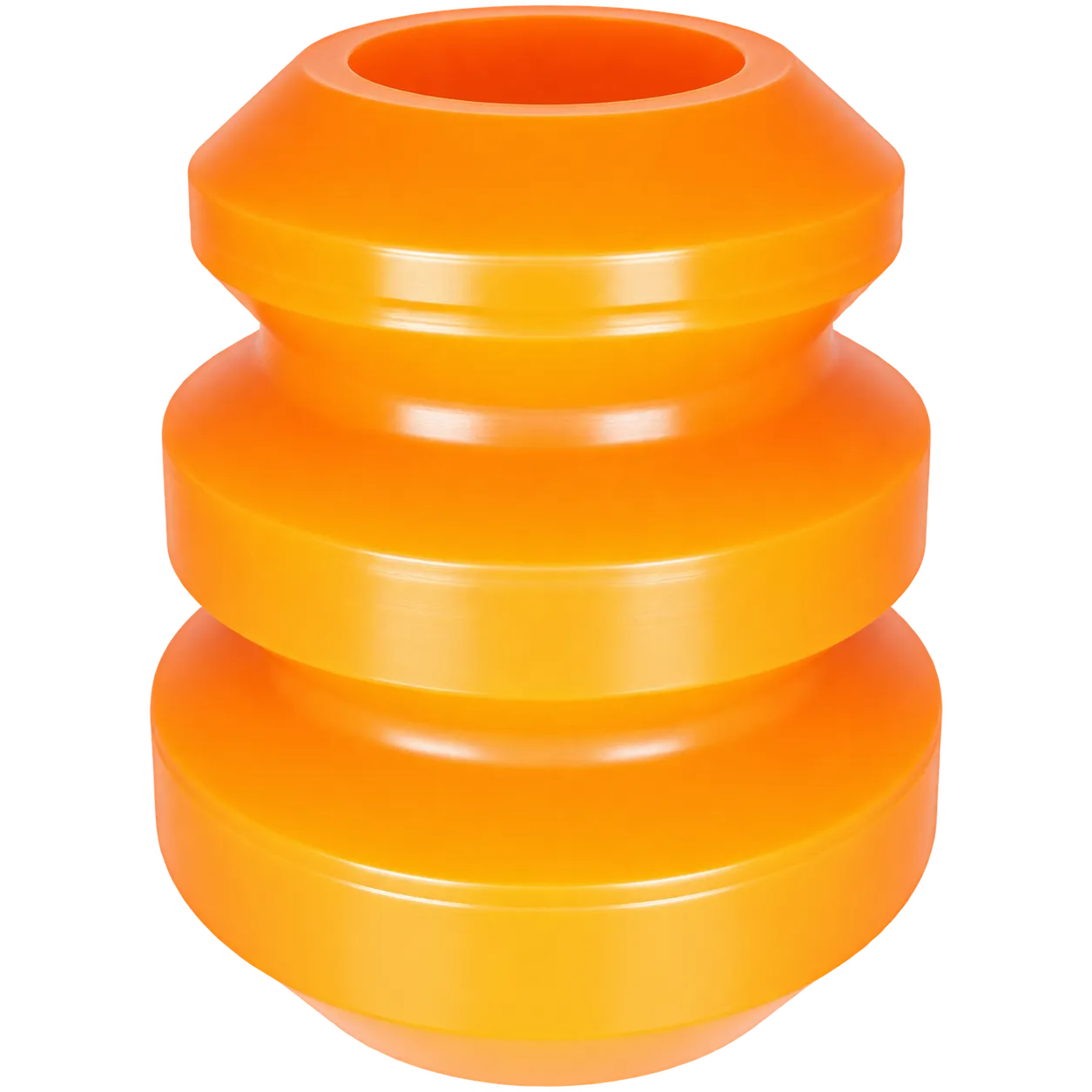
A bump stop is the compression buffer that slides onto the shock or strut rod under the body mount. It takes the last part of the suspension travel, keeps the rod from reaching its hard limit, and shields the seal, the mount and the rod itself from metal-to-metal impact over deep potholes and at full load. PolyPro moulds bump stops from polyurethane in its own casting shop, and the dimensions and Shore hardness are stated on every product page in the catalogue.
The jounce bumper sits between the body seat and the top face of the shock body, threaded onto the rod. While the suspension moves in its normal range the buffer does nothing. As compression travel runs out, the seat meets the buffer and it starts to squash, building resistance sharply. A progressive shape, with grooves, bellows or a taper, lets it give softly at first and then turn almost solid.
In practice it is part of the springing of the car, not a plug. It absorbs the energy of a bottom-out, limits travel so the coil cannot go into coil bind, and takes the hit that would otherwise pass to the rod, the seal and the top mount. On a loaded vehicle or on broken roads the bump stopper is in use constantly, which is why it wears out before the parts around it.
A worn buffer cannot be seen without stripping the strut, but you hear it in the way the suspension behaves. The reliable check happens with the strut off the car: slide the buffer off the rod and inspect the body, the bore and the face that meets the seat.
The buffer often breaks up together with the shock absorber boot, because both work in the same zone and suffer from the same grit. Inspect and replace them together while the strut is apart, rather than one at a time after a knock appears.
A rubber or foam buffer absorbs moisture over time, ages with ozone and road salt and begins to crumble along its grooves. First it loses height, which means the suspension travels further before the impact is caught, and then it simply breaks into pieces. On a loaded vehicle or on poor roads that process takes one or two seasons.
Cast polyurethane is denser, takes up almost no water and resists oils, salt and temperature swings. It holds its designed height for longer, so compression travel stays as intended and the energy of a bottom-out is absorbed progressively instead of arriving as one hard blow. That noticeably reduces the load on the rod, the seal and the top mount. The trade-off is a slightly more defined stop at the end of travel, most of all on an unladen car with soft springs.
Choose by the geometry of the rod and the free space inside the strut, not by the badge on the car. You need the dimensions of the old buffer, the suspension type and a clear idea of how the vehicle is loaded.
Take three figures: the inner diameter of the bore for the rod, the outer diameter of the body and the free height of the buffer. Measure the bore against the rod, not against the worn hole in the old part, because a used buffer always reads oversize. Compare the height with the free space between the seat and the top face of the shock body with the damper fully compressed: a buffer that is too tall shortens travel and works all the time, one that is too short lets the hit reach the stop. Check separately whether the strut has a locating shoulder for the buffer. If the size is not in stock, the part is made from a drawing, a sample or the worn buffer in the made-to-order section.
Shore hardness is listed on the product page and follows the load the vehicle carries. A softer buffer behaves closer to the original: it comes into play gradually and does not thump on an empty car, which suits ordinary passenger use in town. A harder grade holds the last centimetres of travel under weight, so it goes on a loaded car, a van, a vehicle that tows, or one that runs gravel roads regularly. Do not overshoot: a buffer that is too hard on a light car turns the end of travel into an impact and passes it to the mount and the rod instead of absorbing it.
The shape follows where the buffer sits. On a MacPherson front strut it is usually long and grooved and hides under the boot inside the coil. At the rear you more often find a short tapered buffer, sometimes mounted straight onto a body bracket above the beam or the arm. There are versions that locate on a shoulder in the seat, flanged versions, and ones that press directly onto the rod. Check as well that the buffer enters the coil without touching the windings and that there is room for it under the boot. Identify the type from the old part and the way it was retained, and while the strut is apart check the condition of the top shock mount as well.
PolyPro is the manufacturer: our own moulds, our own casting shop, dimensional control on every batch and direct sales with no middlemen. That gives repeatable height and diameter from batch to batch, which matters more for a buffer than for most parts, and a price without extra mark-ups. Retail is by the piece: take one bump stop for a single strut or a set for an axle. Non-standard parts are made from a drawing, a sample or the worn item, starting from one piece. The products carry a warranty, and we ship across Ukraine and internationally.
Workshops, parts shops, fleets and resellers get wholesale terms and a partner programme: bonuses on turnover or on the size of a single order, access to prices and stock levels, and shipment under the partner's own brand.
It limits compression travel and absorbs the energy of a bottom-out. Without it the body seat strikes the top face of the shock body, the coil can go into coil bind, and the hit passes straight to the rod, the seal and the top mount. The result is a scored rod, a leaking strut and a damaged mount, earned in a few deep potholes rather than over mileage.
They are different parts that usually sit side by side. The boot is a thin bellows cover that keeps dust, water and sand off the rod. The bump stopper is a dense buffer that carries load at the end of compression travel. The boot takes no force, the buffer offers no protection from grit, and a strut rebuild normally replaces both.
People do this on lowered cars, but the cost is clear: a shortened buffer engages later and the end of travel arrives as a sharper hit. Service life of the rod, the seal and the mount drops accordingly. If you need a different profile or height, it is cleaner to order a buffer in the geometry you want than to trim the one you have.
Yes, almost every rear suspension layout has one, it just looks different: usually a short tapered buffer on the rod, or a separate stop on a body bracket above the beam or the arm. The rear axle carries more of the payload, so wear there is often faster than at the front, especially on vans and estates.
There is no fixed interval; life depends on roads and load. The practical rule is to inspect the buffer whenever the strut comes off and to replace it together with the shock absorber, since access is already there. If the buffer shows cracks, crumbling, or has lost height, replace it regardless of mileage.
It will, provided three figures match: the rod diameter, the free height available for the buffer and the outer diameter at the mounting point. Bodies and seats differ between makers, so take the measurements from the assembled strut in front of you rather than from an old buffer that has already lost height.
Yes, retail is by the piece: take one buffer for a single strut, a pair for one axle or a set for all four corners. Non-standard sizes and profiles are made from a drawing, a sample or the worn part, starting from one piece. Sales come straight from the production floor, with a warranty on the products and international shipping.
Workshops, parts shops, fleets and resellers work on wholesale terms with a partner programme: bonuses on turnover or on the size of a single order, access to current prices and stock levels, and shipment under the partner's brand. The range and volumes are agreed around your repair flow.