

SKU: PP201028
Polyurethane bushing front upper arm Moskvitch 2140 1976-1988
In stock15 pcs.$7.88Log in as dealer

Polyurethane bushing front upper arm Moskvitch 2140 1976-1988
In stock15 pcs.Polyurethane bushing front upper arm Moskvitch 412 1967-1999
In stock15 pcs.
Polyurethane bushing of the rear beam Audi 100 1982-1991
In stock15 pcs.Polyurethane bushing of the rear beam Audi 200 1976-1982
In stock15 pcs.Polyurethane bushing of the rear beam Audi 200 1983-1991
In stock15 pcs.
Polyurethane bushing of the rear beam Fiat Talento 2016-2021
In stock15 pcs.
Polyurethane bushing of the rear beam Ford Fiesta 1989-1997
In stock15 pcs.Polyurethane bushing of the rear beam Ford Fiesta 1995-2002
In stock15 pcs.Polyurethane bushing of the rear beam Ford Fiesta 2002-2008
In stock15 pcs.Polyurethane bushing of the rear beam Ford Ka 1996-2008
In stock15 pcs.Polyurethane bushing of the rear beam Ford Ka 2008-
In stock15 pcs.Polyurethane bushing of the rear beam Ford Puma 1997-2002
In stock15 pcs.Polyurethane bushing of the rear beam Nissan Nv300 2016-
In stock15 pcs.Polyurethane bushing of the rear beam Opel Vivaro 2014-
In stock15 pcs.
Polyurethane bushing of the rear beam Renault 21 1986-1989
In stock15 pcs.Polyurethane bushing of the rear beam Renault Laguna 1 1994-2001
In stock15 pcs.Polyurethane bushing of the rear beam Renault Scenic 1 1996-2003
In stock15 pcs.Polyurethane bushing of the rear beam Renault Trafic 2014-
In stock15 pcs.
Polyurethane bushing rear beam Audi 80 B3 1986-1991
In stock15 pcs.Polyurethane bushing rear beam Audi 90 B3 1987-1991
In stock15 pcs.
Polyurethane bushing rear beam front Citroen Jumpy 2007-2016
In stock15 pcs.Polyurethane bushing rear beam front Fiat Scudo 2007-2016
In stock15 pcs.Polyurethane bushing rear beam front Peugeot Expert 2007-
In stock15 pcs.
Polyurethane rear beam bushing Audi 100 C4 1990-1994
In stock15 pcs.Polyurethane rear beam bushing Audi A6 C4 1994-1997
In stock15 pcs.
Polyurethane rear beam bushing Citroen Evasion 1994-2002
In stock15 pcs.Polyurethane rear beam bushing Citroen Jumpy 1995-2007
In stock15 pcs.Polyurethane rear beam bushing Fiat Scudo 1995-2007
In stock15 pcs.Polyurethane rear beam bushing Fiat Ulysse 1994-2002
In stock15 pcs.
Polyurethane rear beam bushing Hyundai Solaris 2010-
In stock15 pcs.Polyurethane rear beam bushing Hyunndai Accent 2005-2010
In stock15 pcs.
Polyurethane rear beam bushing Infiniti G20 P11 1998-2002
In stock15 pcs.
Polyurethane rear beam bushing Infiniti I 1996-2001
In stock15 pcs.Polyurethane rear beam bushing Infiniti I30 1996-2001
In stock15 pcs.Polyurethane rear beam bushing Kia Picanto 2004-2011
In stock15 pcs.Polyurethane rear beam bushing Kia Rio 2005-2011
In stock15 pcs.Polyurethane rear beam bushing Lancia Zeta 1995-2002
In stock15 pcs.
Polyurethane rear beam bushing Mazda Mpv 1999-2006
In stock15 pcs.
Polyurethane rear beam bushing Mitsubishi Eclipse 1989-1995
In stock15 pcs.Polyurethane rear beam bushing Mitsubishi Galant 1987-1993
In stock15 pcs.Polyurethane rear beam bushing Nissan Almera N15 1995-2000
In stock15 pcs.Polyurethane rear beam bushing Nissan Almera N16 2000-2006
In stock15 pcs.Polyurethane rear beam bushing Nissan Cefiro A32 1994-1999
In stock15 pcs.Polyurethane rear beam bushing Nissan Cefiro A33 2000-2003
In stock15 pcs.Polyurethane rear beam bushing Nissan Maxima A32 1994-1999
In stock15 pcs.Polyurethane rear beam bushing Nissan Maxima A33 2000-2004
In stock15 pcs.
Polyurethane rear beam bushing Nissan Primastar 2002-2016
In stock15 pcs.
Polyurethane rear beam bushing Nissan Primera 2002-2007
In stock15 pcs.Polyurethane rear beam bushing Nissan Primera P11 1996-1999
In stock15 pcs.Polyurethane rear beam bushing Opel Vivaro 2001-2014
In stock15 pcs.Polyurethane rear beam bushing Peugeot 806 1994-2002
In stock15 pcs.Polyurethane rear beam bushing Peugeot Expert 1995-2007
In stock15 pcs.
Polyurethane rear beam bushing Renault 11 1983-1995
In stock8 pcs.
Polyurethane rear beam bushing Renault 19 1988-1995
In stock15 pcs.Polyurethane rear beam bushing Renault 5 1985-1998
In stock8 pcs.Polyurethane rear beam bushing Renault 9 1981-1998
In stock8 pcs.
Polyurethane rear beam bushing Renault Avantime 2001-2003
In stock15 pcs.Polyurethane rear beam bushing Renault Clio 1990-1998
In stock15 pcs.Polyurethane rear beam bushing Renault Espace 1991-1997
In stock15 pcs.Polyurethane rear beam bushing Renault Espace 1997-2002
In stock15 pcs.
Polyurethane rear beam bushing Renault Kangoo 1997-2008
In stock15 pcs.
Polyurethane rear beam bushing Renault Kangoo 1997-2008 1,6L
In stock15 pcs.Polyurethane rear beam bushing Renault Megane 1995-2003
In stock15 pcs.Polyurethane rear beam bushing Renault Trafic 2001-2014
In stock15 pcs.
Polyurethane rear beam bushing Smart Cabrio 2004-2007
In stock15 pcs.Polyurethane rear beam bushing Smart City 1998-2004
In stock15 pcs.Polyurethane rear beam bushing Smart Fortwo 1998-2002
In stock15 pcs.Polyurethane rear beam bushing Smart Fortwo 2000-2004
In stock15 pcs.Polyurethane rear beam bushing Smart Fortwo 2004-2007
In stock15 pcs.Polyurethane rear beam bushing Smart Roadster 2003-2005
In stock15 pcs.
Rear beam polyurethane bushing Hyundai Elantra 1990-1995
In stock15 pcs.Rear beam polyurethane bushing Hyundai Elantra 1995-2000
In stock15 pcs.Rear beam polyurethane bushing Hyundai Excel 1989-1995
In stock15 pcs.
Rear beam polyurethane bushing Mitsubishi Colt 1986-1992
In stock15 pcs.Rear beam polyurethane bushing Mitsubishi Lancer 1988-1991
In stock15 pcs.
Polyurethane Rear beam bushing Skoda Favorit 1988-1995
In stock15 pcs.Polyurethane Rear beam bushing Skoda Felicia 1994-2001
In stock15 pcs.
Polyurethane bushing front arm Audi 80 B2 1978-1986 (without hydraulics)
In stock15 pcs.Polyurethane bushing front arm Audi 80 B3 1986-1991 (without hydraulics)
In stock15 pcs.Polyurethane bushing front arm Audi 90 B2 1984-1987 (without hydraulics)
In stock15 pcs.Polyurethane bushing front arm Audi 90 B3 1987-1991 (without hydraulics)
In stock15 pcs.Polyurethane bushing front arm Volkswagen Passat B2 1980-1988 (without hydraulics)
In stock15 pcs.
Polyurethane bushing rear beam ZAZ Dana 1105 1994-1997
In stock15 pcs.
Polyurethane bushing rear beam ZAZ Dana 1105 1994-1997 HARDNESS
In stock15 pcs.Polyurethane bushing rear beam ZAZ Славута 1103 1999-2011
In stock15 pcs.Polyurethane bushing rear beam ZAZ Славута 1103 1999-2011 HARDNESS
In stock15 pcs.Polyurethane bushing rear beam ZAZ Таврия 1102 1988-1997
In stock15 pcs.Polyurethane bushing rear beam ZAZ Таврия 1102 1988-1997 HARDNESS
In stock15 pcs.
Polyurethane rear beam bushing Fiat Uno 1983-2014
In stock15 pcs.
Polyurethane rear beam bushing Ford Scorpio 1 1985-1994
In stock15 pcs.Polyurethane rear beam bushing Ford Sierra 1 1982-1987
In stock15 pcs.Polyurethane rear beam bushing Ford Sierra 2 1987-1993
In stock15 pcs.
Polyurethane rear beam bushing VAZ 1118 2004-2018
In stock15 pcs.
Polyurethane rear beam bushing VAZ 2108-21099 1984-2011
In stock15 pcs.Polyurethane rear beam bushing VAZ 2110-2112 1995-2014
In stock15 pcs.Polyurethane rear beam bushing VAZ 2113-2115 2001-2013
In stock15 pcs.Polyurethane rear beam bushing VAZ 2190 2011-
In stock15 pcs.
Polyurethane Rear beam bushing BMW 5 E28 1981-1987
In stock15 pcs.
Polyurethane Rear beam bushing BMW 5 E28 1981-1987 HARDNESS
In stock15 pcs.Polyurethane Rear beam bushing BMW 6 E24 1976-1989
In stock15 pcs.Polyurethane Rear beam bushing BMW 6 E24 1976-1989 HARDNESS
In stock15 pcs.Polyurethane Rear beam bushing BMW 7 E23 1976-1986
In stock15 pcs.Polyurethane Rear beam bushing BMW 7 E23 1976-1986 HARDNESS
In stock15 pcs.
Polyurethane bushing of rear beam strut Opel Combo 1994-2001
In stock15 pcs.Polyurethane bushing of rear beam strut Opel Combo 2001-2011
In stock15 pcs.Polyurethane bushing of rear beam strut Opel Corsa 1993-2004
In stock15 pcs.Polyurethane bushing of rear beam strut Opel Corsa 2000-2006
In stock15 pcs.Polyurethane bushing of rear beam strut Opel Corsa 2006-2014
In stock15 pcs.Polyurethane bushing of rear beam strut Opel Tigra 1994-2000
In stock15 pcs.Polyurethane bushing of rear beam strut Opel Tigra 2004-2009
In stock15 pcs.
Polyurethane bushing of the rear beam Audi A4 1994-2001
In stock15 pcs.Polyurethane bushing of the rear beam Audi A4 2000-2004
In stock15 pcs.
Polyurethane bushing of the rear beam BMW 5 E34 1987-1995
In stock15 pcs.
Polyurethane bushing of the rear beam BMW 5 E34 1987-1995 HARDNESS
In stock15 pcs.Polyurethane bushing of the rear beam BMW 7 E32 1987-1994
In stock15 pcs.
Polyurethane bushing of the rear beam Chery CrossEastar 2006-
In stock15 pcs.
Polyurethane bushing of the rear beam Fiat 500 2007-
In stock15 pcs.Polyurethane bushing of the rear beam Fiat 500L 2012-
In stock15 pcs.Polyurethane bushing of the rear beam Fiat Grande Punto 2005-2018
In stock15 pcs.Polyurethane bushing of the rear beam Fiat Idea 2003-2016
In stock15 pcs.Polyurethane bushing of the rear beam Fiat Panda 2003-2012
In stock15 pcs.Polyurethane bushing of the rear beam Fiat Punto 1999-2012
In stock15 pcs.Polyurethane bushing of the rear beam Fiat Punto 2012-
In stock15 pcs.
Polyurethane bushing of the rear beam Geely Emgrand
In stock15 pcs.Polyurethane bushing of the rear beam Lancia Musa 2004-2012
In stock15 pcs.Polyurethane bushing of the rear beam Lancia Ypsilon 2003-2011
In stock15 pcs.
Polyurethane bushing of the rear beam Nissan Juke 2010-
In stock15 pcs.Polyurethane bushing of the rear beam Nissan Leaf 2010-2017
In stock15 pcs.
Polyurethane bushing of the rear beam Nissan Leaf 2017-
In stock15 pcs.Polyurethane bushing of the rear beam Nissan Qashqai 2006-2013
In stock15 pcs.Polyurethane bushing of the rear beam Nissan Qashqai 2013-
In stock15 pcs.Polyurethane bushing of the rear beam Seat Exeo 2008-2014
In stock15 pcs.Polyurethane bushing of the rear beamм BMW 7 E32 1987-1994 HARDNESS
In stock15 pcs.
Polyurethane bushing rear beam Audi A1 2010-2014
In stock15 pcs.
Polyurethane bushing rear beam Audi A1 2010-2014 HARDNESS
In stock15 pcs.Polyurethane bushing rear beam Audi A3 1996-2006
In stock15 pcs.Polyurethane bushing rear beam Audi A3 1996-2006 HARDNESS
In stock15 pcs.Polyurethane bushing rear beam Chevrolet Aveo 2002-2011
In stock15 pcs.Polyurethane bushing rear beam Chevrolet Aveo 2002-2011 HARDNESS
In stock15 pcs.
Polyurethane bushing rear beam Citroen C4 Aircross 2012-2015
In stock15 pcs.Polyurethane bushing rear beam Citroen C4 L 2004-2010
In stock15 pcs.Polyurethane bushing rear beam Citroen C4 Picasso 2006-2013 1,4L
In stock15 pcs.
Polyurethane bushing rear beam Dacia Duster 2010-2018
In stock15 pcs.
Polyurethane bushing rear beam Dacia Duster 2010-2018 HARDNESS
In stock15 pcs.Polyurethane bushing rear beam Dacia Logan 2004-
In stock15 pcs.Polyurethane bushing rear beam Dacia Logan 2004- HARDNESS
In stock15 pcs.Polyurethane bushing rear beam Dacia Sandero 2007-
In stock15 pcs.Polyurethane bushing rear beam Dacia Sandero 2007- HARDNESS
In stock15 pcs.
Polyurethane bushing rear beam Merсedes Citan 2012-
In stock15 pcs.
Polyurethane bushing rear beam Merсedes Citan 2012- HARDNESS
In stock15 pcs.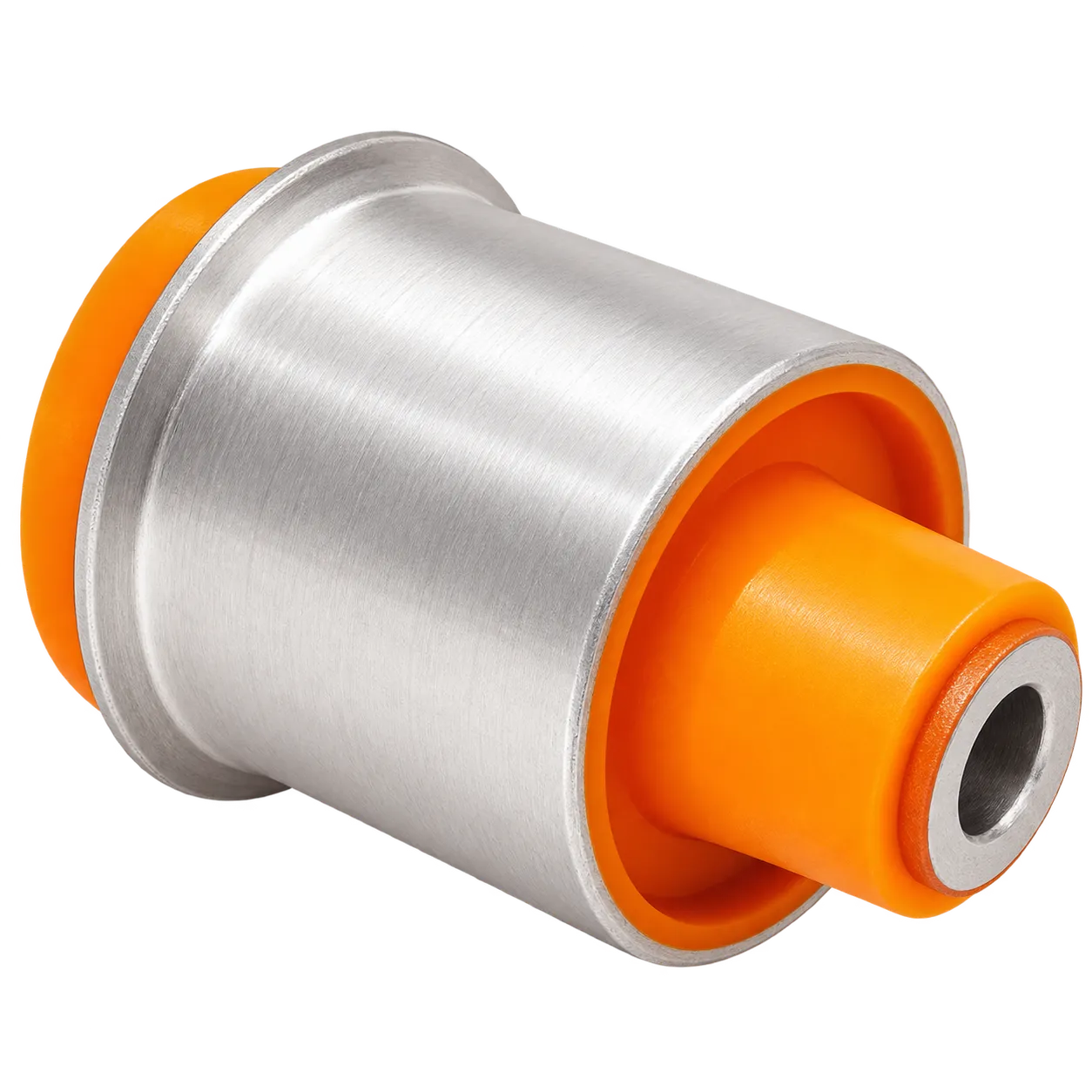
A rear axle beam bushing is the flexible mount that connects a semi-independent rear beam to the car body. It keeps the beam in its designed position, absorbs road impacts and stops the rear axle from changing its angle under braking and cornering. The part works in torsion and compression at the same time, so the material decides how long the geometry stays correct. PolyPro casts these bushings from polyurethane in its own moulds and sells them directly, by the piece or in batches. The full range is listed in the catalog.
A semi-independent rear beam is bolted to the body through two bushings, one in each mounting bracket. Inside the outer steel sleeve sits an elastic element with an inner tube that carries the mounting bolt. As the suspension travels, the beam rotates around that axis and the elastic element works in torsion. At the same time it takes longitudinal and lateral loads from acceleration, braking and cornering.
The stiffness of this joint decides how accurately the rear axle holds its designed angle. A worn rear axle bushing lets the axle steer itself in corners and under braking, and the car starts to wander on a straight road. A joint that is too hard sends every impact straight into the body with no filtering. Polyurethane sits between the two: the part holds geometry without turning the rear suspension into a solid link.
Wear shows up gradually: first a dull knock from the rear over bumps, then a change in how the car behaves in corners. The rubber cracks and separates from the sleeve, metal starts working against metal, and free play grows quickly.
Check the joint on a lift: load the beam near the bracket with a pry bar and watch for free movement of the inner tube inside the sleeve. Any visible play, or elastic material pushed out past the sleeve, means both bushings are replaced together — otherwise the axle geometry stays off.
The factory bushing is moulded from a rubber compound. It is cheap and quiet, but it ages from ozone, oils and temperature swings: within a few years the rubber hardens, cracks and separates from the metal. On cars with a loaded rear axle — estates, minivans, constant hauling — service life drops further, and the axle geometry goes with the lost elasticity.
Polyurethane does not crack from ozone, is not affected by dirt or road salt, and handles tearing and permanent set far better. It keeps the designed geometry longer, so the rear axle does not start steering itself after one season. The trade-off is slightly more small-amplitude vibration reaching the body on the harder grades. Each PolyPro part therefore has its own Shore hardness, stated on the product page, and it is matched to how the car is used.
Selection is based on mounting dimensions and fixing type, not on the car model. Three figures are needed: outer sleeve diameter, inner diameter for the bolt, and height. After that come the design and the required hardness.
A worn part is hard to measure accurately, so it is safer to take dimensions from the seat in the beam bracket and from the mounting bolt. The outer diameter is the diameter of the bore the sleeve is pressed into. The inner diameter matches the bolt with minimal clearance. Height is measured across the sleeve, not across the elastic element, which often protrudes past the faces and distorts the reading. If the old part has fallen apart, take the figures from a new original or from the cleaned seat once rust and rubber residue are removed. Check all three figures before pressing: a few tenths on the diameter noticeably change the interference fit.
Rear axle beam bushings differ in more than size. There are versions with an outer steel sleeve for a press fit, versions with a flanged sleeve that seats against the bracket face, and sleeveless ones where the elastic element goes straight into a cleaned bore. Separately there are designs with an inner plate or an offset centre, which give different stiffness in the longitudinal and lateral directions. Getting the version wrong shows up immediately: the part either will not stay in the bracket or will not let the beam travel properly. The type is identified from the old part, and every version is grouped in the bushings section.
Shore hardness is the main parameter after dimensions. For daily city driving a softer grade is used: it stays closer to factory comfort and passes less of the small impacts into the body. For a loaded car, trailer towing, rough roads and active driving a harder grade is used, because it holds the rear axle angle more precisely under load. The exact value for each item is given on its product page; there is no universal figure, since it depends on the part geometry and the weight of the car. If the car is loaded only occasionally, match the grade to the daily driving pattern rather than to the rare peak load.
Some rear axle beam bushings have been out of production for years, and on older cars the seats are often worn or bored out to a repair size. In that case the part is made to a drawing, a sample or the worn part itself, from a single piece. If the old bushing survived even partly, send it in: the profile and the fit are taken from it. Non-standard heights and diameters for a specific repair, including oversize parts for a machined seat, are produced the same way. The data needed is agreed before production starts, so the part fits without reworking. The ordering procedure is described in the custom-made parts section.
PolyPro is a manufacturer, not a reseller. Own moulds, in-house casting, dimensional control and shipping are all kept inside the company, so the price carries no middleman margin and a repeat batch comes out with the same geometry. Retail is by the piece: you can take a single rear axle beam bushing instead of a full axle set. Non-standard parts are made to a drawing, a sample or a worn part, also from one piece. The products are covered by a warranty, with delivery across Ukraine and international shipping on request.
Workshops, parts shops, fleets and resellers work on wholesale terms and through the partner program: bonuses for turnover or single-order volume, access to prices and stock levels, and shipping under the partner's own brand.
Yes. The beam is carried on two bushings and they wear at roughly the same rate. Fitting a new part on one side only makes the axle work asymmetrically: the wheel angles drift apart, and the new bushing takes more load and gives up sooner. Replacing them as a pair keeps the stiffness identical on both sides.
On some cars it is done with a puller on the vehicle, with the beam supported. The problem is the seat: rust and old rubber residue are hard to clean out in place, and pressing the part in squarely is much harder. If the beam comes off without excessive work, take it off — you also get to inspect the brackets and the mounting bolts.
Yes. These bushings set the position of the rear axle, so camber and toe should be checked on an alignment rig afterwards. This matters especially on cars where the mounting includes adjustment elements. Without a check, the deviation built up on the worn parts stays in the car and keeps eating the tyres.
Polyurethane is less compliant than aged rubber, especially in the harder grades. Over expansion joints and cobbles a larger share of the vibration reaches the body. That is the expected trade-off for more accurate axle geometry. If comfort is the priority, choose a softer Shore hardness; the value for each item is stated on its product page.
Yes, a polyurethane bushing is fitted with a grease compatible with polyurethane. It eases the fit and prevents squeaking on the working surfaces. Petroleum-based greases and copper pastes are not suitable here. Clean the seat of rust and old rubber residue before pressing, otherwise the part will sit at an angle.
If the outer diameter, inner diameter, height and fixing type match, the part will go in. Keep the design in mind though: a flange, an inner plate or an offset centre changes stiffness in different directions and with it the axle behaviour. Selection is therefore based on measured dimensions and version, not on the car model.
Yes, retail is by the piece: one part, a pair for the axle, or a set for a specific repair. Non-standard sizes are made to a drawing, a sample or a worn part, also from one piece. PolyPro sells directly from production with no intermediaries, with a warranty on the products, delivery across Ukraine and international shipping.
Workshops, parts shops, fleets and resellers are served on wholesale terms and through the partner program: bonuses for turnover or single-order volume, access to current prices and stock, and shipping under the partner's brand. The range and volumes are agreed around your repair flow.