

SKU: PP301018
Front stabilizer bar polyurethane bushing Infiniti Q70 1990-1992
In stock15 pcs.$1.86Log in as dealer

Front stabilizer bar polyurethane bushing Infiniti Q70 1990-1992
In stock15 pcs.Front stabilizer bar polyurethane bushing Nissan 100Nx 1990-1994
In stock15 pcs.Front stabilizer bar polyurethane bushing Nissan 300Zx 1983-1990
In stock15 pcs.Front stabilizer bar polyurethane bushing Nissan Almera 1995-2000
In stock15 pcs.Front stabilizer bar polyurethane bushing Nissan Almera 2000-2006
In stock15 pcs.Front stabilizer bar polyurethane bushing Nissan Bluebird 1983-1986
In stock15 pcs.Front stabilizer bar polyurethane bushing Nissan Bluebird 1985-1990
In stock15 pcs.Front stabilizer bar polyurethane bushing Nissan Bluebird Sylphy 2000-2005
In stock15 pcs.Front stabilizer bar polyurethane bushing Nissan Bluebird Sylphy 2006-2014
In stock15 pcs.Front stabilizer bar polyurethane bushing Nissan Cube 1998-2002
In stock15 pcs.Front stabilizer bar polyurethane bushing Nissan Maxima 1988-1994
In stock15 pcs.Front stabilizer bar polyurethane bushing Nissan Patrol 1987-1998
In stock15 pcs.Front stabilizer bar polyurethane bushing Nissan Prairie 1982-1988
In stock15 pcs.Front stabilizer bar polyurethane bushing Nissan Prairie 1988-1998
In stock15 pcs.Front stabilizer bar polyurethane bushing Nissan Primera 1990-1996
In stock15 pcs.Front stabilizer bar polyurethane bushing Nissan Sunny 1986-1990
In stock15 pcs.Front stabilizer bar polyurethane bushing Nissan Sunny 1990-1995
In stock15 pcs.Front stabilizer bar polyurethane bushing Nissan Sunny 1995-2000
In stock15 pcs.
Polyurethane bushing of the front stabilizer bar Audi A3 1996-2006
In stock15 pcs.
Polyurethane bushing of the front stabilizer bar Audi A3 1996-2006 (Under the metal stand)
In stock15 pcs.
Polyurethane bushing of the front stabilizer bar Audi A3 1996-2006 (WITH WELDED METAL BUSHING)
In stock15 pcs.
Polyurethane bushing of the front stabilizer bar Audi A3 1996-2006 PP-1344 (Under the metal stand)
In stock15 pcs.Polyurethane bushing of the front stabilizer bar Audi TT 1998-2006
In stock15 pcs.Polyurethane bushing of the front stabilizer bar Audi TT 1998-2006 (Under the metal stand)
In stock15 pcs.Polyurethane bushing of the front stabilizer bar Audi TT 1998-2006 (WITH WELDED METAL BUSHING)
In stock15 pcs.Polyurethane bushing of the front stabilizer bar Audi TT 1998-2006 PP-1344 (Under the metal stand)
In stock15 pcs.
Polyurethane bushing of the front stabilizer bar Seat Leon 1998-2006
In stock15 pcs.Polyurethane bushing of the front stabilizer bar Seat Leon 1998-2006
In stock15 pcs.Polyurethane bushing of the front stabilizer bar Seat Leon 1998-2006 (Under the metal stand)
In stock15 pcs.Polyurethane bushing of the front stabilizer bar Seat Leon 1998-2006 (WITH WELDED METAL BUSHING)
In stock15 pcs.Polyurethane bushing of the front stabilizer bar Seat Leon 1998-2006 PP-1344 (Under the metal stand)
In stock15 pcs.Polyurethane bushing of the front stabilizer bar Seat Leon 2005-2012
In stock15 pcs.Polyurethane bushing of the front stabilizer bar Seat Leon 2005-2012
In stock15 pcs.Polyurethane bushing of the front stabilizer bar Seat Leon 2005-2012 (Under the metal stand)
In stock15 pcs.Polyurethane bushing of the front stabilizer bar Seat Leon 2005-2012 (WITH WELDED METAL BUSHING)
In stock15 pcs.Polyurethane bushing of the front stabilizer bar Seat Leon 2005-2012 PP-1344 (Under the metal stand)
In stock15 pcs.Polyurethane bushing of the front stabilizer bar Seat Toledo 1991-1999
In stock15 pcs.Polyurethane bushing of the front stabilizer bar Seat Toledo 1991-1999
In stock15 pcs.Polyurethane bushing of the front stabilizer bar Seat Toledo 1991-1999 (Under the metal stand)
In stock15 pcs.Polyurethane bushing of the front stabilizer bar Seat Toledo 1991-1999 (WITH WELDED METAL BUSHING)
In stock15 pcs.Polyurethane bushing of the front stabilizer bar Seat Toledo 1991-1999 PP-1344 (Under the metal stand)
In stock15 pcs.Polyurethane bushing of the front stabilizer bar Seat Toledo 1999-2004
In stock15 pcs.Polyurethane bushing of the front stabilizer bar Seat Toledo 1999-2004
In stock15 pcs.Polyurethane bushing of the front stabilizer bar Seat Toledo 1999-2004 (Under the metal stand)
In stock15 pcs.Polyurethane bushing of the front stabilizer bar Seat Toledo 1999-2004 (WITH WELDED METAL BUSHING)
In stock15 pcs.Polyurethane bushing of the front stabilizer bar Seat Toledo 1999-2004 PP-1344 (Under the metal stand)
In stock15 pcs.Polyurethane bushing of the front stabilizer bar Seat Toledo 2004-2009
In stock15 pcs.Polyurethane bushing of the front stabilizer bar Seat Toledo 2004-2009
In stock15 pcs.Polyurethane bushing of the front stabilizer bar Seat Toledo 2004-2009 (Under the metal stand)
In stock15 pcs.Polyurethane bushing of the front stabilizer bar Seat Toledo 2004-2009 (WITH WELDED METAL BUSHING)
In stock15 pcs.Polyurethane bushing of the front stabilizer bar Seat Toledo 2004-2009 PP-1344 (Under the metal stand)
In stock15 pcs.Polyurethane bushing of the front stabilizer bar Skoda Octavia 1996-2010
In stock15 pcs.Polyurethane bushing of the front stabilizer bar Skoda Octavia 1996-2010
In stock15 pcs.Polyurethane bushing of the front stabilizer bar Skoda Octavia 1996-2010 (Under the metal stand)
In stock15 pcs.Polyurethane bushing of the front stabilizer bar Skoda Octavia 1996-2010 (WITH WELDED METAL BUSHING)
In stock15 pcs.Polyurethane bushing of the front stabilizer bar Skoda Octavia 1996-2010 PP-1344 (Under the metal stand)
In stock15 pcs.Polyurethane bushing of the front stabilizer bar Skoda Octavia 2004-2010
In stock15 pcs.Polyurethane bushing of the front stabilizer bar Skoda Octavia 2004-2010
In stock15 pcs.Polyurethane bushing of the front stabilizer bar Skoda Octavia 2004-2010 (Under the metal stand)
In stock15 pcs.Polyurethane bushing of the front stabilizer bar Skoda Octavia 2004-2010 (WITH WELDED METAL BUSHING)
In stock15 pcs.Polyurethane bushing of the front stabilizer bar Skoda Octavia 2004-2010 PP-1344 (Under the metal stand)
In stock15 pcs.Polyurethane bushing of the front stabilizer bar Skoda Superb 2008-2015
In stock15 pcs.Polyurethane bushing of the front stabilizer bar Skoda Superb 2008-2015
In stock15 pcs.Polyurethane bushing of the front stabilizer bar Skoda Superb 2008-2015 (Under the metal stand)
In stock15 pcs.Polyurethane bushing of the front stabilizer bar Skoda Superb 2008-2015 (WITH WELDED METAL BUSHING)
In stock15 pcs.Polyurethane bushing of the front stabilizer bar Skoda Superb 2008-2015 PP-1344 (Under the metal stand)
In stock15 pcs.Polyurethane bushing of the front stabilizer bar Volkswagen Beetle 2011-2019
In stock15 pcs.Polyurethane bushing of the front stabilizer bar Volkswagen Beetle 2011-2019
In stock15 pcs.Polyurethane bushing of the front stabilizer bar Volkswagen Beetle 2011-2019 (Under the metal stand)
In stock15 pcs.Polyurethane bushing of the front stabilizer bar Volkswagen Beetle 2011-2019 (WITH WELDED METAL BUSHING)
In stock15 pcs.Polyurethane bushing of the front stabilizer bar Volkswagen Beetle 2011-2019 PP-1344 (Under the metal stand)
In stock15 pcs.Polyurethane bushing of the front stabilizer bar Volkswagen Bora 1998-2005
In stock15 pcs.Polyurethane bushing of the front stabilizer bar Volkswagen Bora 1998-2005
In stock15 pcs.Polyurethane bushing of the front stabilizer bar Volkswagen Bora 1998-2005 (Under the metal stand)
In stock15 pcs.Polyurethane bushing of the front stabilizer bar Volkswagen Bora 1998-2005 (WITH WELDED METAL BUSHING)
In stock15 pcs.Polyurethane bushing of the front stabilizer bar Volkswagen Bora 1998-2005 PP-1344 (Under the metal stand)
In stock15 pcs.Polyurethane bushing of the front stabilizer bar Volkswagen Caddy 1995-2004
In stock15 pcs.Polyurethane bushing of the front stabilizer bar Volkswagen Caddy 1995-2004
In stock15 pcs.Polyurethane bushing of the front stabilizer bar Volkswagen Caddy 1995-2004 (Under the metal stand)
In stock15 pcs.Polyurethane bushing of the front stabilizer bar Volkswagen Caddy 1995-2004 (WITH WELDED METAL BUSHING)
In stock15 pcs.Polyurethane bushing of the front stabilizer bar Volkswagen Caddy 1995-2004 PP-1344 (Under the metal stand)
In stock15 pcs.Polyurethane bushing of the front stabilizer bar Volkswagen Golf 1991-1998
In stock15 pcs.Polyurethane bushing of the front stabilizer bar Volkswagen Golf 1991-1998
In stock15 pcs.Polyurethane bushing of the front stabilizer bar Volkswagen Golf 1991-1998 (Under the metal stand)
In stock15 pcs.Polyurethane bushing of the front stabilizer bar Volkswagen Golf 1991-1998 (WITH WELDED METAL BUSHING)
In stock15 pcs.Polyurethane bushing of the front stabilizer bar Volkswagen Golf 1991-1998 PP-1344 (Under the metal stand)
In stock15 pcs.Polyurethane bushing of the front stabilizer bar Volkswagen Golf 1997-2003
In stock15 pcs.Polyurethane bushing of the front stabilizer bar Volkswagen Golf 1997-2003
In stock15 pcs.Polyurethane bushing of the front stabilizer bar Volkswagen Golf 1997-2003 (Under the metal stand)
In stock15 pcs.Polyurethane bushing of the front stabilizer bar Volkswagen Golf 1997-2003 (WITH WELDED METAL BUSHING)
In stock15 pcs.Polyurethane bushing of the front stabilizer bar Volkswagen Golf 1997-2003 PP-1344 (Under the metal stand)
In stock15 pcs.Polyurethane bushing of the front stabilizer bar Volkswagen Golf 2003-2006
In stock15 pcs.Polyurethane bushing of the front stabilizer bar Volkswagen Golf 2003-2006
In stock15 pcs.Polyurethane bushing of the front stabilizer bar Volkswagen Golf 2003-2006 (Under the metal stand)
In stock15 pcs.Polyurethane bushing of the front stabilizer bar Volkswagen Golf 2003-2006 (WITH WELDED METAL BUSHING)
In stock15 pcs.Polyurethane bushing of the front stabilizer bar Volkswagen Golf 2003-2006 PP-1344 (Under the metal stand)
In stock15 pcs.Polyurethane bushing of the front stabilizer bar Volkswagen New Beetle 1998-2010
In stock15 pcs.Polyurethane bushing of the front stabilizer bar Volkswagen New Beetle 1998-2010
In stock15 pcs.Polyurethane bushing of the front stabilizer bar Volkswagen New Beetle 1998-2010 (Under the metal stand)
In stock15 pcs.Polyurethane bushing of the front stabilizer bar Volkswagen New Beetle 1998-2010 (WITH WELDED METAL BUSHING)
In stock15 pcs.Polyurethane bushing of the front stabilizer bar Volkswagen New Beetle 1998-2010 PP-1344 (Under the metal stand)
In stock15 pcs.Polyurethane bushing of the front stabilizer bar Volkswagen Polo 1994-2001
In stock15 pcs.Polyurethane bushing of the front stabilizer bar Volkswagen Polo 1994-2001
In stock15 pcs.Polyurethane bushing of the front stabilizer bar Volkswagen Polo 1994-2001 (Under the metal stand)
In stock15 pcs.Polyurethane bushing of the front stabilizer bar Volkswagen Polo 1994-2001 (WITH WELDED METAL BUSHING)
In stock15 pcs.Polyurethane bushing of the front stabilizer bar Volkswagen Polo 1994-2001 PP-1344 (Under the metal stand)
In stock15 pcs.
Polyurethane bushing of the stabilizer rack BYD F0 2008-
In stock15 pcs.
Polyurethane bushing of the stabilizer rack Citroen C1 2005-2014
In stock15 pcs.Polyurethane bushing of the stabilizer rack Geely Mk 2006-2014
In stock15 pcs.Polyurethane bushing of the stabilizer rack Peugeot 107 2005-
In stock15 pcs.
Polyurethane bushing of the stabilizer rack Toyota Aygo 2005-2014
In stock15 pcs.Polyurethane bushing of the stabilizer rack Toyota Aygo 2014-2020
In stock15 pcs.Polyurethane bushing of the stabilizer rack Toyota Ist 2002-2007
In stock15 pcs.Polyurethane bushing of the stabilizer rack Toyota Porte 2004-2012
In stock15 pcs.Polyurethane bushing of the stabilizer rack Toyota Probox 2002-2014
In stock15 pcs.Polyurethane bushing of the stabilizer rack Toyota Raum 2003-2011
In stock15 pcs.Polyurethane bushing of the stabilizer rack Toyota Yaris 1999-2006
In stock15 pcs.Polyurethane bushing of the stabilizer rack Toyota Yaris 2006-2011
In stock15 pcs.Polyurethane bushing of the stabilizer rack Toyota Yaris 2010-2020
In stock15 pcs.Polyurethane bushing of the stabilizer rack Toyota bB 2000-2005
In stock15 pcs.
Polyurethane bushing rack front stabilizer bar upper IKCO Samand 2002-2022
In stock15 pcs.
Polyurethane bushing rack front stabilizer bar upper Merсedes 210 1996-2003
In stock15 pcs.Polyurethane bushing rack front stabilizer bar upper Peugeot 206 1998-
In stock15 pcs.Polyurethane bushing rack front stabilizer bar upper Peugeot 405 1987-1997
In stock15 pcs.Polyurethane bushing rack front stabilizer bar upper Peugeot 505 1979-1992
In stock15 pcs.Polyurethane bushing rack front stabilizer bar upper Peugeot 604 1975-1985
In stock15 pcs.
Polyurethane bushing rack rear stabilizer bar Audi A6 1994-1997
In stock15 pcs.Polyurethane bushing rack rear stabilizer bar Audi A6 1997-2004
In stock15 pcs.Polyurethane bushing rack rear stabilizer bar Audi A6 2004-2011
In stock15 pcs.Polyurethane bushing rack rear stabilizer bar Audi Allroad 2000-2005
In stock15 pcs.Polyurethane bushing rack rear stabilizer bar Audi Allroad 2006-2011
In stock15 pcs.Polyurethane bushing rack rear stabilizer bar Seat Arosa 1997-2005
In stock15 pcs.Polyurethane bushing rack rear stabilizer bar Skoda Superb 2001-2008
In stock15 pcs.Polyurethane bushing rack rear stabilizer bar Volkswagen Lupo 1998-2005
In stock15 pcs.Polyurethane bushing rack rear stabilizer bar Volkswagen Passat B5 1996-2005
In stock15 pcs.Polyurethane bushing rack rear stabilizer bar Volkswagen Polo 1994-2001
In stock15 pcs.
Polyurethane bushing rack stabilizer bar Gaz 24 1966-1986
In stock15 pcs.Polyurethane bushing rack stabilizer bar Gaz 2410 1972-1992
In stock15 pcs.Polyurethane bushing rack stabilizer bar Gaz 3110 1997-2005
In stock15 pcs.Polyurethane bushing rack stabilizer bar Uaz 3160 1997-2004
In stock15 pcs.
Polyurethane bushing rear rack stabilizer bar Lexus Nx 2014-2021
In stock15 pcs.Polyurethane bushing rear rack stabilizer bar Toyota Land Cruiser 2007-
In stock15 pcs.
Polyurethane bushing rear rack stabilizer bar Toyota Land Cruiser 2007-
In stock15 pcs.Polyurethane bushing rear rack stabilizer bar Toyota Rav4 2005-2013
In stock15 pcs.Polyurethane bushing rear rack stabilizer bar Toyota Rav4 2013-2018
In stock15 pcs.Polyurethane bushing rear rack stabilizer bar Toyota Vanguard 2007-2013
In stock15 pcs.
Polyurethane rear stabilizer bar bushing Ford C-Max 2003-2010
In stock15 pcs.Polyurethane rear stabilizer bar bushing Ford C-Max 2010-
In stock15 pcs.
Polyurethane rear stabilizer bar bushing Ford Escape 2012-2019
In stock15 pcs.Polyurethane rear stabilizer bar bushing Ford Focus 1998-2004
In stock15 pcs.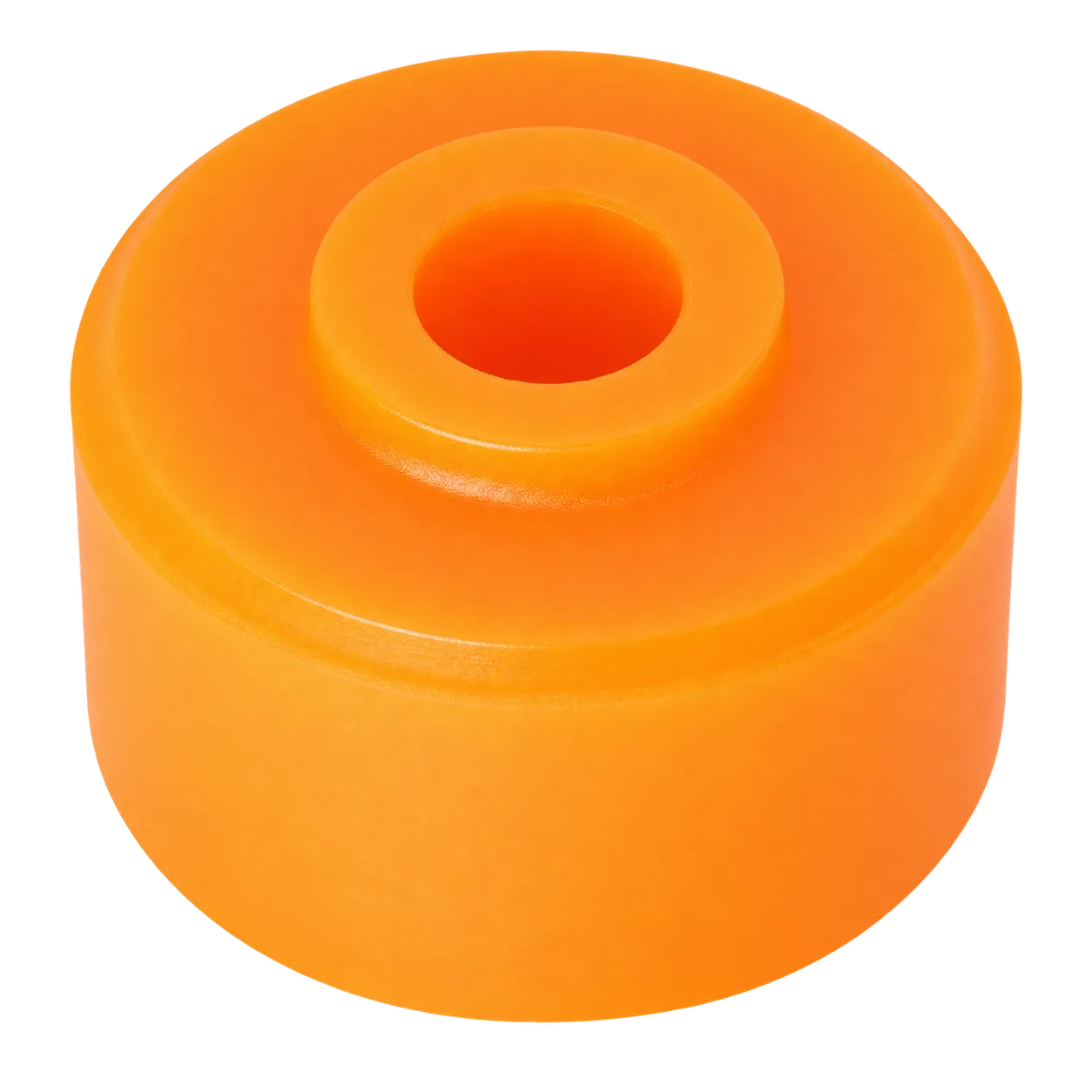
A sway bar link bushing is the elastic insert in the eye of the short rod that ties the anti-roll bar to the strut or the control arm. The mounting bolt passes through it, so the bushing keeps the link aligned, lets it swivel through a few degrees and absorbs the hits as the wheels move through compression and rebound. PolyPro moulds these bushings from polyurethane in its own plant, and the dimensions and Shore hardness are stated on every product page in the catalogue.
The end link is a short rod between the anti-roll bar and the strut body or the control arm. In the simple design its eyes carry no ball joints: an elastic bushing sits in each eye and the bolt runs through it with washers. Movement comes from deformation of the material rather than metal sliding on metal, so the joint needs no grease and has no working clearance. Load from one wheel travels through this part to the opposite side of the axle.
Do not confuse it with the bushing that holds the bar itself in a bracket on the subframe or the chassis rail. An end link bushing is loaded along the axis of the rod, in tension and compression, and also in misalignment of the eye against the bolt when the suspension works unevenly. Once it collapses, the rod knocks against the bolt, the anti-roll bar engages late, and the body leans further in corners and settles more slowly after a bump.
A link on rubber-style bushings rarely fails at once: a light knock over rough tarmac comes first, and only later the play you can feel by hand. Check with the wheel raised — grip the rod, rock it along its axis, and load the eye with a pry bar.
The noise from this joint is finer and higher in pitch than a worn arm or mount, and it follows small bumps rather than braking. If the bushings wear unevenly side to side, the car responds differently in left and right corners, so replace both links on the axle together.
A rubber bushing is softer and quieter over small bumps, but it takes a permanent set faster: the material ages with ozone, fuel and temperature swings, cracks around the edge of the eye and loses its spring. The hole then wears oval and the rod starts working with play after a single hard season on poor roads.
Polyurethane is stiffer in compression, holds its shape better under steady load and resists oils, road salt and water. The anti-roll bar engages earlier and without a dead spot, body roll drops, and the knock over small bumps does not come back as quickly. The trade-off is slightly more vibration passed to the body on coarse surfaces, plus a demand for clean assembly: the seat and the bolt must be free of rust, and the joint must be torqued with the suspension at ride height.
Choose by the geometry of the eye and by how the car is used, not by the badge on the bonnet. You need three measurements and a clear idea of how your link is assembled and what you expect from it.
Take three figures: the outer diameter of the seat in the eye of the rod, the inner diameter for the bolt or the crush sleeve, and the height of the eye. Measure on metal, on the eye and on the bolt, not on the worn rubber, because an old part always reads short once it has sagged. If the hole is worn oval, you need a bushing to an oversize dimension, otherwise the new one seats with play straight away. Record the front and rear joints separately: they look alike but often differ in height. When the size you need is not in stock, the part can be made from a drawing, a sample or the worn bushing in the made-to-order section.
Shore hardness follows the way the car is driven, and it is listed on every product page. A softer grade stays closer to the original filtering: it is quieter over small bumps and passes less of the fine impact into the body, which suits a city car on a soft setup. A harder grade keeps the anti-roll bar tight under side load, so it goes on a loaded vehicle, on a car that tows, on one that runs gravel roads regularly, or where a crisp steering response matters. Fitting the hardest grade to a comfort-oriented car is a mistake: the joint starts passing fine vibration that the rest of the suspension cannot absorb.
Links differ in how they are stacked. Some eyes take a single through bushing, others a pair of tapered half bushings that enter from both sides and are squeezed by washers as the nut is tightened. You will also find versions with a pressed-in steel sleeve, flanged versions that seat against the face of the eye, and sleeveless ones. Identify the type from the old part: count how many elements sat in each eye, check whether a crush sleeve ran between them, and note which way the flange faced. If the rod has different eyes at each end, record the sizes and the count for each end separately.
PolyPro is the manufacturer: our own moulds, our own casting shop, dimensional control on every batch and direct sales with no middlemen. That means repeatable geometry from batch to batch and a price without extra mark-ups along the chain. Retail is by the piece: take one bushing for a single eye, a pair for one axle or a full set for both links. Non-standard parts are made from a drawing, a sample or the worn item, starting from one piece. The products carry a warranty, and we ship across Ukraine and internationally.
Workshops, parts shops, fleets and resellers get wholesale terms and a partner programme: bonuses on turnover or on the size of a single order, access to prices and stock levels, and shipment under the partner's own brand.
They are two different parts. A sway bar bushing clamps the bar itself in a bracket on the subframe or chassis rail and works mainly in torsion. A link bushing sits in the eye of the short rod that joins the bar to the strut or arm, and it is loaded along the axis of that rod, in tension and compression. Their sizes and shapes differ as well.
Yes, provided the metal is sound: threads not stripped, the eye not worn oval and no cracks in the rod. In that case you only replace the elastic bushings and the hardware. If the bore of the eye is chewed out, you need either a part made to an oversize dimension or a new rod, otherwise the fresh bushing starts to move almost immediately.
It depends on the design. In the most common layout each eye takes a pair of half bushings from both sides plus a crush sleeve, so four elastic elements per rod. Some eyes use a single through bushing instead. Count them from the old part, and always replace both links on the same axle at the same time.
A polyurethane bushing works by deforming rather than sliding, so grease is not required for the joint to function. What matters is cleaning rust and old rubber off the seat and the bolt. If you do use a lubricant, pick one compatible with polyurethane; petroleum products and aggressive solvents must not reach the elastic element.
Squeak comes from dry contact and grit in the seat, not from the material itself. Clean the eye and the bolt before assembly, fit the part square, and tighten the nut with the suspension at ride height rather than hanging on the hoist. Assembled that way the joint stays quiet; a noise usually means it has shifted or was left loose.
A link knock is fine and sharp, and it appears over small bumps and joints rather than under braking. Check with the wheel raised: rock the rod by hand along its axis and look for play in the eyes. Another method is to disconnect the link at one end and drive slowly; if the knock disappears, you have found the source.
Yes, retail is by the piece: take one bushing, a set for a single link or a set for both sides of an axle. Non-standard sizes and parts for a worn oversize eye are made from a drawing, a sample or the worn bushing, starting from one piece. Sales come straight from the production floor, with a warranty on the products and international shipping.
Workshops, parts shops, fleets and resellers work on wholesale terms with a partner programme: bonuses on turnover or on the size of a single order, access to current prices and stock levels, and shipment under the partner's brand. The range and volumes are agreed around your repair flow.