

SKU: PP104773
Front shock absorber support repair kit Toyota 4Runner 2003-2009
In stock15 pcs.$40.12Log in as dealer

Front shock absorber support repair kit Toyota 4Runner 2003-2009
In stock15 pcs.Front shock absorber support repair kit Toyota Fj Cruiser 2006-2010
In stock15 pcs.Front shock absorber support repair kit Toyota Fortuner 2015-
In stock15 pcs.Front shock absorber support repair kit Toyota Gx 2009-
In stock15 pcs.Front shock absorber support repair kit Toyota Hilux 2015-
In stock15 pcs.Front shock absorber support repair kit Toyota Land Cruiser 1998-2007
In stock15 pcs.Front shock absorber support repair kit Toyota Land Cruiser Prado 2002-2009
In stock15 pcs.
Polyurethane bearing front shock absorber BMW 5 E34 1987-1995 16мм COMPLEX
In stock15 pcs.
Polyurethane bearing front shock absorber BMW 5 E34 1987-1995 RECONSTRUCTION OF YOUR, COMPLEX 14мм
In stock15 pcs.
Polyurethane bearing front shock absorber BMW 5 E34 1987-1995 RECONSTRUCTION OF YOUR, COMPLEX 16мм
In stock15 pcs.
Polyurethane front shock absorber suppor Citroen C-Crosser 2007-2013
In stock15 pcs.Polyurethane front shock absorber suppor Citroen C4 2010-2018
In stock15 pcs.Polyurethane front shock absorber suppor Dodge Caliber 2006-2011
In stock15 pcs.Polyurethane front shock absorber suppor Jeep Compass 2006-2016
In stock15 pcs.Polyurethane front shock absorber suppor Jeep Patriot 2007-2016
In stock15 pcs.Polyurethane front shock absorber suppor Mitsubishi Asx 2010-
In stock15 pcs.Polyurethane front shock absorber suppor Mitsubishi Lancer 2000-2009
In stock15 pcs.Polyurethane front shock absorber suppor Mitsubishi Outlander 2006-2012
In stock15 pcs.Polyurethane front shock absorber suppor Peugeot 4007 2007-2013
In stock15 pcs.Polyurethane front shock absorber suppor Peugeot 4008 2012-2017
In stock15 pcs.
Polyurethane front shock absorber support Alfa Romeo 155 1992-1998 RECONSTRUCTION OF YOUR
In stock15 pcs.Polyurethane front shock absorber support Alfa Romeo 33 1983-1995 RECONSTRUCTION OF YOUR
In stock15 pcs.
Polyurethane front shock absorber support Alfa Romeo Ar6 1985-1989 Left
In stock15 pcs.
Polyurethane front shock absorber support Alfa Romeo Ar6 1985-1989 Left
In stock15 pcs.
Polyurethane front shock absorber support Alfa Romeo Ar6 1985-1989 Left RECONSTRUCTION OF YOUR
In stock15 pcs.
Polyurethane front shock absorber support Alfa Romeo Ar6 1985-1989 Left RECONSTRUCTION OF YOUR
In stock15 pcs.
Polyurethane front shock absorber support Alfa Romeo Ar6 1985-1989 Right
In stock15 pcs.
Polyurethane front shock absorber support Alfa Romeo Ar6 1985-1989 Right
In stock15 pcs.
Polyurethane front shock absorber support Alfa Romeo Ar6 1985-1989 Right RECONSTRUCTION OF YOUR
In stock15 pcs.
Polyurethane front shock absorber support Alfa Romeo Ar6 1985-1989 Right RECONSTRUCTION OF YOUR
In stock15 pcs.Polyurethane front shock absorber support Alfa Romeo Arna 1983-1987 RECONSTRUCTION OF YOUR
In stock15 pcs.
Polyurethane front shock absorber support Audi 100 C2 1976-1982
In stock15 pcs.
Polyurethane front shock absorber support Audi 100 C2 1976-1982 RECONSTRUCTION OF YOUR
In stock15 pcs.Polyurethane front shock absorber support Audi 100 C3 1982-1991
In stock15 pcs.Polyurethane front shock absorber support Audi 100 C3 1982-1991 RECONSTRUCTION OF YOUR
In stock15 pcs.
Polyurethane front shock absorber support Audi 100 C4 1990-1994 RECONSTRUCTION OF YOUR
In stock13 pcs.Polyurethane front shock absorber support Audi 200 1983-1991
In stock15 pcs.Polyurethane front shock absorber support Audi 200 1983-1991 RECONSTRUCTION OF YOUR
In stock15 pcs.
Polyurethane front shock absorber support Audi 80 1972-1978
In stock15 pcs.
Polyurethane front shock absorber support Audi 80 1972-1978 RECONSTRUCTION OF YOUR
In stock15 pcs.Polyurethane front shock absorber support Audi 80 1978-1986
In stock15 pcs.Polyurethane front shock absorber support Audi 80 1978-1986 RECONSTRUCTION OF YOUR
In stock15 pcs.Polyurethane front shock absorber support Audi 80 1986-1991
In stock15 pcs.Polyurethane front shock absorber support Audi 80 1986-1991 RECONSTRUCTION OF YOUR
In stock15 pcs.Polyurethane front shock absorber support Audi 80 1991-1995
In stock15 pcs.Polyurethane front shock absorber support Audi 80 1991-1995 RECONSTRUCTION OF YOUR
In stock15 pcs.Polyurethane front shock absorber support Audi 90 1981-1985
In stock15 pcs.Polyurethane front shock absorber support Audi 90 1981-1985 RECONSTRUCTION OF YOUR
In stock15 pcs.Polyurethane front shock absorber support Audi 90 1987-1991
In stock15 pcs.Polyurethane front shock absorber support Audi 90 1987-1991 RECONSTRUCTION OF YOUR
In stock15 pcs.
Polyurethane front shock absorber support Audi A1 2010-2018
In stock14 pcs.
Polyurethane front shock absorber support Audi A1 2010-2018 HARDNESS 2,6L
In stock15 pcs.
Polyurethane front shock absorber support Audi A1 2010-2018 HARDNESS 2,6L RECONSTRUCTION OF YOUR
In stock15 pcs.
Polyurethane front shock absorber support Audi A1 2010-2018 RECONSTRUCTION OF YOUR
In stock15 pcs.Polyurethane front shock absorber support Audi A3 1996-2006
In stock14 pcs.Polyurethane front shock absorber support Audi A3 1996-2006 HARDNESS 2,6L
In stock15 pcs.Polyurethane front shock absorber support Audi A3 1996-2006 HARDNESS 2,6L RECONSTRUCTION OF YOUR
In stock15 pcs.Polyurethane front shock absorber support Audi A3 1996-2006 RECONSTRUCTION OF YOUR
In stock15 pcs.
Polyurethane front shock absorber support Audi A3 2012-2020
In stock15 pcs.
Polyurethane front shock absorber support Audi A3 2012-2020
In stock15 pcs.
Polyurethane front shock absorber support Audi A3 2012-2020 RECONSTRUCTION OF YOUR
In stock15 pcs.
Polyurethane front shock absorber support Audi A3 2012-2020 RECONSTRUCTION OF YOUR
In stock15 pcs.
Polyurethane front shock absorber support Audi A4 1994-2001
In stock15 pcs.
Polyurethane front shock absorber support Audi A4 1994-2001 RECONSTRUCTION OF YOUR
In stock15 pcs.Polyurethane front shock absorber support Audi A6 1997-2004
In stock15 pcs.Polyurethane front shock absorber support Audi A6 1997-2004 RECONSTRUCTION OF YOUR
In stock15 pcs.Polyurethane front shock absorber support Audi A6 C4 1994-1997 RECONSTRUCTION OF YOUR
In stock13 pcs.Polyurethane front shock absorber support Audi A8 1994-2002
In stock15 pcs.Polyurethane front shock absorber support Audi A8 1994-2002 RECONSTRUCTION OF YOUR
In stock15 pcs.Polyurethane front shock absorber support Audi Cabriolet 1991-2000
In stock15 pcs.Polyurethane front shock absorber support Audi Cabriolet 1991-2000 RECONSTRUCTION OF YOUR
In stock15 pcs.Polyurethane front shock absorber support Audi Coupe 1980-1988
In stock15 pcs.Polyurethane front shock absorber support Audi Coupe 1980-1988 RECONSTRUCTION OF YOUR
In stock15 pcs.Polyurethane front shock absorber support Audi Coupe 1988-1996
In stock15 pcs.Polyurethane front shock absorber support Audi Coupe 1988-1996 RECONSTRUCTION OF YOUR
In stock15 pcs.Polyurethane front shock absorber support Audi Q2 2016-
In stock15 pcs.Polyurethane front shock absorber support Audi Q2 2016- RECONSTRUCTION OF YOUR
In stock15 pcs.Polyurethane front shock absorber support Audi TT 1998-2006
In stock14 pcs.Polyurethane front shock absorber support Audi TT 1998-2006 HARDNESS 2,6L
In stock15 pcs.Polyurethane front shock absorber support Audi TT 1998-2006 HARDNESS 2,6L RECONSTRUCTION OF YOUR
In stock15 pcs.Polyurethane front shock absorber support Audi TT 1998-2006 RECONSTRUCTION OF YOUR
In stock15 pcs.Polyurethane front shock absorber support Audi TT 2014-2023
In stock15 pcs.Polyurethane front shock absorber support Audi TT 2014-2023
In stock15 pcs.Polyurethane front shock absorber support Audi TT 2014-2023 RECONSTRUCTION OF YOUR
In stock15 pcs.Polyurethane front shock absorber support Audi TT 2014-2023 RECONSTRUCTION OF YOUR
In stock15 pcs.
Polyurethane front shock absorber support BMW E24 1976-1989
In stock15 pcs.
Polyurethane front shock absorber support BMW E24 1976-1989 RECONSTRUCTION OF YOUR
In stock15 pcs.Polyurethane front shock absorber support BMW E30 1982-1994
In stock15 pcs.Polyurethane front shock absorber support BMW E30 1982-1994 RECONSTRUCTION OF YOUR
In stock15 pcs.Polyurethane front shock absorber support BMW E32 1981-1987
In stock15 pcs.Polyurethane front shock absorber support BMW E32 1981-1987 RECONSTRUCTION OF YOUR
In stock15 pcs.Polyurethane front shock absorber support BMW E32 1987-1994
In stock15 pcs.Polyurethane front shock absorber support BMW E32 1987-1994 RECONSTRUCTION OF YOUR
In stock15 pcs.Polyurethane front shock absorber support BMW E34 1987-1995
In stock15 pcs.Polyurethane front shock absorber support BMW E34 1987-1995 RECONSTRUCTION OF YOUR
In stock15 pcs.
Polyurethane front shock absorber support BMW E36
In stock15 pcs.
Polyurethane front shock absorber support BMW E36 RECONSTRUCTION OF YOUR
In stock15 pcs.Polyurethane front shock absorber support BMW E39
In stock15 pcs.Polyurethane front shock absorber support BMW E39 RECONSTRUCTION OF YOUR
In stock15 pcs.Polyurethane front shock absorber support BMW E46
In stock15 pcs.Polyurethane front shock absorber support BMW E46 RECONSTRUCTION OF YOUR
In stock15 pcs.Polyurethane front shock absorber support BMW E60
In stock15 pcs.Polyurethane front shock absorber support BMW E60 RECONSTRUCTION OF YOUR
In stock15 pcs.Polyurethane front shock absorber support BMW E61
In stock15 pcs.Polyurethane front shock absorber support BMW E61 RECONSTRUCTION OF YOUR
In stock15 pcs.Polyurethane front shock absorber support BMW E64
In stock15 pcs.Polyurethane front shock absorber support BMW E64 RECONSTRUCTION OF YOUR
In stock15 pcs.Polyurethane front shock absorber support BMW E81
In stock15 pcs.Polyurethane front shock absorber support BMW E81 RECONSTRUCTION OF YOUR
In stock15 pcs.Polyurethane front shock absorber support BMW E82
In stock15 pcs.Polyurethane front shock absorber support BMW E82 RECONSTRUCTION OF YOUR
In stock15 pcs.Polyurethane front shock absorber support BMW E83
In stock15 pcs.Polyurethane front shock absorber support BMW E83 RECONSTRUCTION OF YOUR
In stock15 pcs.Polyurethane front shock absorber support BMW E84
In stock15 pcs.Polyurethane front shock absorber support BMW E84 RECONSTRUCTION OF YOUR
In stock15 pcs.Polyurethane front shock absorber support BMW E87
In stock15 pcs.Polyurethane front shock absorber support BMW E87 RECONSTRUCTION OF YOUR
In stock15 pcs.Polyurethane front shock absorber support BMW E88
In stock15 pcs.Polyurethane front shock absorber support BMW E88 RECONSTRUCTION OF YOUR
In stock15 pcs.Polyurethane front shock absorber support BMW E90
In stock15 pcs.Polyurethane front shock absorber support BMW E90 RECONSTRUCTION OF YOUR
In stock15 pcs.Polyurethane front shock absorber support BMW E91
In stock15 pcs.Polyurethane front shock absorber support BMW E91 RECONSTRUCTION OF YOUR
In stock15 pcs.Polyurethane front shock absorber support BMW Z1 1988-1991
In stock15 pcs.Polyurethane front shock absorber support BMW Z1 1988-1991 RECONSTRUCTION OF YOUR
In stock15 pcs.Polyurethane front shock absorber support BMW Z3
In stock15 pcs.Polyurethane front shock absorber support BMW Z3 RECONSTRUCTION OF YOUR
In stock15 pcs.Polyurethane front shock absorber support BMW Z4
In stock15 pcs.Polyurethane front shock absorber support BMW Z4 RECONSTRUCTION OF YOUR
In stock15 pcs.
Polyurethane front shock absorber support Bmw E21
In stock15 pcs.Polyurethane front shock absorber support Bmw E21 RECONSTRUCTION OF YOUR
In stock15 pcs.
Polyurethane front shock absorber support Bmw E24 1976-1989
In stock15 pcs.
Polyurethane front shock absorber support Bmw E24 1976-1989 RECONSTRUCTION OF YOUR
In stock15 pcs.Polyurethane front shock absorber support Bmw E30 1982-1994
In stock15 pcs.Polyurethane front shock absorber support Bmw E30 1982-1994 RECONSTRUCTION OF YOUR
In stock15 pcs.Polyurethane front shock absorber support Bmw E32 1981-1987
In stock15 pcs.Polyurethane front shock absorber support Bmw E32 1981-1987 RECONSTRUCTION OF YOUR
In stock15 pcs.Polyurethane front shock absorber support Bmw E32 1987-1994
In stock15 pcs.Polyurethane front shock absorber support Bmw E32 1987-1994 RECONSTRUCTION OF YOUR
In stock15 pcs.Polyurethane front shock absorber support Bmw E34 1987-1995
In stock15 pcs.Polyurethane front shock absorber support Bmw E34 1987-1995 RECONSTRUCTION OF YOUR
In stock15 pcs.Polyurethane front shock absorber support Bmw E36 1990-2001
In stock15 pcs.Polyurethane front shock absorber support Bmw E36 1990-2001 Left RECONSTRUCTION OF YOUR
In stock15 pcs.Polyurethane front shock absorber support Bmw E36 1990-2001 RECONSTRUCTION OF YOUR
In stock15 pcs.Polyurethane front shock absorber support Bmw E36 1990-2001 Right RECONSTRUCTION OF YOUR
In stock15 pcs.Polyurethane front shock absorber support Bmw E46 1998-2006
In stock15 pcs.Polyurethane front shock absorber support Bmw E46 1998-2006 RECONSTRUCTION OF YOUR
In stock15 pcs.Polyurethane front shock absorber support Bmw E53 1999-2006
In stock15 pcs.Polyurethane front shock absorber support Bmw E53 1999-2006 RECONSTRUCTION OF YOUR
In stock15 pcs.Polyurethane front shock absorber support Bmw Z1 1988-1991
In stock15 pcs.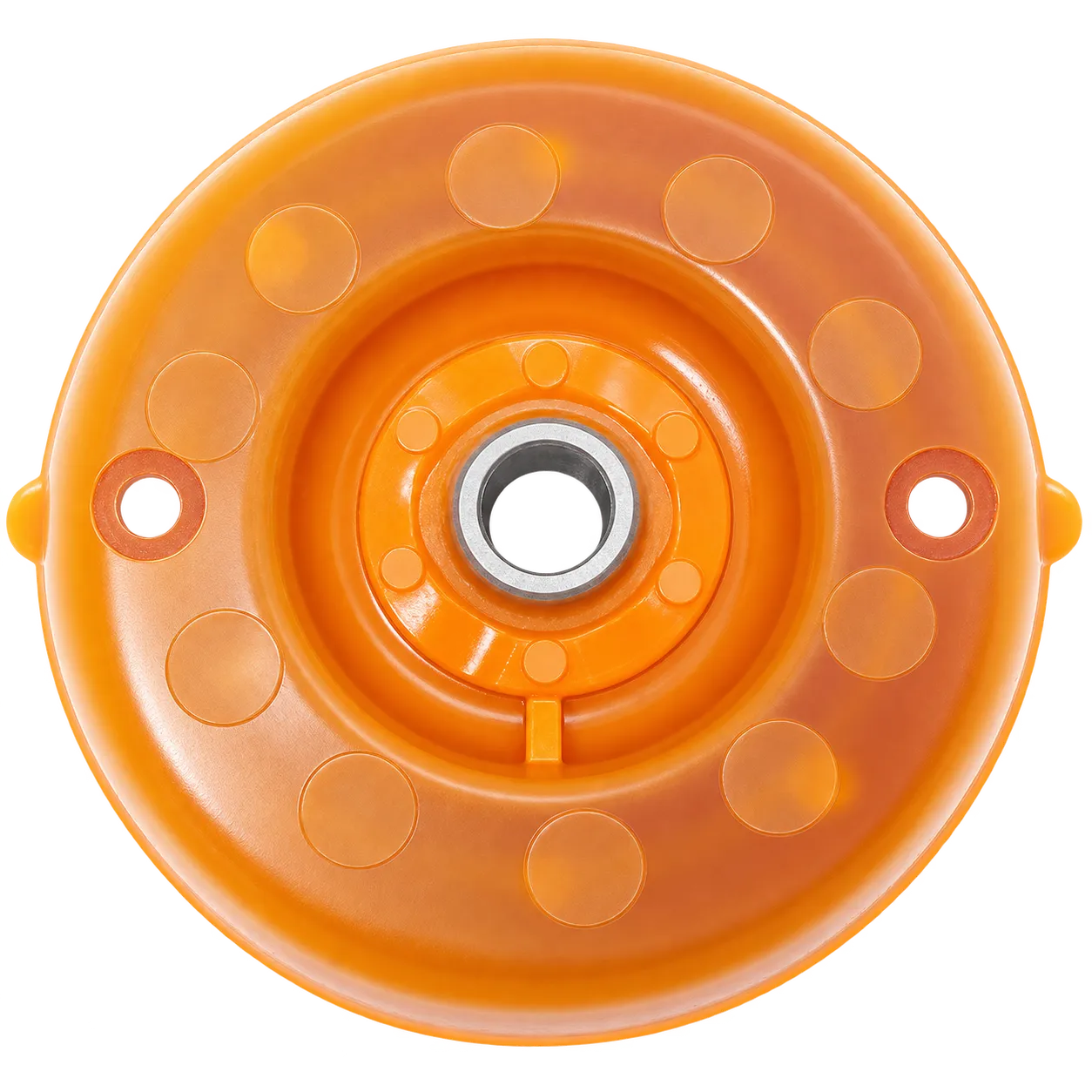
A front strut mount is the upper joint that ties the strut to the body: it holds the rod, takes the load and impacts coming from the wheel, and carries the strut as it turns with the steering. PolyPro casts these mounts from polyurethane for passenger cars, vans and commercial vehicles, where the factory rubber collapses within a season. The rest of the suspension parts sit in the catalogue, and the Shore hardness is listed on every product page.
The front strut mount sits at the top of the strut, between the body tower and the damper rod. All vertical load from the wheel passes through it into the tower, together with vibration and road impacts. Because the front strut rotates with the steering, the assembly usually includes a bearing or a sliding washer: the spring and damper turn, while the seat in the body stays fixed.
The polyurethane element works as an elastic joint. It takes axial compression from the rod, damps high-frequency vibration and limits lateral movement of the strut top, which is what shifts camber and caster over time. The mount works together with the bump stops: once a bump stop breaks up, the mount takes the hits directly and fails much sooner.
A mount wears out gradually, so its knocking is often blamed on the sway bar links or the steering rack. The simplest check is to rock the car and put a palm on the strut tower: the impact and the clicks can be felt by hand.
Mounts are checked in pairs: if one side has sagged, the other has run the same mileage. Inspect the boot and the bump stop at the same time, as dirt on the rod speeds up wear of the whole assembly.
A stock rubber mount is soft and quiet, but it ages under ozone, oils and temperature cycling: after a few seasons the elastic element sags, the rod shifts and every pothole produces a knock. Polyurethane has higher tear resistance and lower permanent set, so it holds the geometry of the strut top for longer and does not creep away under constant axial load.
The trade-off is a firmer path for small vibrations into the body, more noticeable on cold surfaces. Hardness is therefore chosen for the job: a softer grade for daily city driving, a firmer one for loaded commercial vehicles or broken roads. Polyurethane also resists oil and road chemicals, so the element does not swell or wash out over the winter.
A mount is selected by the dimensions and the design of the assembly, not by the car badge. Remove the old part before ordering and write down a few figures.
With a caliper, measure the outer diameter of the elastic element, the diameter of the central bore for the damper rod, the thickness of the mount along its axis, and the bolt circle diameter together with the number of studs. Check separately whether the mount has a recess for the bearing and how deep it is. These figures are then compared with the data on the product pages. If the old part is destroyed and nothing can be measured on it, use the mount from the opposite side, which is normally less worn. Take the measurements on a cleaned part: leftovers of old rubber and dirt shift the figures by a few millimetres, and at the strut top that matters.
Strut tops differ in layout: in some the elastic element is pressed into a steel cup, in others it is a separate pad with washers, and in others again the mount comes paired with a bearing or a sliding washer. The type decides how the part seats on the rod and whether it carries the spring. Check as well whether the mount carries the top spring coil itself or whether a separate plate sits in between, and whether the assembly includes a compression buffer: that decides how many parts are ordered together with the elastic element. Front and rear mounts are not interchangeable: the rear axle uses a different design, listed under rear shock mount.
Polyurethane hardness sets the balance between ride comfort and steering precision. A softer grade is closer to factory rubber in noise and vibration, while a firmer one holds the geometry of the strut top under load and sags later, at the cost of passing small road texture into the body more clearly. Daily city use calls for the softer option; loaded commercial vehicles, towing or rough roads call for the firmer one. The Shore value is listed on every product page. If the car feels harsh after the swap, the cause is more often a broken bump stop or a tired damper working alongside it than the material itself.
Take the duty cycle into account: constant payload, a trailer, gravel roads and winter chemicals all shorten the life of the strut top, so a margin in hardness makes sense there. If the mount you need is not among the standard items, or the part comes off rare or heavy-duty machinery, PolyPro makes it from a drawing, a sample or the worn part itself, starting from a single piece. A custom order needs the same dimensions as a standard one, plus the worn part itself or a photo of it next to a ruler, so that the profile and the height of the element can be reproduced. Such items are handled through the custom-made parts section.
PolyPro is a manufacturer, not a reseller: molds, casting, dimensional control and shipping all happen at our own site, with no middlemen between the shop floor and the buyer. That is why a mount can be bought as a single piece at retail, and why a part missing from the standard range can be made from a drawing, a sample or a worn original. The products are covered by warranty, with delivery across Ukraine and international shipping.
Wholesale supply goes to garages, auto parts shops, vehicle fleets and resellers. The partner programme opens access to prices and stock levels, bonuses for turnover or single order volume, and shipping under the partner's own brand.
Yes, that is the basic rule for strut tops. Both mounts have covered the same mileage, so once one side is replaced the other will sag shortly after and the knocking comes back. On top of that, different hardness left and right gives a different strut top height, and that shows up in the wheel alignment figures.
It depends on the design of the specific assembly: on some cars the bearing is pressed into the mount itself, on others it sits above the spring as a separate part. PolyPro makes the polyurethane elastic element of the mount, so check the contents on the product page and compare them with the part you removed before ordering.
The rod starts to move at the top point, which increases the load on the damper itself, on its seal and on the body tower. The result is knocking, steering wheel shake, wheel angles out of spec and faster tyre wear. Left long enough, the seat in the tower gets damaged, and that repair costs far more than a new mount.
No. The front assembly is built for a strut that turns and has its own mounting dimensions, while the rear one works mainly in compression and has a different geometry. Even when the parts look similar, the rod bore, the axial thickness and the fixing pattern differ, so the mount has to be chosen for its own axle.
Yes, the wheel angles should be checked. The strut top defines camber and caster, and a worn mount will usually have shifted both. Once a new elastic element is fitted, the geometry returns to its designed position, so the previous alignment settings no longer match where the strut actually sits.
Polyurethane is firmer than aged rubber, so small road irregularities come through more clearly, especially in cold weather and on broken surfaces. How much depends on the hardness chosen: softer grades feel close to the factory parts, firmer ones are taken for loaded duty where stable geometry matters more.
Yes, retail here is per piece: one part can be ordered without taking a full set. Custom work is handled the same way, from a single piece, made to a drawing, a sample or the worn part you send in. Delivery covers Ukraine and international destinations, the products carry a warranty, and the Shore hardness is listed on every product page.
Wholesale orders are shipped to service garages, auto parts shops, vehicle fleets and resellers directly from production. The partner programme opens access to prices and stock levels, bonuses for turnover or single order volume, and shipping under the partner's own brand.