

SKU: PP202602
Polyurethane C-pillar Support Audi 80 1991-1995
In stock15 pcs.$44.29Log in as dealer

Polyurethane C-pillar Support Audi 80 1991-1995
In stock15 pcs.
Polyurethane C-pillar Support Audi 80 1991-1995 HARDNESS
In stock15 pcs.
Polyurethane C-pillar Support Audi 80 1991-1995 HARDNESS RECONSTRUCTION OF YOUR
In stock15 pcs.
Polyurethane C-pillar Support Audi 80 1991-1995 RECONSTRUCTION OF YOUR
In stock15 pcs.Polyurethane C-pillar Support Audi A1 2010-2018
In stock15 pcs.Polyurethane C-pillar Support Audi A1 2010-2018 HARDNESS
In stock15 pcs.Polyurethane C-pillar Support Audi A1 2010-2018 HARDNESS RECONSTRUCTION OF YOUR
In stock15 pcs.Polyurethane C-pillar Support Audi A1 2010-2018 RECONSTRUCTION OF YOUR
In stock15 pcs.Polyurethane C-pillar Support Audi A2 1999-2005
In stock15 pcs.Polyurethane C-pillar Support Audi A2 1999-2005 HARDNESS
In stock15 pcs.Polyurethane C-pillar Support Audi A2 1999-2005 HARDNESS RECONSTRUCTION OF YOUR
In stock15 pcs.Polyurethane C-pillar Support Audi A2 1999-2005 RECONSTRUCTION OF YOUR
In stock15 pcs.Polyurethane C-pillar Support Audi A3 1996-2006
In stock15 pcs.Polyurethane C-pillar Support Audi A3 1996-2006 HARDNESS
In stock15 pcs.Polyurethane C-pillar Support Audi A3 1996-2006 HARDNESS RECONSTRUCTION OF YOUR
In stock15 pcs.Polyurethane C-pillar Support Audi A3 1996-2006 RECONSTRUCTION OF YOUR
In stock15 pcs.Polyurethane C-pillar Support Audi A3 2003-2012
In stock15 pcs.Polyurethane C-pillar Support Audi A3 2003-2012 HARDNESS
In stock15 pcs.Polyurethane C-pillar Support Audi A3 2003-2012 HARDNESS RECONSTRUCTION OF YOUR
In stock15 pcs.Polyurethane C-pillar Support Audi A3 2003-2012 RECONSTRUCTION OF YOUR
In stock15 pcs.Polyurethane C-pillar Support Audi A4 2007-2015
In stock15 pcs.Polyurethane C-pillar Support Audi A4 2007-2015 HARDNESS
In stock15 pcs.Polyurethane C-pillar Support Audi A4 2007-2015 HARDNESS RECONSTRUCTION OF YOUR
In stock15 pcs.Polyurethane C-pillar Support Audi A4 2007-2015 RECONSTRUCTION OF YOUR
In stock15 pcs.Polyurethane C-pillar Support Audi A5 2007-2016
In stock15 pcs.Polyurethane C-pillar Support Audi A5 2007-2016 HARDNESS
In stock15 pcs.Polyurethane C-pillar Support Audi A5 2007-2016 HARDNESS RECONSTRUCTION OF YOUR
In stock15 pcs.Polyurethane C-pillar Support Audi A5 2007-2016 RECONSTRUCTION OF YOUR
In stock15 pcs.Polyurethane C-pillar Support Audi Q5 2008-2018
In stock15 pcs.Polyurethane C-pillar Support Audi Q5 2008-2018 HARDNESS
In stock15 pcs.Polyurethane C-pillar Support Audi Q5 2008-2018 HARDNESS RECONSTRUCTION OF YOUR
In stock15 pcs.Polyurethane C-pillar Support Audi Q5 2008-2018 RECONSTRUCTION OF YOUR
In stock15 pcs.Polyurethane C-pillar Support Audi TT 1998-2006
In stock15 pcs.Polyurethane C-pillar Support Audi TT 1998-2006 HARDNESS
In stock15 pcs.Polyurethane C-pillar Support Audi TT 1998-2006 HARDNESS RECONSTRUCTION OF YOUR
In stock15 pcs.Polyurethane C-pillar Support Audi TT 1998-2006 RECONSTRUCTION OF YOUR
In stock15 pcs.Polyurethane C-pillar Support Seat Cordoba 1993-2002
In stock15 pcs.Polyurethane C-pillar Support Seat Cordoba 1993-2002 HARDNESS
In stock15 pcs.Polyurethane C-pillar Support Seat Cordoba 1993-2002 HARDNESS RECONSTRUCTION OF YOUR
In stock15 pcs.Polyurethane C-pillar Support Seat Cordoba 1993-2002 RECONSTRUCTION OF YOUR
In stock15 pcs.Polyurethane C-pillar Support Seat Cordoba 2002-2008
In stock15 pcs.Polyurethane C-pillar Support Seat Cordoba 2002-2008 HARDNESS
In stock15 pcs.Polyurethane C-pillar Support Seat Cordoba 2002-2008 HARDNESS RECONSTRUCTION OF YOUR
In stock15 pcs.Polyurethane C-pillar Support Seat Cordoba 2002-2008 RECONSTRUCTION OF YOUR
In stock15 pcs.Polyurethane C-pillar Support Seat Ibiza 1993-2002
In stock15 pcs.Polyurethane C-pillar Support Seat Ibiza 1993-2002 HARDNESS
In stock15 pcs.Polyurethane C-pillar Support Seat Ibiza 1993-2002 HARDNESS RECONSTRUCTION OF YOUR
In stock15 pcs.Polyurethane C-pillar Support Seat Ibiza 1993-2002 RECONSTRUCTION OF YOUR
In stock15 pcs.Polyurethane C-pillar Support Seat Ibiza 2002-2008
In stock15 pcs.Polyurethane C-pillar Support Seat Ibiza 2002-2008 HARDNESS
In stock15 pcs.Polyurethane C-pillar Support Seat Ibiza 2002-2008 HARDNESS RECONSTRUCTION OF YOUR
In stock15 pcs.Polyurethane C-pillar Support Seat Ibiza 2002-2008 RECONSTRUCTION OF YOUR
In stock15 pcs.Polyurethane C-pillar Support Seat Ibiza 2008-2017
In stock15 pcs.Polyurethane C-pillar Support Seat Ibiza 2008-2017 HARDNESS
In stock15 pcs.Polyurethane C-pillar Support Seat Ibiza 2008-2017 HARDNESS RECONSTRUCTION OF YOUR
In stock15 pcs.Polyurethane C-pillar Support Seat Ibiza 2008-2017 RECONSTRUCTION OF YOUR
In stock15 pcs.Polyurethane C-pillar Support Seat Leon 1998-2006
In stock15 pcs.Polyurethane C-pillar Support Seat Leon 1998-2006 HARDNESS
In stock15 pcs.Polyurethane C-pillar Support Seat Leon 1998-2006 HARDNESS RECONSTRUCTION OF YOUR
In stock15 pcs.Polyurethane C-pillar Support Seat Leon 1998-2006 RECONSTRUCTION OF YOUR
In stock15 pcs.Polyurethane C-pillar Support Seat Leon 2005-2012
In stock15 pcs.Polyurethane C-pillar Support Seat Leon 2005-2012 HARDNESS
In stock15 pcs.Polyurethane C-pillar Support Seat Leon 2005-2012 HARDNESS RECONSTRUCTION OF YOUR
In stock15 pcs.Polyurethane C-pillar Support Seat Leon 2005-2012 RECONSTRUCTION OF YOUR
In stock15 pcs.Polyurethane C-pillar Support Seat Toledo 1991-1999
In stock15 pcs.Polyurethane C-pillar Support Seat Toledo 1991-1999 HARDNESS
In stock15 pcs.Polyurethane C-pillar Support Seat Toledo 1991-1999 HARDNESS RECONSTRUCTION OF YOUR
In stock15 pcs.Polyurethane C-pillar Support Seat Toledo 1991-1999 RECONSTRUCTION OF YOUR
In stock15 pcs.Polyurethane C-pillar Support Seat Toledo 1999-2004
In stock15 pcs.Polyurethane C-pillar Support Seat Toledo 1999-2004 HARDNESS
In stock15 pcs.Polyurethane C-pillar Support Seat Toledo 1999-2004 HARDNESS RECONSTRUCTION OF YOUR
In stock15 pcs.Polyurethane C-pillar Support Seat Toledo 1999-2004 RECONSTRUCTION OF YOUR
In stock15 pcs.Polyurethane C-pillar Support Seat Toledo 2004-2009
In stock15 pcs.Polyurethane C-pillar Support Seat Toledo 2004-2009 HARDNESS
In stock15 pcs.Polyurethane C-pillar Support Seat Toledo 2004-2009 HARDNESS RECONSTRUCTION OF YOUR
In stock15 pcs.Polyurethane C-pillar Support Seat Toledo 2004-2009 RECONSTRUCTION OF YOUR
In stock15 pcs.Polyurethane C-pillar Support Seat Toledo 2012-
In stock15 pcs.Polyurethane C-pillar Support Seat Toledo 2012- HARDNESS
In stock15 pcs.Polyurethane C-pillar Support Seat Toledo 2012- HARDNESS RECONSTRUCTION OF YOUR
In stock15 pcs.Polyurethane C-pillar Support Seat Toledo 2012- RECONSTRUCTION OF YOUR
In stock15 pcs.Polyurethane C-pillar Support Skoda Fabia 1999-2007
In stock15 pcs.Polyurethane C-pillar Support Skoda Fabia 1999-2007 HARDNESS
In stock15 pcs.Polyurethane C-pillar Support Skoda Fabia 1999-2007 HARDNESS RECONSTRUCTION OF YOUR
In stock15 pcs.Polyurethane C-pillar Support Skoda Fabia 1999-2007 RECONSTRUCTION OF YOUR
In stock15 pcs.Polyurethane C-pillar Support Skoda Fabia 2007-2014
In stock15 pcs.Polyurethane C-pillar Support Skoda Fabia 2007-2014 HARDNESS
In stock15 pcs.Polyurethane C-pillar Support Skoda Fabia 2007-2014 HARDNESS RECONSTRUCTION OF YOUR
In stock15 pcs.Polyurethane C-pillar Support Skoda Fabia 2007-2014 RECONSTRUCTION OF YOUR
In stock15 pcs.Polyurethane C-pillar Support Skoda Fabia 2014-
In stock15 pcs.Polyurethane C-pillar Support Skoda Fabia 2014- HARDNESS
In stock15 pcs.Polyurethane C-pillar Support Skoda Fabia 2014- HARDNESS RECONSTRUCTION OF YOUR
In stock15 pcs.Polyurethane C-pillar Support Skoda Fabia 2014- RECONSTRUCTION OF YOUR
In stock15 pcs.Polyurethane C-pillar Support Skoda Octavia 2004-2010
In stock15 pcs.Polyurethane C-pillar Support Skoda Octavia 2004-2010 HARDNESS
In stock15 pcs.Polyurethane C-pillar Support Skoda Octavia 2004-2010 HARDNESS RECONSTRUCTION OF YOUR
In stock15 pcs.Polyurethane C-pillar Support Skoda Octavia 2004-2010 RECONSTRUCTION OF YOUR
In stock15 pcs.Polyurethane C-pillar Support Skoda Rapid 2012-
In stock15 pcs.Polyurethane C-pillar Support Skoda Rapid 2012- HARDNESS
In stock15 pcs.Polyurethane C-pillar Support Skoda Rapid 2012- HARDNESS RECONSTRUCTION OF YOUR
In stock15 pcs.Polyurethane C-pillar Support Skoda Rapid 2012- RECONSTRUCTION OF YOUR
In stock15 pcs.Polyurethane C-pillar Support Skoda Roomster 2006-2015
In stock15 pcs.Polyurethane C-pillar Support Skoda Roomster 2006-2015 HARDNESS
In stock15 pcs.Polyurethane C-pillar Support Skoda Roomster 2006-2015 HARDNESS RECONSTRUCTION OF YOUR
In stock15 pcs.Polyurethane C-pillar Support Skoda Roomster 2006-2015 RECONSTRUCTION OF YOUR
In stock15 pcs.Polyurethane C-pillar Support Volkswagen Bora 1998-2005
In stock15 pcs.Polyurethane C-pillar Support Volkswagen Bora 1998-2005 HARDNESS
In stock15 pcs.Polyurethane C-pillar Support Volkswagen Bora 1998-2005 HARDNESS RECONSTRUCTION OF YOUR
In stock15 pcs.Polyurethane C-pillar Support Volkswagen Bora 1998-2005 RECONSTRUCTION OF YOUR
In stock15 pcs.Polyurethane C-pillar Support Volkswagen Fox 2003-2014
In stock15 pcs.Polyurethane C-pillar Support Volkswagen Fox 2003-2014 HARDNESS
In stock15 pcs.Polyurethane C-pillar Support Volkswagen Fox 2003-2014 HARDNESS RECONSTRUCTION OF YOUR
In stock15 pcs.Polyurethane C-pillar Support Volkswagen Fox 2003-2014 RECONSTRUCTION OF YOUR
In stock15 pcs.Polyurethane C-pillar Support Volkswagen Golf 1991-1998
In stock15 pcs.Polyurethane C-pillar Support Volkswagen Golf 1991-1998 HARDNESS
In stock15 pcs.Polyurethane C-pillar Support Volkswagen Golf 1991-1998 HARDNESS RECONSTRUCTION OF YOUR
In stock15 pcs.Polyurethane C-pillar Support Volkswagen Golf 1991-1998 RECONSTRUCTION OF YOUR
In stock15 pcs.Polyurethane C-pillar Support Volkswagen Golf 1997-2003
In stock15 pcs.Polyurethane C-pillar Support Volkswagen Golf 1997-2003 HARDNESS
In stock15 pcs.Polyurethane C-pillar Support Volkswagen Golf 1997-2003 HARDNESS RECONSTRUCTION OF YOUR
In stock15 pcs.Polyurethane C-pillar Support Volkswagen Golf 1997-2003 RECONSTRUCTION OF YOUR
In stock15 pcs.Polyurethane C-pillar Support Volkswagen Golf 2008-2012
In stock15 pcs.Polyurethane C-pillar Support Volkswagen Golf 2008-2012 HARDNESS
In stock15 pcs.Polyurethane C-pillar Support Volkswagen Golf 2008-2012 HARDNESS RECONSTRUCTION OF YOUR
In stock15 pcs.Polyurethane C-pillar Support Volkswagen Golf 2008-2012 RECONSTRUCTION OF YOUR
In stock15 pcs.Polyurethane C-pillar Support Volkswagen New Beetle 1998-2010
In stock15 pcs.Polyurethane C-pillar Support Volkswagen New Beetle 1998-2010 HARDNESS
In stock15 pcs.Polyurethane C-pillar Support Volkswagen New Beetle 1998-2010 HARDNESS RECONSTRUCTION OF YOUR
In stock15 pcs.Polyurethane C-pillar Support Volkswagen New Beetle 1998-2010 RECONSTRUCTION OF YOUR
In stock15 pcs.Polyurethane C-pillar Support Volkswagen Passat 2005-2010
In stock15 pcs.Polyurethane C-pillar Support Volkswagen Passat 2005-2010 HARDNESS
In stock15 pcs.Polyurethane C-pillar Support Volkswagen Passat 2005-2010 HARDNESS RECONSTRUCTION OF YOUR
In stock15 pcs.Polyurethane C-pillar Support Volkswagen Passat 2005-2010 RECONSTRUCTION OF YOUR
In stock15 pcs.Polyurethane C-pillar Support Volkswagen Polo 1994-2001
In stock15 pcs.Polyurethane C-pillar Support Volkswagen Polo 1994-2001 HARDNESS
In stock15 pcs.Polyurethane C-pillar Support Volkswagen Polo 1994-2001 HARDNESS RECONSTRUCTION OF YOUR
In stock15 pcs.Polyurethane C-pillar Support Volkswagen Polo 1994-2001 RECONSTRUCTION OF YOUR
In stock15 pcs.Polyurethane C-pillar Support Volkswagen Polo 2001-2009
In stock15 pcs.Polyurethane C-pillar Support Volkswagen Polo 2001-2009 HARDNESS
In stock15 pcs.Polyurethane C-pillar Support Volkswagen Polo 2001-2009 HARDNESS RECONSTRUCTION OF YOUR
In stock15 pcs.Polyurethane C-pillar Support Volkswagen Polo 2001-2009 RECONSTRUCTION OF YOUR
In stock15 pcs.Polyurethane C-pillar Support Volkswagen Polo 2009-
In stock15 pcs.Polyurethane C-pillar Support Volkswagen Polo 2009- HARDNESS
In stock15 pcs.Polyurethane C-pillar Support Volkswagen Polo 2009- HARDNESS RECONSTRUCTION OF YOUR
In stock15 pcs.Polyurethane C-pillar Support Volkswagen Polo 2009- RECONSTRUCTION OF YOUR
In stock15 pcs.
Polyurethane rear shock absorber support Alfa Romeo 164 1987-1998
In stock15 pcs.
Polyurethane rear shock absorber support Alfa Romeo 164 1987-1998
In stock15 pcs.
Polyurethane rear shock absorber support Alfa Romeo 164 1987-1998 RECONSTRUCTION OF YOUR
In stock15 pcs.
Polyurethane rear shock absorber support Alfa Romeo 164 1987-1998 RECONSTRUCTION OF YOUR
In stock15 pcs.
Polyurethane rear shock absorber support Audi 100 1990-1994
In stock15 pcs.Polyurethane rear shock absorber support Audi 200 1983-1991
In stock15 pcs.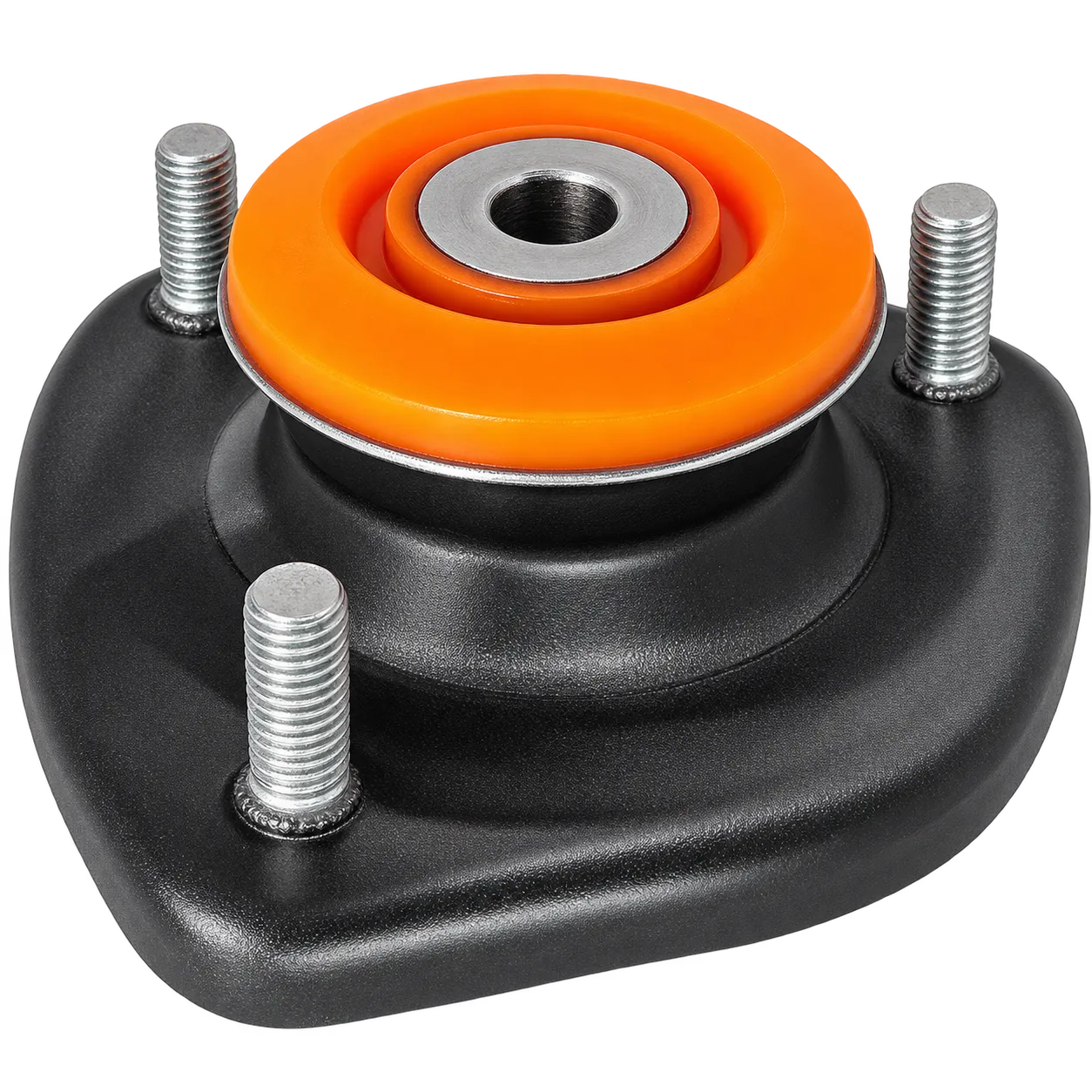
A rear shock mount is the joint through which the damper of the rear axle rests against the body or the beam. Unlike the front one, it does not carry a turning strut: it works mainly in compression, absorbs impacts from the road and keeps rear axle rumble out of the cabin. PolyPro casts these mounts from polyurethane for cars, vans and trailers, where the factory pad tires out under constant compression. The rest of the suspension sits in the catalogue.
A rear damper does not turn with the wheel, so a bearing is normally not needed here. The upper point is fixed either by a through rod running between pads and washers, or by an eye with a pressed-in bushing. The elastic element is clamped between the body and the rod nut: it takes axial compression on every suspension stroke, absorbs impacts and breaks the path of vibration from the axle into the body.
That gives the rear mount a different duty cycle from the front one: fewer alternating loads from steering, but more direct hits with a loaded boot, a trailer or on gravel. The assembly is held together with the shock absorber bushing as well, and a worn bushing produces the same knock, so the whole joint is inspected at once.
A knock from the rear is usually blamed on the dampers or the springs, though a collapsed mount is often the real cause. The telling detail is that the noise grows with a loaded boot and disappears when the car runs empty on smooth tarmac.
Both sides are checked together, since the mounts have run the same mileage. Inspect the bump stop and the boot as well, because without them the rod and the mount take impacts directly.
The stock rubber pad of a rear mount is soft but tires quickly: it works in compression on every suspension stroke, and under constant load it takes a permanent set. Once the pad has sagged it no longer holds the rod on its axis, and instead of absorbing the impact the joint starts passing it on. Polyurethane takes less permanent set, so the mounting geometry holds for longer.
The downside is that small vibrations reach the body more audibly, and at the rear this shows up more, since there is less sound insulation than at the bulkhead. Hardness is therefore matched to the load: a softer grade for a car without a permanent payload, a firmer one for a van, a trailer or daily driving with cargo. Polyurethane also resists oil and road chemicals, so the element does not swell.
Selection runs by the mounting layout and the fitting dimensions, not by the car badge. Remove the old part and write down the figures before ordering.
With a caliper, measure the outer diameter of the pad, the diameter of the bore for the rod or the pin, the height of the element along its axis, and the diameter of the washer that clamps it. If the mount sits in the damper eye, the inner diameter of the sleeve and the length of the bushing are needed as well. These figures are compared with the product pages. When the old part has crumbled away, take the dimensions from the opposite side of the car or from the seat in the body. Measure a cleaned part, since leftovers of old rubber add a couple of millimetres, and a photo of the mount next to a ruler makes the comparison with the product page easier.
Rear dampers are fixed in several ways: a through rod running between two pads and washers, a single-sided joint with a buffer, or an eye with a pressed-in bushing on a bolt. The layout decides both the shape of the element and how many parts the kit contains. Count as well how many elastic elements and washers the joint uses on each side: a through-rod layout needs a pair of pads per damper, while an eye with a bushing needs one pressed-in part. That settles how many items go into an order for the axle. A front mount does not belong here, as it is built for a turning strut, and it is listed under front strut mount.
Polyurethane hardness sets how much of the impact from the rear axle reaches the body. A softer grade is closer to factory rubber in noise, a firmer one holds the rod on its axis under load and resists sagging, at the cost of passing small road texture into the floor and the boot more clearly. A car without a permanent payload calls for the softer option; loaded commercial vehicles and trailers call for the firmer one. The Shore value is listed on the product page. If the car mostly runs empty, extra hardness brings nothing here: the joint will simply pass every expansion joint into the floor without any gain in service life.
Account for the duty cycle: permanent cargo, towing a trailer, gravel roads and road chemicals all shorten the life of a rear mount, so a margin in hardness is reasonable there. If the size you need is not among the standard items, or the part comes off a trailer or heavy-duty machinery, PolyPro makes it from a drawing, a sample or the worn part, starting from a single piece. Such an order needs the dimensions of the removed mount, or the part itself, so that the profile, the height and the rod bore can be reproduced. The same applies when a standard item fits dimensionally but a different hardness is required. It is handled through the custom-made parts section.
We are the manufacturer: our own molds, casting shop, dimensional control and shipping, with no middlemen in between. That has two practical consequences. First, a mount can be bought per piece, even when only one side needs a new part. Second, a non-standard size that is missing from the regular range is made from a drawing, a sample or the worn part, starting from a single piece. The products carry a warranty, with delivery across Ukraine and international shipping.
Wholesale shipments go to service garages, auto parts shops, vehicle fleets and resellers. The partner programme gives access to prices and stock levels, bonuses for turnover or single order volume, and shipping under the partner's own brand.
As a rule, no. The rear damper does not turn with the wheel, so no bearing is needed at the top point: the joint works in compression and absorbs impacts. The exception is a handful of layouts with rear struts, where the design is closer to the front one, so compare the part you removed with the product page before ordering.
An empty car rarely reaches the long suspension strokes, so a sagged mount still works without bottoming out. With load in the boot or a trailer behind, the suspension goes deeper into compression, the elastic element is squeezed fully, and the rod strikes the body through what is left of the pad. That is a classic sign of a worn top mount.
Yes. Both mounts have covered the same mileage under the same load, so once one side is replaced the other becomes the next to sag. Different element heights left and right misalign the upper mounting point, and that speeds up wear of the damper seal on whichever side has settled further.
No. The front assembly is built for a turning strut, with a different profile, different fitting dimensions and often a recess for the bearing. The rear mount works mainly in compression and uses its own layout: a through rod, a buffer or an eye with a bushing. Selection has to follow the axle and the mounting layout.
The condition of the damper itself, the bump stop and the rod boot, plus the bushings of the lower mounting point. A broken bump stop passes impacts straight into the mount, a torn boot lets dirt onto the rod, and a worn lower bushing produces the same knock. A new mount surrounded by worn parts will last less than it could.
Small road irregularities come through more clearly than they would with new factory rubber, and at the rear it is more noticeable because there is less sound insulation. How much depends on the hardness chosen: softer grades feel close to stock, firmer ones are taken for cargo and towing, where keeping the joint from sagging matters more.
Yes, retail here is per piece: take one part, a full set is not required. Custom work to a drawing, a sample or a worn original is handled the same way, from a single piece. Delivery covers Ukraine and international destinations, the products carry a warranty, and the Shore hardness is listed on every product page, so it does not have to be guessed.
Wholesale supply goes to service garages, auto parts shops, vehicle fleets and resellers, shipped directly from production. The partner programme opens access to prices and stock levels, bonuses for turnover or single order volume, and shipping under the partner's own brand.