SKU: PP301479
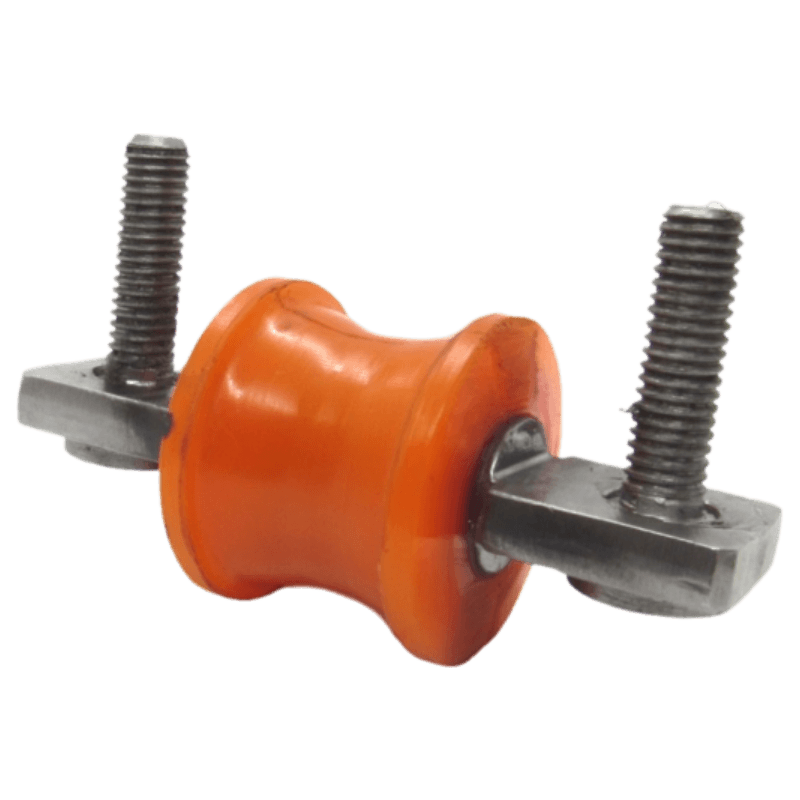
Polyurethane bushing front shock absorber Fox with plate Jeep Grand Cherokee 1998-2004
In stock15 pcs.$25.28Log in as dealer
1 EUR = 51,06 грн1 USD = 43,12 грн

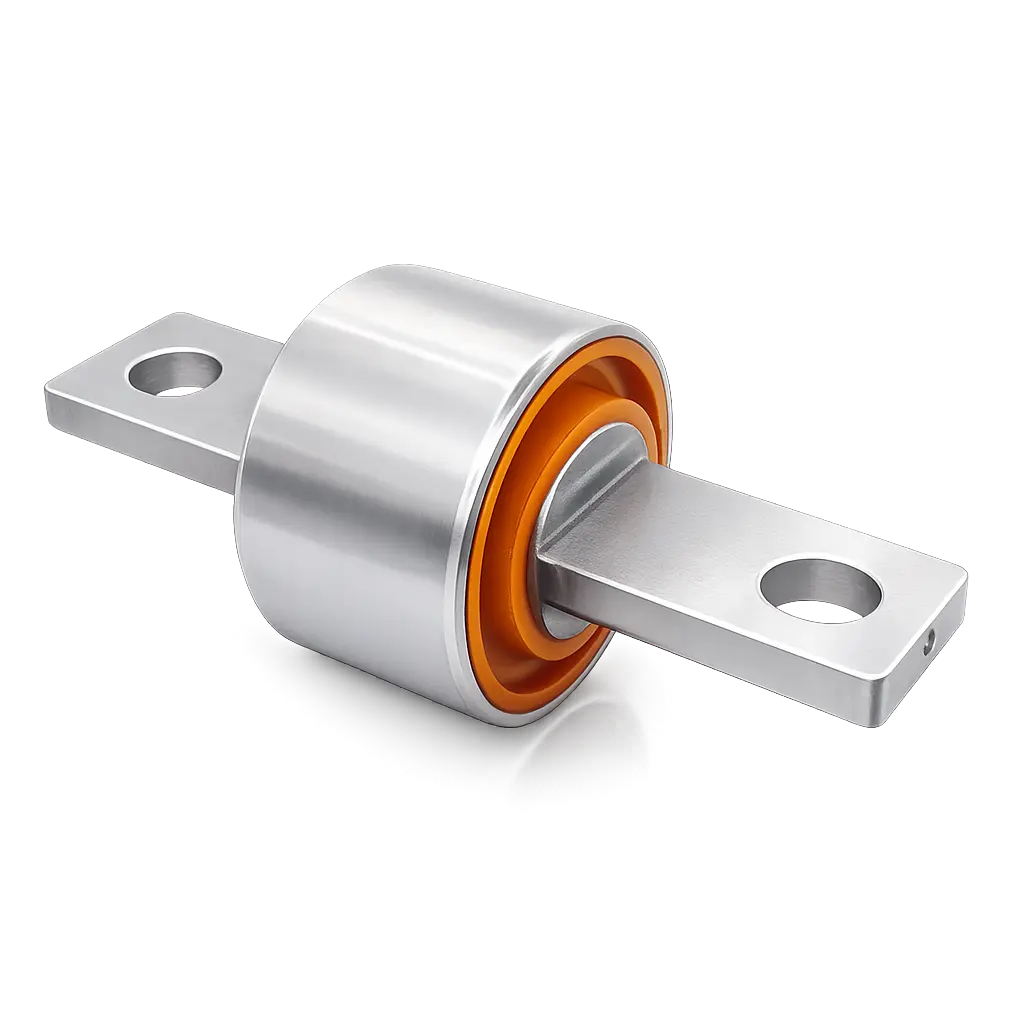
A polyurethane bushing with an inner plate has a steel plate bonded inside the urethane body. The plate spreads load across the element and gives the part a rigid bolt-through mounting point, so one bushing carries both the weight of the assembly and its torque. The design is used in engine and transmission mounts, torque rods and rear beam mounts — see the full range in our polyurethane parts catalog.
The general principle is covered on the bushings without outer shell page: an elastic element between two parts lets the joint rotate through a small angle without metal-on-metal contact. Here we cover the difference.
The steel plate runs through the urethane, bonded across the full contact area. It never slides against the element, so this is not a plain bearing: the urethane deforms while the plate sets the direction of that deformation and limits travel. The part works in two modes at once — in torsion, around the bolt axis, and in shear, along the plate. That combination separates it from an ordinary bushing, loaded mostly in torsion.
A powertrain mount carries the weight of the engine and takes reaction torque under launch and engine braking — force running along the mount, not around its axis. Without the plate, urethane of that thickness would sag and let the assembly move vertically. Complete units are listed under engine, transmission and differential mounts.
The second group is any arm or rod taking longitudinal load. In truck and body-on-frame torque rods the part works in shear under acceleration and braking, and the plate keeps the element from creeping out of its bracket. In rear beam and subframe mounts it holds the axle in plane, so the rear end doesn't steer itself.
Wear rarely starts with visible cracks: the element loses preload around the plate, free play appears, and the joint starts passing road input into the body. To check a mount, have someone shift D–R–D with the brakes on and watch the engine: a visible lurch means the mount has failed.
The factory part has one weak spot: the bond line between rubber and steel. That is where it fails — the rubber separates from the plate, play appears and the joint knocks while the part still looks intact from outside. Polyurethane has no such failure mode: it works in compression, does not swell in oil, does not harden in the cold and keeps its bond to the plate. A quality polyurethane bushing lasts 100,000–150,000 km, three to five times longer than rubber.
Two things change in use: vibration doesn't increase with mileage, and the geometry holds under load — the beam keeps its angles, the engine doesn't hit its bracket over bumps. The trade-off is slightly more idle vibration, barely noticeable in standard durometer.
A steel plate bonded inside the element means this category. An element in a solid steel sleeve pressed in as one piece is a bushing with outer shell; a lip on that sleeve means the flanged version, and no metal at all means the shell-less version. They are not interchangeable: a plate-type part bolts through the plate instead of being pressed in. Measure the body, plate thickness and offset, hole size and center distance.
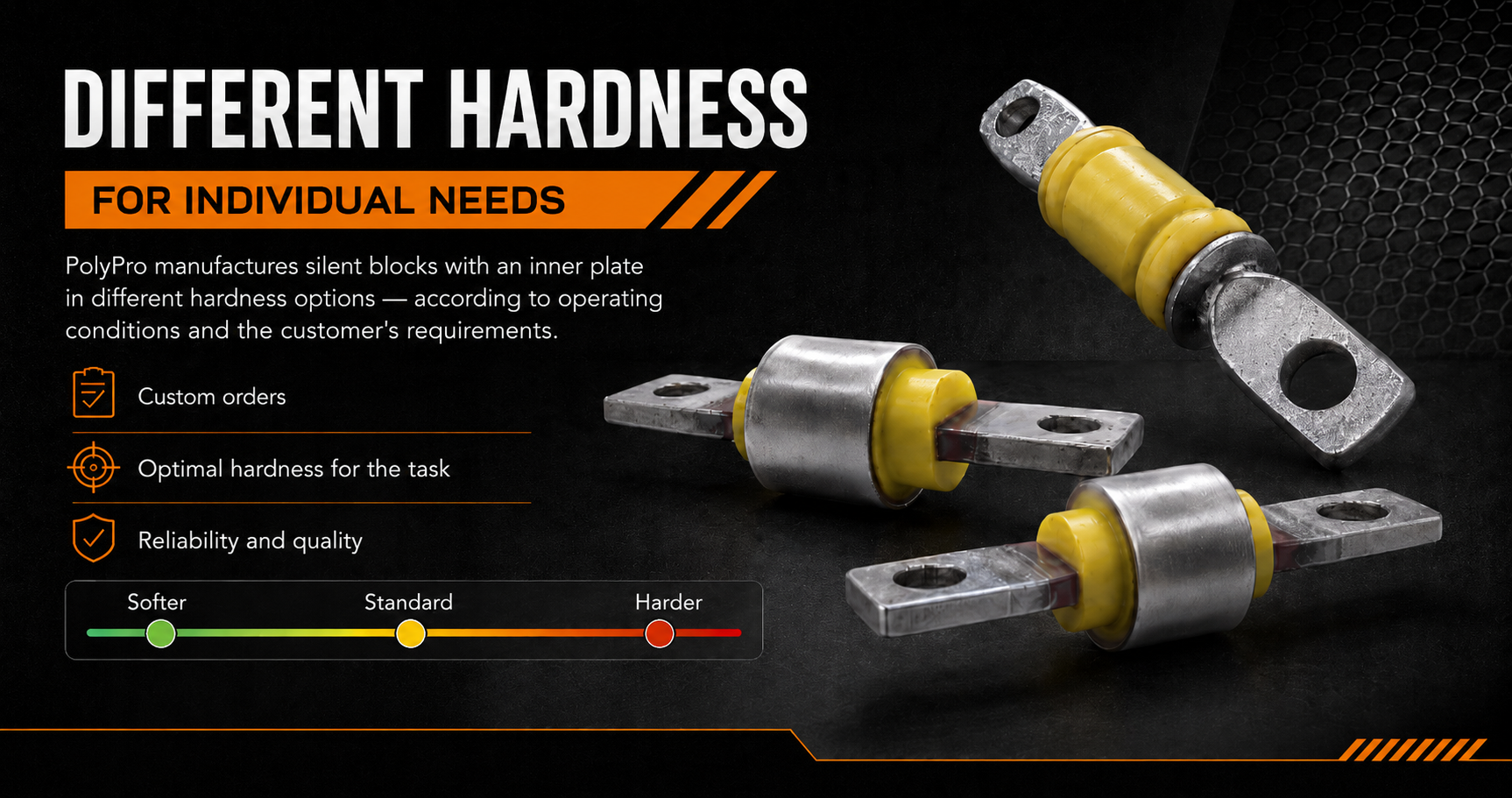
Standard durometer suits daily driving: comfort close to rubber, several times the service life. Choose the stiffer grade for a loaded vehicle, towing, off-road use or a built engine — the assembly is held tighter, but idle vibration is more noticeable.
Replace the part when the element is cracked or collapsed or a knock appears over bumps. Torque the bolts with the assembly loaded. Durometer is listed on every product page.
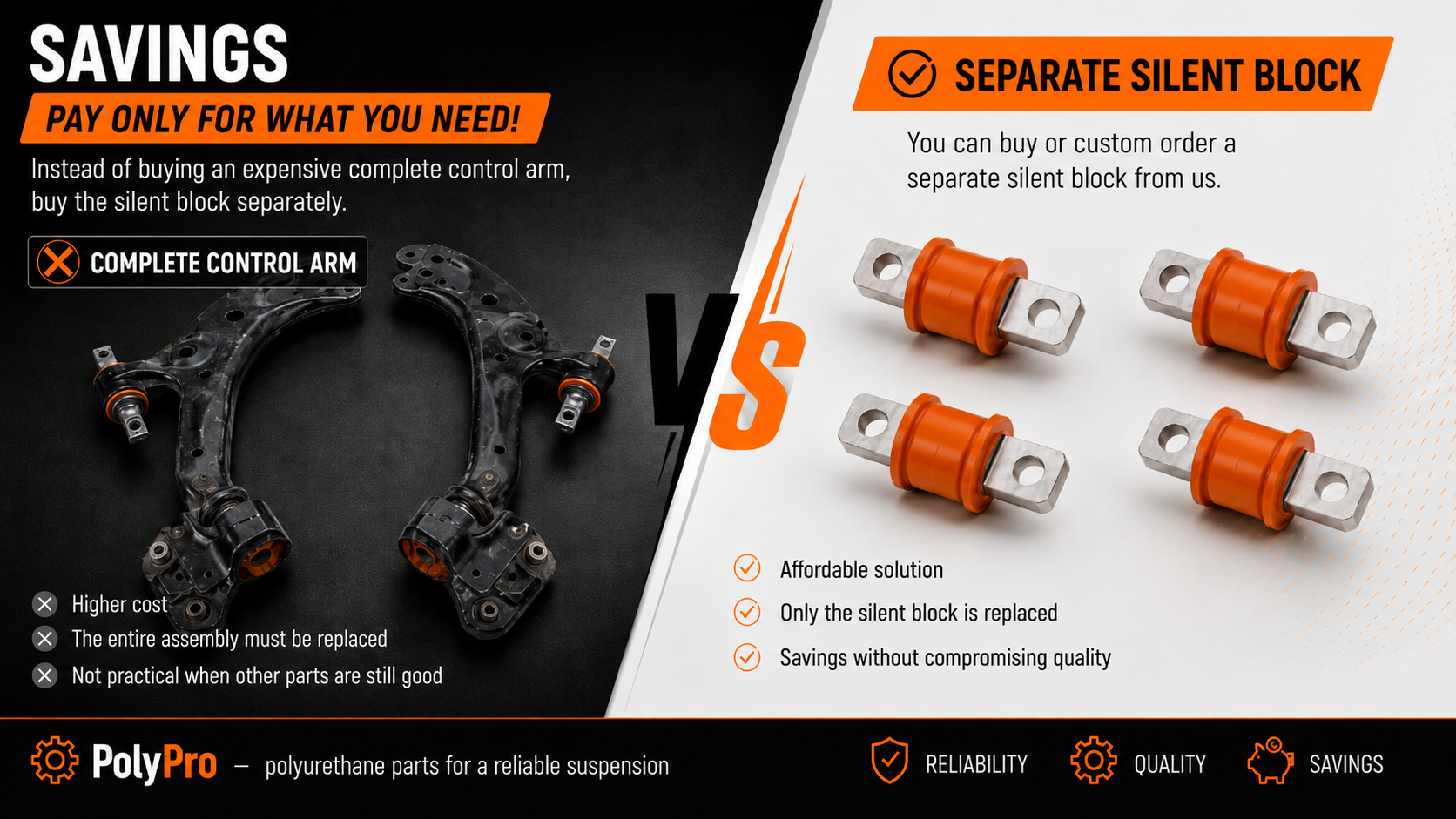
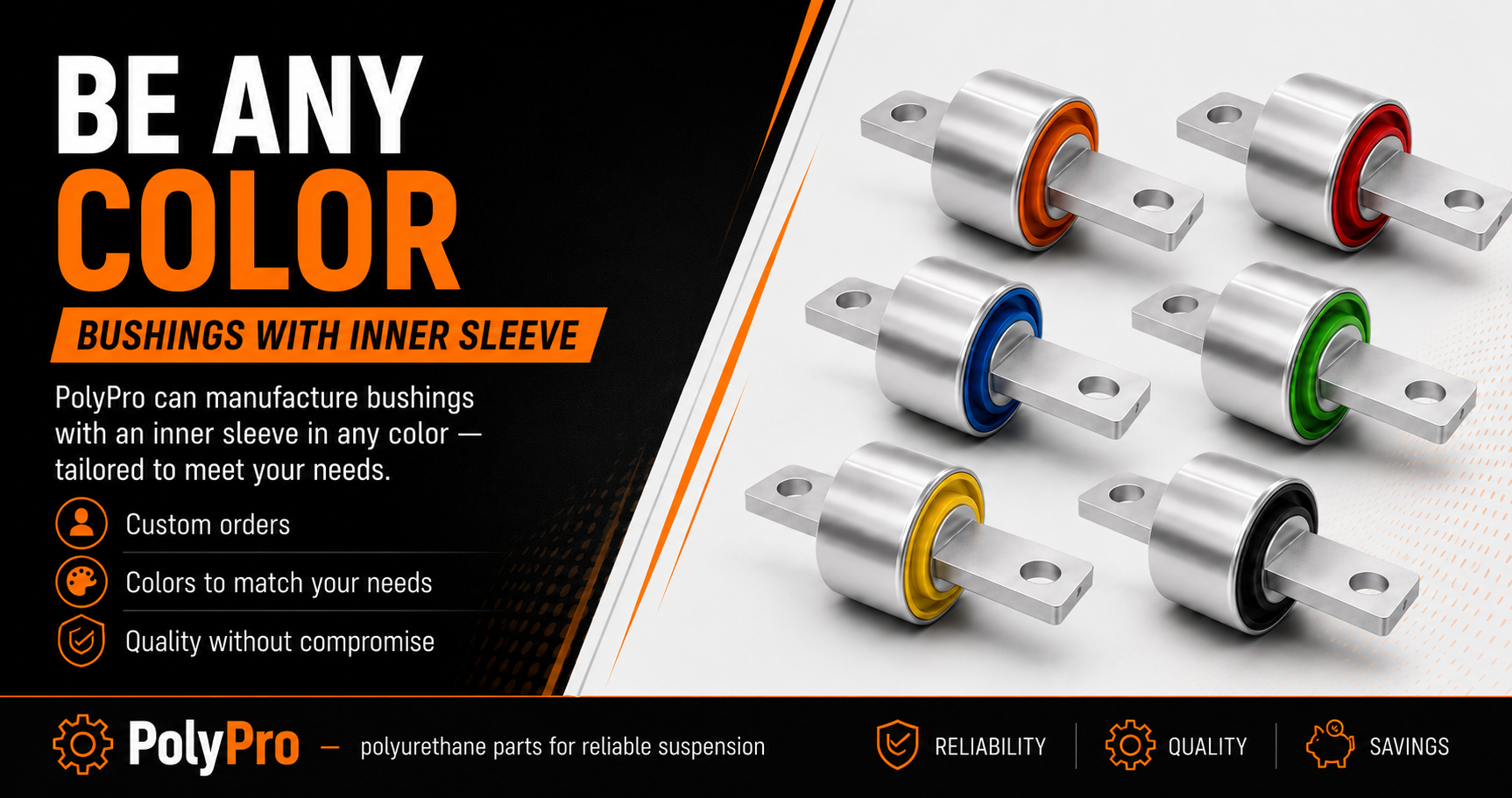
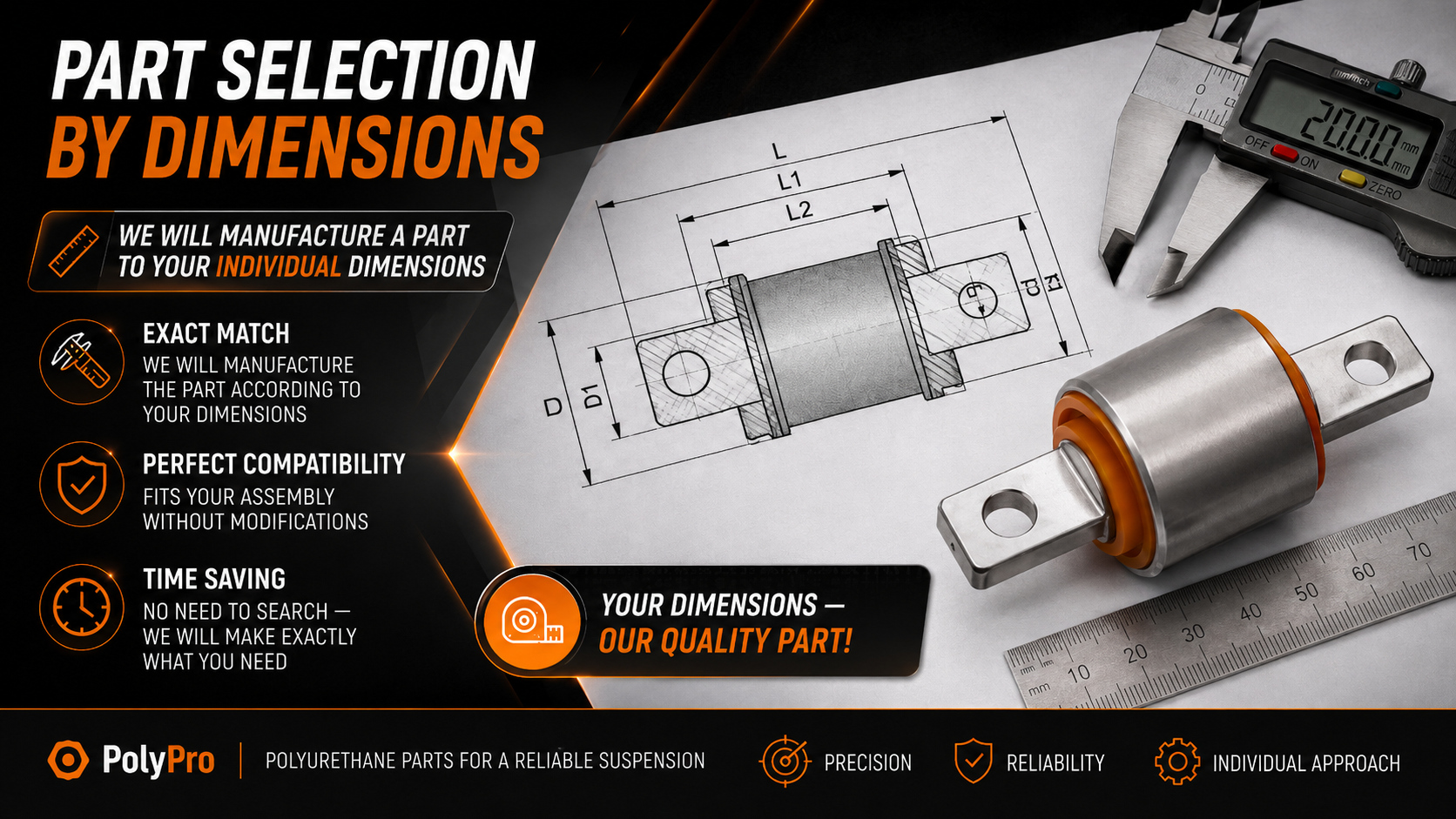
PolyPro is the manufacturer, not a reseller: production in Ukraine, own molds, batch control of the urethane compound. We sell retail from a single part and wholesale to shops and fleets through a partner program, and anything outside the catalog we make as custom polyurethane parts — from a drawing, a sample or a worn part, including the steel plate. For rare and discontinued equipment that is often the only option. All parts carry a warranty.
It is a polyurethane bushing with a steel plate bonded inside the elastic body. The plate gives the part a rigid bolt-through mounting point and lets it work in shear as well as in torsion. Ordinary bushings are loaded mostly in torsion, which is why plate-type parts are used where the load also runs along the mount.
Mainly in powertrain mounts — engine, transmission and rear differential. They are also used in the torque rods of trucks and body-on-frame SUVs, and in rear beam and subframe mounts on passenger cars. What these joints share is that the elastic element carries weight and longitudinal force at the same time.
A quality polyurethane bushing lasts 100,000–150,000 km, three to five times longer than a rubber one. Polyurethane does not dry-rot with age, road salt or temperature swings, and it does not delaminate from the inner plate the way rubber does. PolyPro warranties all of its products.
Yes. PolyPro makes bushings, mounts and non-standard polyurethane parts to order — from a drawing, a sample or even a worn-out part, starting at one piece. For plate-type parts we fabricate the steel insert as well. This is usually the only option for rare vehicles and discontinued equipment.
Standard durometer for daily driving: ride comfort close to rubber with several times the service life. Stiffer grades for a loaded vehicle, towing, off-road use or a built engine — tighter control of the assembly, but more idle vibration in the cabin. The durometer of each part is listed on its product page.
No. Retail starts at a single bushing, which matters when only one mount has failed. Custom parts made from a drawing, a sample or a worn part also start at one piece, steel plate included. Sets and larger quantities are simply the wholesale side of the same catalog.
Fleets, workshops, parts stores and resellers buy through the partner program. It brings bonuses tied to turnover or to the volume of a single order, access to prices, stock and shipping dates, and the option to have parts shipped under the partner's own brand. Retail orders continue on the usual terms alongside it.