

SKU: PP202265
Polyurethane big bushing of the rear lower arm Ford Fusion 2012-2020
In stock15 pcs.$34.79Log in as dealer

Polyurethane big bushing of the rear lower arm Ford Fusion 2012-2020
In stock15 pcs.Polyurethane big bushing of the rear lower arm Ford Mondeo 2014-
In stock15 pcs.
Polyurethane big bushing of the rear under-spring arm Ford Fusion 2012-2020
In stock15 pcs.
Polyurethane big bushing of the rear under-spring arm Ford Fusion 2012-2020
In stock15 pcs.Polyurethane big bushing of the rear under-spring arm Ford Mondeo 2014-
In stock15 pcs.Polyurethane big bushing of the rear under-spring arm Ford Mondeo 2014-
In stock15 pcs.
Polyurethane big bushing rear vertical arm Bmw F01 2009-2015
In stock15 pcs.Polyurethane big bushing rear vertical arm Bmw F02 2009-2015
In stock15 pcs.Polyurethane big bushing rear vertical arm Bmw F03 2009-2015
In stock15 pcs.Polyurethane big bushing rear vertical arm Bmw F04 2009-2015
In stock15 pcs.Polyurethane big bushing rear vertical arm Bmw F06 2010-
In stock15 pcs.Polyurethane big bushing rear vertical arm Bmw F07 2009-2017
In stock15 pcs.Polyurethane big bushing rear vertical arm Bmw F10 2010-2017
In stock15 pcs.Polyurethane big bushing rear vertical arm Bmw F11 2010-2017
In stock15 pcs.Polyurethane big bushing rear vertical arm Bmw F12 2010-
In stock15 pcs.Polyurethane big bushing rear vertical arm Bmw F13 2010-
In stock15 pcs.Polyurethane big bushing rear vertical arm Bmw G11 2015-2022
In stock15 pcs.Polyurethane big bushing rear vertical arm Bmw G12 2015-2022
In stock15 pcs.
Polyurethane bushing camber rear arm Jaguar X-Type 2001-2009
In stock15 pcs.
Polyurethane bushing front arm rear C2 2003-2005 (JM) HARDNESS
In stock15 pcs.Polyurethane bushing front arm rear Citroen Berlingo 1996-2008 (MF) HARDNESS
In stock15 pcs.
Polyurethane bushing front arm rear Citroen Berlingo 1996-2008 (MF) RECONSTRUCTION OF YOUR HARDNESS
In stock15 pcs.Polyurethane bushing front arm rear Citroen Berlingo 1996-2010 1,8L HARDNESS
In stock15 pcs.Polyurethane bushing front arm rear Citroen Berlingo 1996-2010 RECONSTRUCTION OF YOUR HARDNESS
In stock15 pcs.Polyurethane bushing front arm rear Citroen Berlingo 2008-2018 (B9) HARDNESS
In stock15 pcs.Polyurethane bushing front arm rear Citroen Berlingo 2008-2018 (B9) RECONSTRUCTION OF YOUR HARDNESS
In stock15 pcs.Polyurethane bushing front arm rear Citroen C1 2005-2014 PP-0353pa HARDNESS
In stock15 pcs.Polyurethane bushing front arm rear Citroen C1 2005-2014 RECONSTRUCTION OF YOUR HARDNESS
In stock15 pcs.Polyurethane bushing front arm rear Citroen C1 2014- HARDNESS
In stock15 pcs.Polyurethane bushing front arm rear Citroen C1 2014- RECONSTRUCTION OF YOUR HARDNESS
In stock15 pcs.Polyurethane bushing front arm rear Citroen C2 2003-2005 (JM) RECONSTRUCTION OF YOUR HARDNESS
In stock15 pcs.Polyurethane bushing front arm rear Citroen C3 2009- HARDNESS
In stock15 pcs.Polyurethane bushing front arm rear Citroen C3 2009- RECONSTRUCTION OF YOUR HARDNESS
In stock15 pcs.Polyurethane bushing front arm rear Citroen Xantia 1998-2003 HARDNESS
In stock15 pcs.Polyurethane bushing front arm rear Citroen Xantia 1998-2003 RECONSTRUCTION OF YOUR HARDNESS
In stock15 pcs.Polyurethane bushing front arm rear Citroen Xsara 1997-2006 1,8L HARDNESS
In stock15 pcs.Polyurethane bushing front arm rear Citroen Xsara 1997-2006 RECONSTRUCTION OF YOUR HARDNESS
In stock15 pcs.Polyurethane bushing front arm rear Citroen Xsara Picasso 1999-2004 HARDNESS
In stock15 pcs.Polyurethane bushing front arm rear Citroen Xsara Picasso 1999-2004 RECONSTRUCTION OF YOUR HARDNESS
In stock15 pcs.Polyurethane bushing front arm rear Citroen Zx 1991-1997 1,8L HARDNESS
In stock15 pcs.Polyurethane bushing front arm rear Citroen Zx 1991-1997 RECONSTRUCTION OF YOUR HARDNESS
In stock15 pcs.Polyurethane bushing front arm rear Peugeot 1007 2005-2009 (KM) HARDNESS
In stock15 pcs.Polyurethane bushing front arm rear Peugeot 1007 2005-2009 (KM) RECONSTRUCTION OF YOUR HARDNESS
In stock15 pcs.Polyurethane bushing front arm rear Peugeot 306 1993-2002 1,8L HARDNESS
In stock15 pcs.Polyurethane bushing front arm rear Peugeot 306 1993-2002 RECONSTRUCTION OF YOUR HARDNESS
In stock15 pcs.Polyurethane bushing front arm rear Peugeot 405 1987-1997 HARDNESS
In stock15 pcs.Polyurethane bushing front arm rear Peugeot 405 1987-1997 RECONSTRUCTION OF YOUR HARDNESS
In stock15 pcs.Polyurethane bushing front arm rear Peugeot 406 1995-2004 HARDNESS
In stock15 pcs.Polyurethane bushing front arm rear Peugeot 406 1995-2004 RECONSTRUCTION OF YOUR HARDNESS
In stock15 pcs.Polyurethane bushing front arm rear Peugeot 407 2004-2011 (6D) HARDNESS
In stock15 pcs.Polyurethane bushing front arm rear Peugeot 407 2004-2011 (6D) RECONSTRUCTION OF YOUR HARDNESS
In stock15 pcs.Polyurethane bushing front arm rear Peugeot 806 1994-2002 (221) HARDNESS
In stock15 pcs.Polyurethane bushing front arm rear Peugeot 806 1994-2002 (221) RECONSTRUCTION OF YOUR HARDNESS
In stock15 pcs.Polyurethane bushing front arm rear Peugeot Partner 1996- HARDNESS
In stock15 pcs.Polyurethane bushing front arm rear Peugeot Partner 1996- RECONSTRUCTION OF YOUR HARDNESS
In stock15 pcs.Polyurethane bushing front arm rear Peugeot Partner 2008- 1,8L HARDNESS
In stock15 pcs.Polyurethane bushing front arm rear Peugeot Partner 2008- RECONSTRUCTION OF YOUR HARDNESS
In stock15 pcs.
Polyurethane bushing front, rear trailing arm front Land Rover Discovery 1989-1999
In stock15 pcs.Polyurethane bushing front, rear trailing arm front Land Rover Discovery 1998-2004
In stock15 pcs.
Polyurethane bushing inner of rear lower transverse arm Alfa Romeo 164 1987-1998
In stock15 pcs.
Polyurethane bushing inner of rear spring-loaded arm Chrysler 300 2004-2010
In stock15 pcs.Polyurethane bushing inner of rear spring-loaded arm Chrysler 300 2010-
In stock15 pcs.Polyurethane bushing inner of rear spring-loaded arm Dodge Challenger 2007-
In stock15 pcs.Polyurethane bushing inner of rear spring-loaded arm Dodge Charger 2005-2010
In stock15 pcs.Polyurethane bushing inner of rear spring-loaded arm Dodge Charger 2011-
In stock15 pcs.
Polyurethane bushing inner of rear spring-loaded arm Merсedes 140 1991-1998
In stock15 pcs.
Polyurethane bushing inner of rear spring-loaded arm Merсedes 140 1991-1998 HARDNESS
In stock15 pcs.Polyurethane bushing inner of rear spring-loaded arm Merсedes 203 2000-2007
In stock15 pcs.Polyurethane bushing inner of rear spring-loaded arm Merсedes 203 2000-2007 HARDNESS
In stock15 pcs.Polyurethane bushing inner of rear spring-loaded arm Merсedes 204 2007-2014
In stock15 pcs.Polyurethane bushing inner of rear spring-loaded arm Merсedes 204 2007-2014
In stock15 pcs.Polyurethane bushing inner of rear spring-loaded arm Merсedes 204 2007-2014 HARDNESS
In stock15 pcs.Polyurethane bushing inner of rear spring-loaded arm Merсedes 205 2014-
In stock15 pcs.Polyurethane bushing inner of rear spring-loaded arm Merсedes 207 2009-
In stock15 pcs.Polyurethane bushing inner of rear spring-loaded arm Merсedes 209 2002-2009
In stock15 pcs.Polyurethane bushing inner of rear spring-loaded arm Merсedes 209 2002-2009 HARDNESS
In stock15 pcs.Polyurethane bushing inner of rear spring-loaded arm Merсedes 211 2002-2009
In stock15 pcs.Polyurethane bushing inner of rear spring-loaded arm Merсedes 212 2009-2016
In stock15 pcs.Polyurethane bushing inner of rear spring-loaded arm Merсedes 213 2016-
In stock15 pcs.Polyurethane bushing inner of rear spring-loaded arm Merсedes 215 1999-2006
In stock15 pcs.Polyurethane bushing inner of rear spring-loaded arm Merсedes 215 1999-2006
In stock15 pcs.Polyurethane bushing inner of rear spring-loaded arm Merсedes 215 1999-2006 HARDNESS
In stock15 pcs.Polyurethane bushing inner of rear spring-loaded arm Merсedes 216 2006-2013
In stock15 pcs.Polyurethane bushing inner of rear spring-loaded arm Merсedes 217 2013-
In stock15 pcs.Polyurethane bushing inner of rear spring-loaded arm Merсedes 218 2011-2018
In stock15 pcs.Polyurethane bushing inner of rear spring-loaded arm Merсedes 219 2004-2010
In stock15 pcs.Polyurethane bushing inner of rear spring-loaded arm Merсedes 220 1998-2005
In stock15 pcs.Polyurethane bushing inner of rear spring-loaded arm Merсedes 220 1998-2005
In stock15 pcs.Polyurethane bushing inner of rear spring-loaded arm Merсedes 220 1998-2005 HARDNESS
In stock15 pcs.Polyurethane bushing inner of rear spring-loaded arm Merсedes 221 2005-2013
In stock15 pcs.Polyurethane bushing inner of rear spring-loaded arm Merсedes 222 2013-
In stock15 pcs.Polyurethane bushing inner of rear spring-loaded arm Merсedes 230 2001-2011
In stock15 pcs.Polyurethane bushing inner of rear spring-loaded arm Merсedes 231 2012-
In stock15 pcs.Polyurethane bushing inner of rear spring-loaded arm Merсedes 238 2016-
In stock15 pcs.Polyurethane bushing inner of rear spring-loaded arm Merсedes 253 2015-
In stock15 pcs.Polyurethane bushing inner of rear spring-loaded arm Merсedes 257 2017-
In stock15 pcs.Polyurethane bushing inner of rear spring-loaded arm Merсedes 290 2018-
In stock15 pcs.
Polyurethane bushing inner of rear spring-loaded arm Mitsubishi Pajero III 2000-2006
In stock15 pcs.Polyurethane bushing inner of rear spring-loaded arm Mitsubishi Pajero IV 2006-
In stock15 pcs.
Polyurethane bushing inner of rear transverse arm Mazda 323 1985-1993
In stock15 pcs.
Polyurethane bushing inner of rear upper transverse arm Citroen C5 2001-2008
In stock15 pcs.Polyurethane bushing inner of rear upper transverse arm Citroen C5 2008-2017
In stock15 pcs.Polyurethane bushing inner of rear upper transverse arm Citroen C6 2005-2012
In stock15 pcs.Polyurethane bushing inner of rear upper transverse arm Peugeot 407 2004-2011
In stock15 pcs.Polyurethane bushing inner of rear upper transverse arm Peugeot 508 2010-2018
In stock15 pcs.
Polyurethane bushing of rear spring-loaded arm Hyundai Grandeur (TG) 2005-2011
In stock15 pcs.Polyurethane bushing of rear spring-loaded arm Hyundai Sonata NF V 2004-2010
In stock15 pcs.Polyurethane bushing of rear spring-loaded arm Kia Opirus 2003-2011
In stock15 pcs.Polyurethane bushing of rear spring-loaded arm Suzuki Grand Vitara I 1998-2005
In stock15 pcs.
Polyurethane bushing of rear trailing arm Mazda 929 1982-1987
In stock15 pcs.
Polyurethane bushing of rear upper arm Nissan Altima 2012-
In stock15 pcs.Polyurethane bushing of rear upper arm Nissan Maxima 2015-
In stock15 pcs.
Polyurethane bushing of the rear arm inner Opel Vectra B 1995-2002
In stock15 pcs.Polyurethane bushing of the rear arm inner Saab 9-5 1997-2010
In stock15 pcs.
Polyurethane bushing of the rear lower and upper trailing arm Toyota Previa 1990-2000
In stock15 pcs.
Polyurethane bushing of the rear lower arm instead of the ball Ford Fusion 2013-
In stock15 pcs.Polyurethane bushing of the rear lower arm instead of the ball Ford Mondeo 2014-
In stock15 pcs.
Polyurethane bushing of the rear trailing long arm Lexus Lx 2007-
In stock15 pcs.Polyurethane bushing of the rear trailing long arm SsangYong Actyon 2012-
In stock15 pcs.Polyurethane bushing of the rear trailing long arm SsangYong Korando 2010-
In stock15 pcs.Polyurethane bushing of the rear trailing long arm SsangYong Rodius 2013-
In stock15 pcs.Polyurethane bushing of the rear trailing long arm Toyota Land Cruiser 2007-
In stock15 pcs.
Polyurethane bushing of the rear trailing short arm Lexus Lx 2007-
In stock15 pcs.Polyurethane bushing of the rear trailing short arm Toyota Land Cruiser 2007-
In stock15 pcs.
Polyurethane bushing of the rear under-spring arm instead of the ball Ford Fusion 2013-
In stock15 pcs.
Polyurethane bushing of the rear under-spring arm instead of the ball Ford Fusion 2013-
In stock15 pcs.Polyurethane bushing of the rear under-spring arm instead of the ball Ford Mondeo 2014-
In stock15 pcs.Polyurethane bushing of the rear under-spring arm instead of the ball Ford Mondeo 2014-
In stock15 pcs.
Polyurethane bushing of the rear upper U-shaped lever Chevrolet Epica 2006-2014
In stock15 pcs.Polyurethane bushing of the rear upper U-shaped lever Chevrolet Evanda 2000-2006
In stock15 pcs.
Polyurethane bushing of the rear upper arm Chrysler 300 2004-2010
In stock15 pcs.
Polyurethane bushing of the rear upper arm Ford Escape 2012-2019
In stock15 pcs.
Polyurethane bushing of the rear upper arm Lexus GS 2005-2011
In stock15 pcs.
Polyurethane bushing of the rear upper arm Lexus GS 2005-2011
In stock15 pcs.Polyurethane bushing of the rear upper arm Lexus IS II 2006-2013
In stock15 pcs.Polyurethane bushing of the rear upper arm Lexus IS II 2006-2013
In stock15 pcs.Polyurethane bushing of the rear upper arm Toyota Crown 2003-2008
In stock15 pcs.Polyurethane bushing of the rear upper arm Toyota Crown 2003-2008
In stock15 pcs.Polyurethane bushing of the rear upper arm Toyota Mark X I 2004-2009
In stock15 pcs.Polyurethane bushing of the rear upper arm Toyota Mark X I 2004-2009
In stock15 pcs.Polyurethane bushing of the rear upper arm Toyota Mark X II 2009-2019
In stock15 pcs.
Polyurethane bushing of the rear upper arm from ball joint Lexus GS 2005-2011
In stock15 pcs.Polyurethane bushing of the rear upper arm from ball joint Lexus IS II 2006-2013
In stock15 pcs.Polyurethane bushing of the rear upper arm from ball joint Toyota Crown 2003-2008
In stock15 pcs.Polyurethane bushing of the rear upper arm from ball joint Toyota Mark X I 2004-2009
In stock15 pcs.
Polyurethane bushing of the rear upper sickle-shaped lever, outer Audi A1 2010-2018
In stock15 pcs.Polyurethane bushing of the rear upper sickle-shaped lever, outer Audi A3 2003-2012
In stock15 pcs.Polyurethane bushing of the rear upper sickle-shaped lever, outer Audi A3 2012-2020
In stock15 pcs.Polyurethane bushing of the rear upper sickle-shaped lever, outer Audi Q2 2016-
In stock15 pcs.Polyurethane bushing of the rear upper sickle-shaped lever, outer Audi Q3 2011-2014
In stock15 pcs.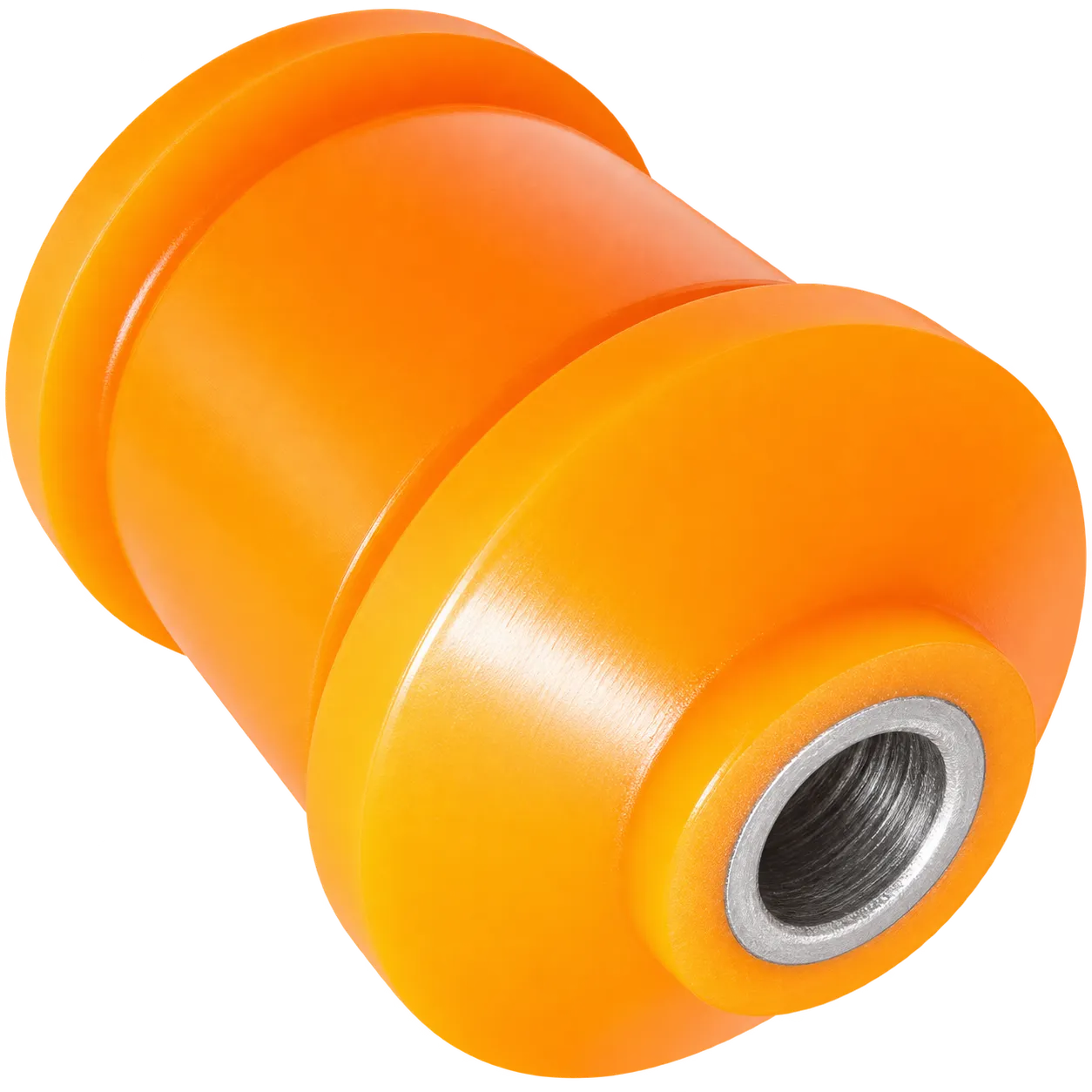
A rear control arm bushing is the compliant joint that holds the trailing, lateral and camber arms of the rear suspension to the body or rear subframe. It decides whether the rear axle stays square under load and how much the rear end steers itself in a corner. PolyPro molds these bushings from polyurethane for passenger cars, crossovers, vans and towed equipment. All available sizes are listed in the catalog.
A multi-link rear axle carries three to five arms per wheel, and every arm rests on joints at both ends. The trailing arm takes drive and braking loads, the lateral arms set rear camber and toe, and the camber link allows the wheel angle to be adjusted. The elastic insert inside each joint works in torsion, compression and shear at the same time. The more arms a layout uses, the more places free play can appear.
The rear axle is not steered, so its angles are held only by the stiffness of these joints. As the inserts soften, side loads move the arms and the wheel changes its own toe — that is rear steer in practice. On the front arms the driver feels this through the steering; at the rear it shows only as a change of line.
Rear joints rarely knock as clearly as front ones, so they are often overlooked. The first symptom is a restless rear end: the car seems to lag during a lane change, it rocks on undulations, and with cargo in the trunk or a trailer behind it visibly wanders in its lane. Most drivers blame the tires or the dampers instead.
Inspect the rear suspension on a lift with the arms unloaded: pry each arm fore-and-aft and sideways, looking for movement of the inner sleeve against the shell. Check the trailing arms separately, since they take the highest loads and fail first. An alignment rack shows whether the rear axle returns to its set angles after loading or already drifts within the free play of its joints.
The rear joint is asked for something different than the front one: not sharp response, but a stable axle under changing load. Rubber at the rear gives comfort, yet it sags under cargo weight and eventually lets the axle drift. On older cars the rear inserts are often the first to break down, because they work under constantly reversing loads.
Polyurethane sags less under weight and builds almost no permanent set, so rear toe keeps its setting longer and the car tracks straighter when loaded or towing. That removes part of the sawtooth wear on the rear tires. In exchange the rear axle becomes slightly louder over expansion joints. Choose hardness by how heavily the car is loaded; the Shore value is stated on each product page.
Start by identifying the rear suspension type and the exact arm, then measure the old part. One axle often carries three or four different sizes, so ordering a blind rear kit rarely ends well.
A twist beam, a multi-link layout and a trailing arm axle each use a different set of joints. On a twist beam the main load sits on the beam mounts, which call for a rear beam bushing rather than an arm bushing. A multi-link wheel carries several different bushings: the trailing arm, two or three lateral arms and the camber link. Before ordering, raise the car and count the joints instead of relying on a generic model description. Check as well whether the arm uses a flanged shell and which face it bears against, since that decides whether the part fits without rework.
The working figures are the same as at the front: outer diameter of the shell, inner diameter for the bolt and length of the joint. At the rear the risk is mixing positions up — neighboring arms often share an outer diameter but differ in length, and a short bushing will sit skewed in the bracket once the bolt is torqued. Measure each part separately with calipers and label straight away which arm it came off. If the arm has been repaired before, the bore may be worn or machined oversize, so measure it as it is rather than from a reference table. The same three figures appear on every catalog page.
At the rear, hardness follows load rather than driving style. A car that carries people and cargo, tows a trailer or regularly runs loaded behaves more predictably on firmer grades, because the rear axle changes its toe less under side forces. A passenger car without permanent load is well served by softer grades, and they add no boom over expansion joints. The Shore value is listed on every product page, so the intended duty can be matched to a specific item before ordering. Cars with a tow hitch usually take firmer grades on the trailing arms, because those joints carry the pulling load.
We mold the parts ourselves: our own molds, our own casting shop, dimensional control at the end of the line and sales without middlemen. For rear suspensions that matters in practice, because the rear axle uses many rare sizes that the retail chain simply does not stock. Orders go by the piece: if one trailing arm joint has failed, there is no need to buy a kit for the whole axle. Non-standard parts are made from a drawing, a sample or a worn bushing, starting from one unit, and our products carry a warranty.
Repair shops, parts stores, fleets and resellers work on wholesale terms through the partner program: bonuses for turnover or for the size of a single order, access to prices and stock, and shipments under the partner's brand.
It depends on the layout. A twist beam axle has one main mounting joint per side. A multi-link wheel runs three to five arms, and each arm carries one or two joints. Raise the car and count the mounting points before ordering, because sizes differ within a single axle and neighboring arms are easy to confuse.
Because the rear axle sends no feedback to the steering wheel. Instead of a clear knock the driver gets a restless rear: lag on lane changes, rocking over swells and wandering with weight in the trunk. The symptom is usually blamed on tires or dampers, so rear bushings often run until the insert tears through.
Yes. As the inserts soften, the rear axle changes toe under load and the tire tracks at a slight angle to the road. That produces sawtooth wear across the tread blocks and uneven shoulder scrubbing. Replacing the joints and then setting rear axle geometry stops the process before the tires are ruined.
Yes, where the suspension design allows adjustment. New bushings return the arms to their designed position, so rear toe and camber should be checked on a rack. Torque the mounting bolts with the suspension loaded and the car standing on its wheels, otherwise the insert stays pre-twisted and wears from the first kilometers.
Some of them, if there is access from below and the press tool fits. Trailing arms and joints with flanged shells are easier to press with the arm removed, because the force has to stay coaxial or the shell goes in skewed. The decision comes down to the state of the mounts and the corrosion on the bolts.
Technically, yes. A new joint on one side works stiffer than a worn one on the other, and the rear axle then sits asymmetrically: under load one wheel changes toe more than the other. If the second side still measures well, at least pry-test it during the same job so it is not overlooked.
Yes, retail here is by the piece. At the rear that is a common case: one trailing arm joint fails while the lateral arms are still sound. If the size you need is missing from the catalog, we will make it from a drawing, a sample or the worn part, also starting from a single unit.
They are served on wholesale terms. The partner program gives bonuses for turnover or for the volume of a single order, access to current prices and stock, and shipments under the partner's brand. For fleets we usually build a repeating parts list by vehicle model.