

SKU: PP300137
Front anti roll bar bush Bmw E34 1987-1995 2.5D
In stock15 pcs.$10.9Log in as dealer

Front anti roll bar bush Bmw E34 1987-1995 2.5D
In stock15 pcs.
Front anti roll bar bush Bmw E34 1987-1995 3.0D
In stock15 pcs.Front anti roll bar bush Bmw E39 1995-2003 2.5D
In stock15 pcs.
Front anti roll bar bush Bmw E39 1995-2003 2.5L
In stock15 pcs.
Front anti roll bar bush Bmw E39 1995-2003 3,0L
In stock15 pcs.Front anti roll bar bush Bmw E39 1995-2003 3.0D
In stock15 pcs.Front anti roll bar bush Bmw E60 2003-2010 2.5D
In stock15 pcs.Front anti roll bar bush Bmw E60 2003-2010 2.5L
In stock15 pcs.Front anti roll bar bush Bmw E60 2003-2010 3,0L
In stock15 pcs.Front anti roll bar bush Bmw E60 2003-2010 3.0D
In stock15 pcs.
Front anti roll bar bush Citroen C1 2005-2014 1.0L
In stock15 pcs.
Front anti roll bar bush Citroen C1 2005-2014 1.4L
In stock15 pcs.
Front anti roll bar bush Citroen C4 2010-2018 1.6L-2.0L
In stock15 pcs.
Front anti roll bar bush Hummer H3 2006-2010 3.5L
In stock15 pcs.
Front anti roll bar bush Infiniti G 1991-1996 1.8L
In stock15 pcs.
Front anti roll bar bush Nissan Almera 1995-2000 1,6L
In stock15 pcs.Front anti roll bar bush Nissan Bluebird 1985-1990 1,6L
In stock15 pcs.Front anti roll bar bush Nissan Bluebird 1991-1997 1.8L
In stock15 pcs.
Front anti roll bar bush Nissan Bluebird 1991-1997 2.4L
In stock15 pcs.Front anti roll bar bush Nissan Bluebird 1996-2001 1.8L
In stock15 pcs.Front anti roll bar bush Nissan Bluebird 1996-2001 2.4L
In stock15 pcs.Front anti roll bar bush Nissan Prairie 1988-1998 1.8L
In stock15 pcs.Front anti roll bar bush Nissan Prairie 1988-1998 2.4L
In stock15 pcs.Front anti roll bar bush Nissan Primera 1990-1996 1,6L
In stock15 pcs.Front anti roll bar bush Nissan Primera 1990-1996 1.8L
In stock15 pcs.Front anti roll bar bush Nissan Primera 1990-1996 2.4L
In stock15 pcs.Front anti roll bar bush Nissan Primera 1996-1999 1,6L
In stock15 pcs.Front anti roll bar bush Nissan Primera 1996-1999 1.8L
In stock15 pcs.Front anti roll bar bush Nissan Primera 1996-1999 2.4L
In stock15 pcs.Front anti roll bar bush Nissan Sunny 1990-1995 1,6L
In stock15 pcs.Front anti roll bar bush Nissan Sunny 1995-2000 1,6L
In stock15 pcs.Front anti roll bar bush Peugeot 107 2005- 1.0L
In stock15 pcs.Front anti roll bar bush Peugeot 107 2005- 1.4L
In stock15 pcs.Front anti roll bar bush Toyota Aygo 2005-2014 1.0L
In stock15 pcs.Front anti roll bar bush Toyota Aygo 2005-2014 1.4L
In stock15 pcs.
Front stabilizer polyurethane bushing Bmw E30 1982-1994 1,6L
In stock15 pcs.
Front stabilizer polyurethane bushing Bmw E30 1982-1994 1.8L
In stock15 pcs.
Front stabilizer polyurethane bushing Merсedes-Benz 140 1991-1998 2.0L
In stock15 pcs.
Front stabilizer polyurethane bushing Merсedes-Benz 140 1991-1998 2.0L HARDNESS
In stock15 pcs.
Front stabilizer polyurethane bushing Merсedes-Benz 140 1991-1998 2.3L
In stock15 pcs.
Front stabilizer polyurethane bushing Merсedes-Benz 140 1991-1998 2.3L HARDNESS
In stock15 pcs.
Front stabilizer polyurethane bushing Merсedes-Benz 140 1991-1998 4.2L
In stock15 pcs.
Front stabilizer polyurethane bushing Merсedes-Benz 140 1991-1998 4.2L HARDNESS
In stock15 pcs.Front stabilizer polyurethane bushing Merсedes-Benz 201 1988-1993 2.0L
In stock15 pcs.Front stabilizer polyurethane bushing Merсedes-Benz 201 1988-1993 2.0L HARDNESS
In stock15 pcs.Front stabilizer polyurethane bushing Merсedes-Benz 201 1988-1993 4,2L HARDNESS
In stock15 pcs.Front stabilizer polyurethane bushing Merсedes-Benz 201 1988-1993 4.2L
In stock15 pcs.Front stabilizer polyurethane bushing Merсedes-Benz 210 1995-2002 2.0L
In stock15 pcs.Front stabilizer polyurethane bushing Merсedes-Benz 210 1995-2002 2.0L HARDNESS
In stock15 pcs.Front stabilizer polyurethane bushing Merсedes-Benz 210 1995-2002 2.3L
In stock15 pcs.Front stabilizer polyurethane bushing Merсedes-Benz 210 1995-2002 2.3L HARDNESS
In stock15 pcs.
Front stabilizer polyurethane bushing Merсedes-Benz 210 1995-2002 2.4L
In stock15 pcs.
Front stabilizer polyurethane bushing Merсedes-Benz 210 1995-2002 2.4L HARDNESS
In stock15 pcs.
Front stabilizer polyurethane bushing Merсedes-Benz 210 1995-2002 2.6L
In stock15 pcs.Front stabilizer polyurethane bushing Merсedes-Benz 210 1995-2002 2.6L HARDNESS
In stock15 pcs.Front stabilizer polyurethane bushing Merсedes-Benz 210 1995-2002 4,2L HARDNESS
In stock15 pcs.Front stabilizer polyurethane bushing Merсedes-Benz 210 1995-2002 4.2L
In stock15 pcs.
Polyurethane bushing front active stabilizer Mercedes-Benz 166 2011- 3.0L
In stock15 pcs.
Polyurethane bushing front active stabilizer Mercedes-Benz 292 2015- 3.0L
In stock15 pcs.
Polyurethane bushing front stabilizer Acura Legend 1986-1995 2.0L
In stock15 pcs.
Polyurethane bushing front stabilizer Acura Mdx 2006-2013 3.7L
In stock15 pcs.
Polyurethane bushing front stabilizer Alfa Romeo 164 1987-1998 2.0L
In stock15 pcs.Polyurethane bushing front stabilizer Alfa Romeo GTV 1995-2005 2.0L
In stock15 pcs.Polyurethane bushing front stabilizer Alfa Romeo Spider 1971-1994 2.0L
In stock15 pcs.Polyurethane bushing front stabilizer Alfa Romeo Spider 1995-2006 2.0L
In stock15 pcs.Polyurethane bushing front stabilizer Alfa Romeo Spider 2006-2010 2.0L
In stock15 pcs.
Polyurethane bushing front stabilizer Audi 100 1976-1982 1.9D
In stock15 pcs.
Polyurethane bushing front stabilizer Audi 100 1982-1991 2,2L
In stock15 pcs.
Polyurethane bushing front stabilizer Audi 100 1982-1991 2,2l
In stock15 pcs.Polyurethane bushing front stabilizer Audi 200 1983-1991 2,2L
In stock15 pcs.Polyurethane bushing front stabilizer Audi 200 1983-1991 2,2l
In stock15 pcs.
Polyurethane bushing front stabilizer Audi 80 1986-1991
In stock15 pcs.
Polyurethane bushing front stabilizer Audi 80 1986-1991
In stock15 pcs.
Polyurethane bushing front stabilizer Audi 80 1986-1991 1.4L
In stock15 pcs.
Polyurethane bushing front stabilizer Audi 80 1986-1991 1.6L
In stock15 pcs.
Polyurethane bushing front stabilizer Audi 80 1986-1991 2.3L
In stock15 pcs.
Polyurethane bushing front stabilizer Audi A1 2010-2018 1,4L
In stock15 pcs.
Polyurethane bushing front stabilizer Audi A1 2010-2018 1.0L
In stock15 pcs.
Polyurethane bushing front stabilizer Audi A1 2010-2018 1.2L
In stock15 pcs.
Polyurethane bushing front stabilizer Audi A1 2010-2018 1.6L
In stock15 pcs.
Polyurethane bushing front stabilizer Audi A2 1999-2005 1,2L
In stock15 pcs.Polyurethane bushing front stabilizer Audi A2 1999-2005 1,4L
In stock15 pcs.Polyurethane bushing front stabilizer Audi A2 1999-2005 1.0L
In stock15 pcs.Polyurethane bushing front stabilizer Audi A2 1999-2005 1.2L
In stock15 pcs.Polyurethane bushing front stabilizer Audi A2 1999-2005 1.6L
In stock15 pcs.Polyurethane bushing front stabilizer Audi A3 1996-2006
In stock15 pcs.Polyurethane bushing front stabilizer Audi A3 1996-2006
In stock15 pcs.Polyurethane bushing front stabilizer Audi A3 1996-2006 1,4L
In stock15 pcs.Polyurethane bushing front stabilizer Audi A3 1996-2006 1.2L
In stock15 pcs.
Polyurethane bushing front stabilizer Audi A3 1996-2006 1.4-2.3L
In stock15 pcs.Polyurethane bushing front stabilizer Audi A3 1996-2006 1.4L
In stock15 pcs.Polyurethane bushing front stabilizer Audi A3 1996-2006 1.6 L
In stock15 pcs.Polyurethane bushing front stabilizer Audi A3 1996-2006 1.6L
In stock15 pcs.
Polyurethane bushing front stabilizer Audi A3 1996-2006 1.8L
In stock15 pcs.
Polyurethane bushing front stabilizer Audi A3 1996-2006 2.0L
In stock15 pcs.Polyurethane bushing front stabilizer Audi A3 1996-2006 2.3L
In stock15 pcs.Polyurethane bushing front stabilizer Audi A3 2003-2012
In stock15 pcs.Polyurethane bushing front stabilizer Audi A3 2003-2012
In stock15 pcs.
Polyurethane bushing front stabilizer Audi A3 2003-2012 1,6L
In stock15 pcs.
Polyurethane bushing front stabilizer Audi A3 2003-2012 1,8L
In stock15 pcs.
Polyurethane bushing front stabilizer Audi A3 2003-2012 1.2l
In stock15 pcs.Polyurethane bushing front stabilizer Audi A3 2003-2012 1.4L
In stock15 pcs.
Polyurethane bushing front stabilizer Audi A3 2003-2012 1.4l
In stock15 pcs.
Polyurethane bushing front stabilizer Audi A3 2003-2012 1.6D
In stock15 pcs.Polyurethane bushing front stabilizer Audi A3 2003-2012 1.6L
In stock15 pcs.
Polyurethane bushing front stabilizer Audi A3 2003-2012 1.9D
In stock15 pcs.
Polyurethane bushing front stabilizer Audi A3 2003-2012 2,0D
In stock15 pcs.
Polyurethane bushing front stabilizer Audi A3 2003-2012 2,0L
In stock15 pcs.
Polyurethane bushing front stabilizer Audi A3 2003-2012 2.0D
In stock15 pcs.
Polyurethane bushing front stabilizer Audi A3 2003-2012 2.0TDi
In stock15 pcs.Polyurethane bushing front stabilizer Audi A3 2003-2012 2.3L
In stock15 pcs.Polyurethane bushing front stabilizer Audi A3 2012-2020 1,6L
In stock15 pcs.
Polyurethane bushing front stabilizer Audi A3 2012-2020 1.0L
In stock15 pcs.
Polyurethane bushing front stabilizer Audi A3 2012-2020 1.4L
In stock15 pcs.
Polyurethane bushing front stabilizer Audi A3 2012-2020 1.5L
In stock15 pcs.
Polyurethane bushing front stabilizer Audi A3 2012-2020 1.8L
In stock15 pcs.Polyurethane bushing front stabilizer Audi A3 2012-2020 2,0L
In stock15 pcs.Polyurethane bushing front stabilizer Audi A3 2020- 1.0L
In stock15 pcs.Polyurethane bushing front stabilizer Audi A3 2020- 1.4L
In stock15 pcs.Polyurethane bushing front stabilizer Audi A3 2020- 1.5L
In stock15 pcs.Polyurethane bushing front stabilizer Audi A3 2020- 1.8L
In stock15 pcs.Polyurethane bushing front stabilizer Audi A4 1994-2001
In stock15 pcs.Polyurethane bushing front stabilizer Audi A4 1994-2001
In stock15 pcs.Polyurethane bushing front stabilizer Audi A4 1994-2001 1.4L
In stock15 pcs.Polyurethane bushing front stabilizer Audi A4 1994-2001 1.6L
In stock15 pcs.Polyurethane bushing front stabilizer Audi A4 1994-2001 2.3L
In stock15 pcs.Polyurethane bushing front stabilizer Audi A4 2004-2008 1,4L
In stock15 pcs.Polyurethane bushing front stabilizer Audi A4 2004-2008 1.6L
In stock15 pcs.Polyurethane bushing front stabilizer Audi A6 1994-1997
In stock15 pcs.Polyurethane bushing front stabilizer Audi A6 1994-1997
In stock15 pcs.Polyurethane bushing front stabilizer Audi A6 1994-1997 1.4L
In stock15 pcs.Polyurethane bushing front stabilizer Audi A6 1994-1997 1.6L
In stock15 pcs.Polyurethane bushing front stabilizer Audi A6 1994-1997 2.3L
In stock15 pcs.
Polyurethane bushing front stabilizer Audi A8 2002-2009 2.8L
In stock15 pcs.
Polyurethane bushing front stabilizer Audi A8 2002-2009 3.0L
In stock15 pcs.
Polyurethane bushing front stabilizer Audi A8 2002-2009 3.2L
In stock15 pcs.Polyurethane bushing front stabilizer Audi Cabriolet 1991-2000
In stock15 pcs.Polyurethane bushing front stabilizer Audi Cabriolet 1991-2000
In stock15 pcs.Polyurethane bushing front stabilizer Audi Cabriolet 1991-2000 1.4L
In stock15 pcs.Polyurethane bushing front stabilizer Audi Cabriolet 1991-2000 1.6L
In stock15 pcs.Polyurethane bushing front stabilizer Audi Cabriolet 1991-2000 2.3L
In stock15 pcs.Polyurethane bushing front stabilizer Audi Q2 2016- 1.4L
In stock15 pcs.Polyurethane bushing front stabilizer Audi Q2 2016- 1.5L
In stock15 pcs.Polyurethane bushing front stabilizer Audi Q2 2016- 1.8L
In stock15 pcs.Polyurethane bushing front stabilizer Audi Q3 2011-2014 1.2l
In stock15 pcs.Polyurethane bushing front stabilizer Audi Q3 2011-2014 1.9D
In stock15 pcs.Polyurethane bushing front stabilizer Audi Q3 2011-2014 2,0D
In stock15 pcs.Polyurethane bushing front stabilizer Audi Q3 2011-2014 2,0L
In stock15 pcs.
Polyurethane bushing front stabilizer Audi Q3 2011-2014 2,0TDi
In stock15 pcs.Polyurethane bushing front stabilizer Audi Q3 2011-2014 2.0D
In stock15 pcs.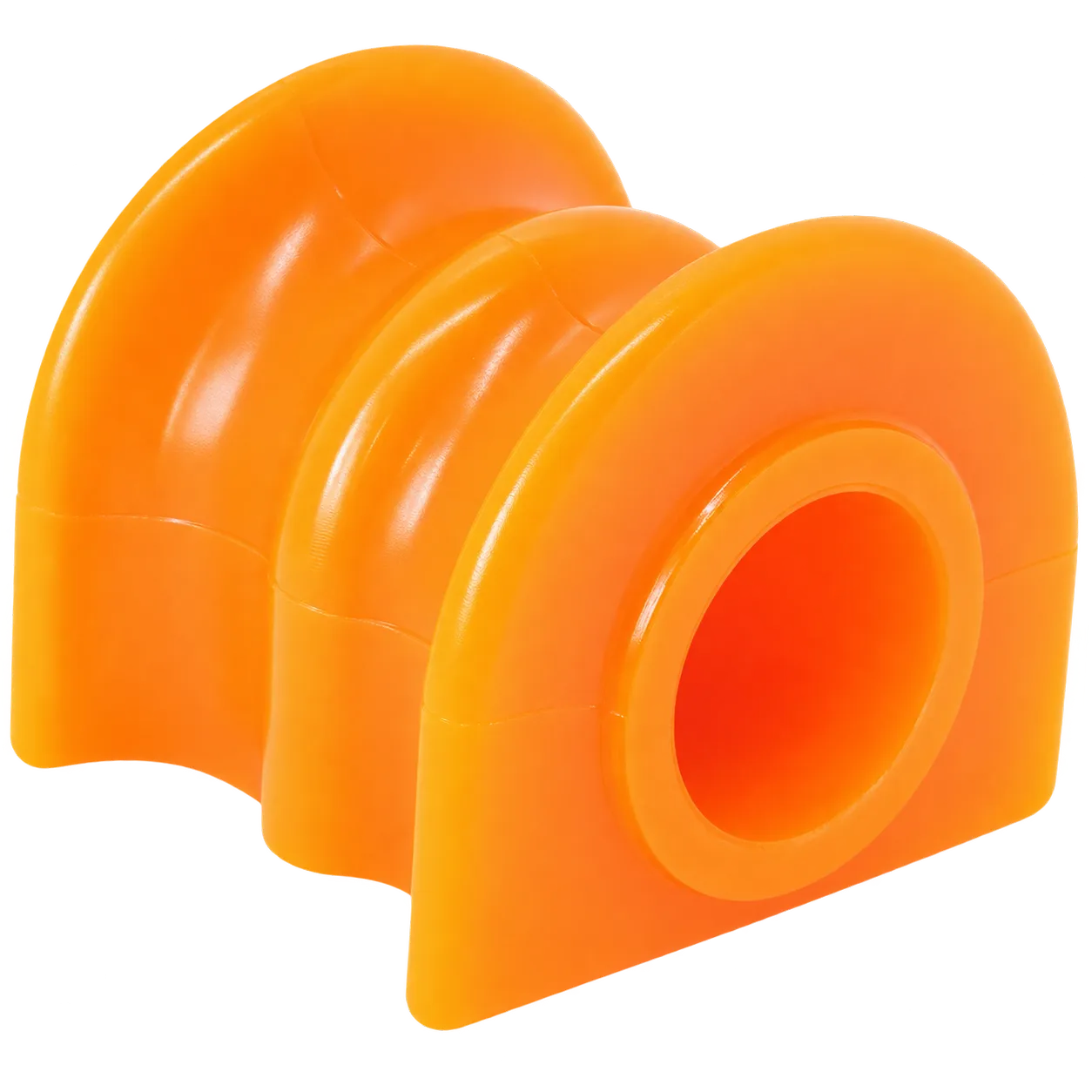
A front sway bar bushing is the moulded sleeve that clamps the front anti-roll bar to the subframe or the body. It holds the bar on its axis, lets it rotate without galling and passes load from one wheel to the other when the car leans. These parts are fitted to passenger cars, crossovers and light commercial vehicles. PolyPro casts them in its own tooling for specific bar diameters and bracket shapes; sizes and hardness are listed in the catalogue.
The front anti-roll bar is a torsion bar linking the left and right sides of the suspension. When one wheel rides over a bump, the bar twists and transfers part of that load to the opposite side, which limits body roll. The bar is clamped to the body or subframe by two bushings held in brackets. The bushing is not a spacer: it locates the bar axially, carries the radial load and still lets the steel rotate inside it.
The front axle is the more heavily loaded one: it carries the engine, the steering and most of the braking effort. The front bar is thicker and the torque through it is higher, so its bushings work on almost every irregularity, from fine washboard to potholes and tram rails. Polyurethane keeps the bore round longer than rubber, so clearance builds up slowly and steering response stays predictable. General information on the assembly is in the sway bar bushing section.
Front bushings wear from the inside out: the bore opens up, clearance appears and the bar starts knocking inside its bracket. It is heard first on fine washboard and cobbles at low speed, later on any bump.
A worn sway bar link bushing makes a similar noise, so rock the link by hand first and separate the two causes before ordering parts.
Rubber is softer and damps fine vibration better, but it takes a permanent set sooner: the bore deforms, the compound ages from ozone, oils and road salt, and cracks open at the edges. On the front axle, where the loading is constant and cyclic, this shows up earlier than at the rear, and the growing clearance brings knocking and vague steering with it.
Polyurethane is more elastic and far more resistant to abrasion and chemicals, so it keeps the bore size and holds the bar without play for much longer. The trade-off is slightly more vibration reaching the body and a stricter assembly routine: the seat must be clean and the bore greased with a polyurethane-compatible lubricant, otherwise it will squeak. For daily driving on broken roads, towing or a loaded vehicle it is the more practical material; the Shore hardness of each item is given on its product page.
Selection is based on measurements, not on the car model: bar diameter, bushing width and height, bracket shape. Measure the bar with a caliper at the mounting point and compare it with the dimensions on the product page.
The inner diameter of the bushing must match the bar at the mounting point, not at its thickest section. Measure with a caliper in two planes: after years of service the steel in the contact zone wears unevenly and goes oval. If the difference is noticeable, use the nominal size of the undamaged area next to it. A polyurethane bushing is fitted with a slight interference and should not spin freely on the bar by hand. A bore that is too large leaves play and knocking within a hundred kilometres, while one that is too small pinches the bar and makes it work with increased friction.
Bushings differ in outer shape as well as in bore: cylindrical types for a U-shaped bracket, flat-based types for a clamping plate, versions with a collar that stops the bar from walking sideways, and split ones with a slit so they can be fitted without removing the bar. Use the old part and the bracket as your reference: the seat must sit flat over its whole area, without skew. A bent or worn bracket will destroy a new bushing quickly, so it is straightened or replaced. The split version saves time where the bar is hard to drop. Clean the seat of rust and dirt before assembly so the new part sits flat.
Hardness is chosen for the job, not on the principle that harder is always better. Softer polyurethane stays close to the factory rubber: comfort barely changes while service life is already noticeably longer, which suits daily city driving. Harder material deforms less under load, so it locates the bar more precisely, cuts body roll and works for a loaded car, trailer towing, rough roads and track use. In return, more vibration from small bumps reaches the cabin. The exact Shore value for each position is stated on the product page. If you are unsure, take the middle option rather than the hardest one.
Front bushings rarely wear out on their own. Check the sway bar links and their bushings, the brackets and their bolts, and the control arm bushings as well: if an arm has play, the knock will still be there after the bar bushings are replaced. Inspect the bar itself — deep scoring and an oval profile at the seat mean a new bushing will wear out sooner than it should. Fasteners with stretched or damaged threads are replaced too, since a bracket that cannot be torqued down gives the same knock. To tell a front knock from a rear one it helps to know how the other axle behaves: see the rear sway bar bushing section.
PolyPro is a Ukrainian manufacturer of polyurethane car parts. We design and build our own moulds, cast the parts on our own equipment and check the dimensions of every batch, which is why we sell directly, without middlemen. Retail is per piece: if you need one bushing, you buy one. If a size is not in the catalogue, we make the part from a drawing, a sample or the worn bushing itself, starting from a single unit.
Wholesale supply goes to workshops, parts shops, fleets and resellers. Regular buyers work through our partner programme: bonuses for turnover or for the size of a single order, access to prices and stock levels, and shipment under the partner's own brand. Our products carry a warranty, with delivery across Ukraine and international shipping.
In diameter and in working conditions. The front bar is thicker, the torque through it is higher, and the axle itself carries the engine and most of the braking effort, so the bushing takes load on almost every bump. The rear bar is thinner and depends far more on how the car is loaded. The parts are not interchangeable and are chosen strictly by bar diameter and bracket shape.
Sometimes. A split bushing with a lengthwise slit goes onto the bar once the bracket is undone and the bar has been eased down. A solid bushing usually has to be slid on from the end, which means dropping the bar or disconnecting the links. Which option applies is clear from the shape of the old part and from the access to the brackets on your car.
Usually because the parts went in dry. Polyurethane runs against steel and needs lubrication: the bore of the bushing and the seat area of the bar are greased with a compound compatible with polyurethane before assembly. Ordinary petroleum-based greases are not suitable. The other common cause is grit trapped under the bushing, or a bracket tightened down out of square.
Yes. The left and right sides work in the same conditions and wear at much the same rate. Fitting only one new bushing gives the bar different support on each side, and the car will behave asymmetrically in corners. It is also worth checking the sway bar links at the same time, since their wear produces a similar knock and there is no point doing the same job twice.
It will, if the bushings are really the source. The check is simple: lever the bar next to the bracket — obvious vertical play means the bore is worn out. If the play is in the links, the ball joints or the control arm bushings, new bar bushings will not remove the noise. Inspect the whole front suspension on a lift or a pit before ordering parts.
We make it to order. We need the dimensions — inner diameter for the bar, outer profile, width, whether there is a collar or a slit — or a drawing, a sample, or the old worn bushing. One piece is enough. From that data we make a part to suit your bar and bracket, and agree the hardness according to how the vehicle is used.
Yes, retail here is per piece. You can take one bushing, a pair for the axle, or a set for a specific job — there is no minimum quantity. That helps when only one side needs replacing or when you want a spare to carry with you. The same rule applies to non-standard sizes: we produce them starting from a single unit.
We sell wholesale directly from production, without intermediaries. Regular buyers work through our partner programme: bonuses for turnover or for the size of a single order, access to current prices and stock levels, and the option of shipment under the partner's own brand. Range and sizes are agreed to suit your region and type of work.