

SKU: PP300134
Polyurethane bushing front and rear stabilizer Chery M11 2008- 1.6L
In stock15 pcs.$7.88Log in as dealer

Polyurethane bushing front and rear stabilizer Chery M11 2008- 1.6L
In stock15 pcs.
Polyurethane bushing front and rear stabilizer Chery M11 2008- 1.8L
In stock15 pcs.
Polyurethane bushing front and rear stabilizer Mazda 3 2003-2009 1.9L
In stock15 pcs.
Polyurethane bushing front and rear stabilizer Mazda 3 2003-2009 2.0L
In stock15 pcs.Polyurethane bushing front and rear stabilizer Mazda 3 2009-2013 1.9L
In stock15 pcs.Polyurethane bushing front and rear stabilizer Mazda 3 2009-2013 2.0L
In stock15 pcs.Polyurethane bushing front and rear stabilizer Mazda 5 2005-2009 1.9L
In stock15 pcs.Polyurethane bushing front and rear stabilizer Mazda 5 2005-2009 2.0L
In stock15 pcs.Polyurethane bushing front and rear stabilizer Mazda 5 2010- 1.9L
In stock15 pcs.Polyurethane bushing front and rear stabilizer Mazda 5 2010- 2.0L
In stock15 pcs.Polyurethane bushing front and rear stabilizer Mazda Premacy 1999-2004 1.9L
In stock15 pcs.Polyurethane bushing front and rear stabilizer Mazda Premacy 1999-2004 2.0L
In stock15 pcs.
Polyurethane bushing front stabilizer Daihatsu Materia 2006- 1.3L
In stock15 pcs.Polyurethane bushing front stabilizer Daihatsu Sirion 2004-2015 1.3L
In stock15 pcs.
Polyurethane bushing front stabilizer Daihatsu Sirion 2004-2015 1.5L
In stock15 pcs.
Polyurethane bushing front stabilizer Kia Picanto 2004-2011 1.0L
In stock15 pcs.
Polyurethane bushing front stabilizer Toyota 4Runner 1984-1989
In stock15 pcs.Polyurethane bushing front stabilizer Toyota 4Runner 1989-1995
In stock15 pcs.Polyurethane bushing front stabilizer Toyota 4Runner 1995-2002
In stock15 pcs.
Polyurethane bushing front stabilizer Toyota Avensis 1998-2003
In stock15 pcs.Polyurethane bushing front stabilizer Toyota Caldina 1992-1997
In stock15 pcs.Polyurethane bushing front stabilizer Toyota Caldina 1997-2002
In stock15 pcs.Polyurethane bushing front stabilizer Toyota Carina 1970-1977
In stock15 pcs.Polyurethane bushing front stabilizer Toyota Carina 1977-1981
In stock15 pcs.Polyurethane bushing front stabilizer Toyota Carina 1981-1988
In stock15 pcs.Polyurethane bushing front stabilizer Toyota Carina 1988-1992
In stock15 pcs.Polyurethane bushing front stabilizer Toyota Carina 1992-1996
In stock15 pcs.Polyurethane bushing front stabilizer Toyota Carina 1996-2001
In stock15 pcs.Polyurethane bushing front stabilizer Toyota Carina E 1992-1998
In stock15 pcs.Polyurethane bushing front stabilizer Toyota Celica 1977-1981
In stock15 pcs.Polyurethane bushing front stabilizer Toyota Celica 1993-1999
In stock15 pcs.Polyurethane bushing front stabilizer Toyota Century 1982-1996
In stock15 pcs.Polyurethane bushing front stabilizer Toyota Corolla 1979-1983
In stock15 pcs.Polyurethane bushing front stabilizer Toyota Corolla 1983-1987
In stock15 pcs.
Polyurethane bushing front stabilizer Toyota Corolla 2000-2006
In stock15 pcs.Polyurethane bushing front stabilizer Toyota Corolla Verso 2001-2007
In stock15 pcs.Polyurethane bushing front stabilizer Toyota Corona 1973-1979
In stock15 pcs.Polyurethane bushing front stabilizer Toyota Corona 1979-1983
In stock15 pcs.Polyurethane bushing front stabilizer Toyota Corona 1992-1998
In stock15 pcs.Polyurethane bushing front stabilizer Toyota Cressida 1976-1981
In stock15 pcs.Polyurethane bushing front stabilizer Toyota Hiace 1977-1982
In stock15 pcs.Polyurethane bushing front stabilizer Toyota Hilux 1978-1983
In stock15 pcs.Polyurethane bushing front stabilizer Toyota Hilux 1983-1988
In stock15 pcs.Polyurethane bushing front stabilizer Toyota Hilux 1988-1997
In stock15 pcs.Polyurethane bushing front stabilizer Toyota Hilux 1997-2005
In stock15 pcs.Polyurethane bushing front stabilizer Toyota Land Cruiser 1984-1990
In stock15 pcs.Polyurethane bushing front stabilizer Toyota LiteAce 1970-1979
In stock15 pcs.Polyurethane bushing front stabilizer Toyota LiteAce 1979-1986
In stock15 pcs.Polyurethane bushing front stabilizer Toyota Premio 2001-
In stock15 pcs.Polyurethane bushing front stabilizer Toyota Rav4 2000-2005
In stock15 pcs.Polyurethane bushing front stabilizer Toyota bB 2005-2016 1.5L
In stock15 pcs.
Polyurethane bushing rear stabilizer Acura Rdx 2006-2012 2.3L
In stock15 pcs.
Polyurethane bushing rear stabilizer Audi A3 2003-2012 1.2L
In stock15 pcs.
Polyurethane bushing rear stabilizer Audi A3 2003-2012 1.6L
In stock15 pcs.
Polyurethane bushing rear stabilizer Audi A3 2003-2012 1.8L
In stock15 pcs.
Polyurethane bushing rear stabilizer Audi A3 2003-2012 1.9L
In stock15 pcs.
Polyurethane bushing rear stabilizer Audi A3 2003-2012 2.0L
In stock15 pcs.Polyurethane bushing rear stabilizer Audi A3 2012-2020 1.6L
In stock15 pcs.Polyurethane bushing rear stabilizer Audi A3 2012-2020 1.8L
In stock15 pcs.Polyurethane bushing rear stabilizer Audi A3 2012-2020 1.9L
In stock15 pcs.Polyurethane bushing rear stabilizer Audi A5 2007-2016 1.2L
In stock15 pcs.Polyurethane bushing rear stabilizer Audi A5 2007-2016 1.6L
In stock15 pcs.
Polyurethane bushing rear stabilizer Audi A6 2004-2011 2.8L
In stock15 pcs.Polyurethane bushing rear stabilizer Audi A8 1994-2002 2.8L
In stock15 pcs.Polyurethane bushing rear stabilizer Audi A8 2002-2009 2.8L
In stock15 pcs.Polyurethane bushing rear stabilizer Audi A8 2010-2017 1.2L
In stock15 pcs.Polyurethane bushing rear stabilizer Audi A8 2010-2017 1.6L
In stock15 pcs.Polyurethane bushing rear stabilizer Audi A8 2010-2017 1.8L
In stock15 pcs.Polyurethane bushing rear stabilizer Audi A8 2010-2017 1.9L
In stock15 pcs.Polyurethane bushing rear stabilizer Audi Q3 2011-2014 1.2L
In stock15 pcs.Polyurethane bushing rear stabilizer Audi Q3 2011-2014 1.6L
In stock15 pcs.Polyurethane bushing rear stabilizer Audi Q3 2014-2018 1.2L
In stock15 pcs.Polyurethane bushing rear stabilizer Audi Q3 2014-2018 1.6L
In stock15 pcs.Polyurethane bushing rear stabilizer Audi TT 1998-2006 1.6L
In stock15 pcs.Polyurethane bushing rear stabilizer Audi TT 1998-2006 1.8L
In stock15 pcs.Polyurethane bushing rear stabilizer Audi TT 2006-2014 1.6L
In stock15 pcs.Polyurethane bushing rear stabilizer Audi TT 2006-2014 1.8L
In stock15 pcs.Polyurethane bushing rear stabilizer Audi TT 2006-2014 1.9L
In stock15 pcs.Polyurethane bushing rear stabilizer Audi TT 2006-2014 2.0L
In stock15 pcs.Polyurethane bushing rear stabilizer Audi TT 2014-2023 1.8L
In stock15 pcs.
Polyurethane bushing rear stabilizer Bmw E70 2006-2013 2.0L
In stock15 pcs.
Polyurethane bushing rear stabilizer Bmw E70 2006-2013 3.0L
In stock15 pcs.
Polyurethane bushing rear stabilizer Bmw E70 2006-2013 4.4L
In stock15 pcs.Polyurethane bushing rear stabilizer Bmw E71 2008-2012 2.0L
In stock15 pcs.Polyurethane bushing rear stabilizer Bmw E71 2008-2012 3.0L
In stock15 pcs.Polyurethane bushing rear stabilizer Bmw E71 2008-2012 4.4L
In stock15 pcs.Polyurethane bushing rear stabilizer Bmw E72 2008-2012 2.0L
In stock15 pcs.Polyurethane bushing rear stabilizer Bmw E72 2008-2012 3.0L
In stock15 pcs.Polyurethane bushing rear stabilizer Bmw E72 2008-2012 4.4L
In stock15 pcs.Polyurethane bushing rear stabilizer Bmw F15 2012-2018 2.0L
In stock15 pcs.
Polyurethane bushing rear stabilizer Bmw F15 2012-2018 3.0 L
In stock15 pcs.Polyurethane bushing rear stabilizer Bmw F15 2012-2018 3.0L
In stock15 pcs.Polyurethane bushing rear stabilizer Bmw F15 2012-2018 4.4L
In stock15 pcs.Polyurethane bushing rear stabilizer Bmw F16 2014- 3.0 L
In stock15 pcs.Polyurethane bushing rear stabilizer Bmw F16 2014- 3.0L
In stock15 pcs.Polyurethane bushing rear stabilizer Bmw F16 2014- 4.4L
In stock15 pcs.Polyurethane bushing rear stabilizer Bmw F85 2012-2018 2.0L
In stock15 pcs.Polyurethane bushing rear stabilizer Bmw F85 2012-2018 3.0 L
In stock15 pcs.Polyurethane bushing rear stabilizer Bmw F85 2012-2018 3.0L
In stock15 pcs.Polyurethane bushing rear stabilizer Bmw F85 2012-2018 4.4L
In stock15 pcs.Polyurethane bushing rear stabilizer Bmw F86 2014- 3.0 L
In stock15 pcs.Polyurethane bushing rear stabilizer Bmw F86 2014- 3.0L
In stock15 pcs.Polyurethane bushing rear stabilizer Bmw F86 2014- 4.4L
In stock15 pcs.
Polyurethane bushing rear stabilizer Byd F6 2008-2012 2,0l
In stock15 pcs.
Polyurethane bushing rear stabilizer Byd F6 2008-2012 2.0 L
In stock15 pcs.
Polyurethane bushing rear stabilizer C-Max 2003-2010 1.0L
In stock15 pcs.
Polyurethane bushing rear stabilizer C-Max 2003-2010 1.6D
In stock15 pcs.
Polyurethane bushing rear stabilizer C-Max 2003-2010 1.8TDCi
In stock15 pcs.
Polyurethane bushing rear stabilizer C-Max 2007-2010 1.5L
In stock15 pcs.Polyurethane bushing rear stabilizer C-Max 2010- 1.0L
In stock15 pcs.Polyurethane bushing rear stabilizer C-Max 2010- 1.5L
In stock15 pcs.Polyurethane bushing rear stabilizer C-Max 2010- 1.6D
In stock15 pcs.Polyurethane bushing rear stabilizer C-Max 2010- 1.8TDCi
In stock15 pcs.
Polyurethane bushing rear stabilizer Cadillac Escalade 1999-2006 5.7L
In stock15 pcs.Polyurethane bushing rear stabilizer Cadillac Escalade 2006-2013 5.7L
In stock15 pcs.
Polyurethane bushing rear stabilizer Cadillac Escalade 2020-
In stock15 pcs.Polyurethane bushing rear stabilizer Chevrolet Astro 1985-2005 5.7L
In stock15 pcs.Polyurethane bushing rear stabilizer Chevrolet Avalanche 2002-2006 5.7L
In stock15 pcs.Polyurethane bushing rear stabilizer Chevrolet Avalanche 2006-2013 5.7L
In stock15 pcs.
Polyurethane bushing rear stabilizer Chevrolet Captiva 2006-2018 2.0D
In stock15 pcs.
Polyurethane bushing rear stabilizer Chevrolet Captiva 2006-2018 2.2D
In stock15 pcs.
Polyurethane bushing rear stabilizer Chevrolet Captiva 2006-2018 2.2L
In stock15 pcs.
Polyurethane bushing rear stabilizer Chevrolet Captiva 2006-2018 2.4L
In stock15 pcs.Polyurethane bushing rear stabilizer Chevrolet Cheyenne 2019-2024
In stock15 pcs.Polyurethane bushing rear stabilizer Chevrolet Express 1996-2002 5.7L
In stock15 pcs.
Polyurethane bushing rear stabilizer Chevrolet Malibu 2012-2015 2.4L
In stock15 pcs.Polyurethane bushing rear stabilizer Chevrolet Silverado 1998-2007 5.7L
In stock15 pcs.Polyurethane bushing rear stabilizer Chevrolet Silverado 2007-2014 5.7L
In stock15 pcs.Polyurethane bushing rear stabilizer Chevrolet Silverado 2013-2019 5.7L
In stock15 pcs.Polyurethane bushing rear stabilizer Chevrolet Silverado 2019-
In stock15 pcs.Polyurethane bushing rear stabilizer Chevrolet Suburban 1991-2001 5.7L
In stock15 pcs.Polyurethane bushing rear stabilizer Chevrolet Suburban 2006-2013 5.7L
In stock15 pcs.Polyurethane bushing rear stabilizer Chevrolet Suburban 2014-2020 5.7L
In stock15 pcs.Polyurethane bushing rear stabilizer Chevrolet Suburban 2020-
In stock15 pcs.Polyurethane bushing rear stabilizer Chevrolet Tahoe 2000-2006 5.7L
In stock15 pcs.Polyurethane bushing rear stabilizer Chevrolet Tahoe 2006-2013 5.7L
In stock15 pcs.Polyurethane bushing rear stabilizer Chevrolet Tahoe 2014-2020 5.7L
In stock15 pcs.Polyurethane bushing rear stabilizer Chevrolet Tahoe 2020-
In stock15 pcs.
Polyurethane bushing rear stabilizer Chrysler Voyager 2001-2007
In stock15 pcs.Polyurethane bushing rear stabilizer Daewoo Nubira 1999-2003 2.2L
In stock15 pcs.
Polyurethane bushing rear stabilizer Daf 65 1992-2000
In stock15 pcs.Polyurethane bushing rear stabilizer Daf 65CF 1998-2000
In stock15 pcs.Polyurethane bushing rear stabilizer Daf 75 1992-1997
In stock15 pcs.Polyurethane bushing rear stabilizer Daf 75CF 1998-2002
In stock15 pcs.Polyurethane bushing rear stabilizer Daf 85 1992-1997
In stock15 pcs.Polyurethane bushing rear stabilizer Daf 85CF 1998-2000
In stock15 pcs.Polyurethane bushing rear stabilizer Daf 95 1987-1996
In stock15 pcs.Polyurethane bushing rear stabilizer Daf 95XF 1997-2001
In stock15 pcs.Polyurethane bushing rear stabilizer Daf CF65 2000-
In stock15 pcs.Polyurethane bushing rear stabilizer Daf CF75 2000-
In stock15 pcs.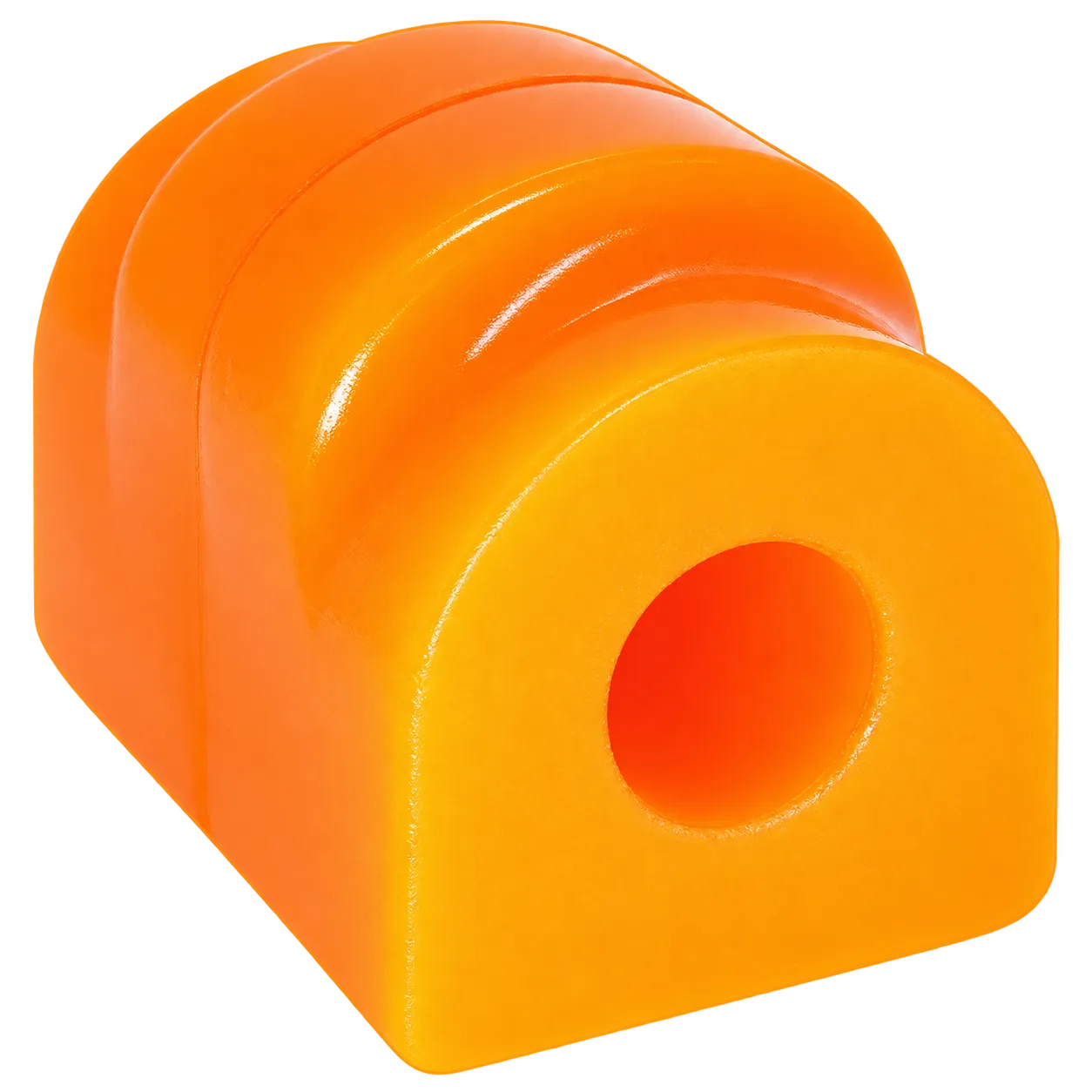
A rear sway bar bushing carries the rear anti-roll bar, the torsion bar that links the left and right sides of the rear suspension and is clamped to the beam, body or subframe by brackets. The rear bar is thinner than the front one, so its bushings are smaller in diameter and work in a regime that depends heavily on how the car is loaded. PolyPro casts them in its own tooling for specific bar and bracket sizes; see the catalogue for sizes and hardness.
The rear anti-roll bar works on the same principle as the front one: when the body leans, the bar twists and passes part of the load to the opposite side. Its job, however, is different — it balances how grip is shared between the axles. The bar rests on two bushings held in brackets, and the bushing is what sets its position, carries the radial load and lets the steel rotate. Some cars have no rear bar at all, while on others it is thinner and shorter than the front one.
Because the diameter and the torque are lower, rear bushings are loaded more lightly on smooth roads, but they are loaded hard as soon as the boot is full, the car is carrying passengers or a trailer is hitched. The second factor is location: they sit in the area that takes salt, grit and water thrown up by the rear wheels. General information on the assembly is in the sway bar bushing section.
Rear bushing wear is noticed later than front wear: the noise is duller and is often masked by sounds from the boot. The giveaway is that the car's behaviour changes with the load it is carrying.
A worn rear sway bar link bushing and tired rear beam bushings give similar symptoms, so check all three before ordering parts.
At the rear, factory rubber ages mainly from its environment rather than from load: salt, water, grit and temperature swings do their work faster than the cyclic twisting of the bar. Rear bushings therefore often end up hard and cracked around the edges before the bore itself has opened up to any great extent.
Polyurethane is unaffected by road chemicals and water, does not harden in the same way and keeps its bore size, so the rear axle holds its intended cornering behaviour for longer, loaded or empty. The drawback is the same as at the front: slightly more vibration, and mandatory lubrication with a compatible grease during assembly. Keep the balance in mind as well — much stiffer bushings at the rear alone make the tail sharper in a corner. Shore hardness is stated on each product page.
Selection goes by the dimensions of the bar and the bracket, not by the car model. Measure the bar with a caliper at the mounting point, look at the bracket shape and the condition of the steel, then compare with the product pages.
Rear bars are thinner than front ones and neighbouring sizes often differ by only a few millimetres, so accurate measurement matters even more here than at the front. Use a caliper in two planes at the mounting area itself, because the steel there wears and goes oval. Then look at the bracket: you may need a cylindrical bushing for a U-shaped bracket, a flat-based one for a clamping plate, a version with a collar to stop the bar walking, or a split type that fits without dropping the bar. Rear brackets corrode more often, so inspect them and replace worn ones together with the bushings.
At the rear, hardness affects the balance of the car as well as service life. Softer polyurethane stays close to factory rubber: handling barely changes while the part lasts noticeably longer, which suits ordinary everyday use. Harder material locates the bar more precisely, deforms less under load and is useful when the car is often loaded, towing or driven on rough roads. But markedly harder bushings at the rear only will make the rear axle sharper in a corner, so choose them with the front axle in mind. The exact Shore value is on each product page.
Rear bushings are chosen for the way the car is actually used. An empty city car loads them lightly and a softer material is enough. If the boot always carries tools or stock, the car runs fully loaded or tows a trailer, the bar works through a larger range and a harder option makes sense. Consider the environment separately: salt, mud and water from the rear wheels shorten the life of rubber, and this is where polyurethane gains the most. Winter shows it most clearly: rubber stiffens in the cold and clearance in the bracket grows faster. For a comparison with the other axle, see the front sway bar bushing section.
PolyPro is a Ukrainian manufacturer of polyurethane car parts. We design and build our moulds in house, cast the parts on our own equipment and check the dimensions of each batch, which is why we trade without middlemen. Retail is per piece: if you need one rear bushing, we sell one. If the size you need is not in the catalogue, we make the part from a drawing, a sample or the worn bushing itself, starting from a single unit.
Wholesale supply goes to workshops, parts shops, fleets and resellers. Regular partners work through our partner programme: bonuses for turnover or for the size of a single order, access to prices and stock levels, and shipment under the partner's own brand. Products are covered by warranty, with delivery across Ukraine and international shipping on request.
Mainly in diameter: the rear bar is thinner and the torque through it is lower. Front bushings work on almost every bump, while rear ones depend far more on load — with cargo or a trailer they are loaded sharply. Dimensions and bracket shapes differ, so the parts are not interchangeable even when they look similar from the outside.
That is the classic sign of worn rear bushings. Once the bore has opened up, the bar has free movement in the bracket and starts working late. The body leans further before the bar reacts, and the rear axle settles into line afterwards, which is felt as swaying through a long curve or during a lane change at speed.
Not necessarily. For an empty city car a softer polyurethane is enough: it behaves much like factory rubber but keeps its bore size far longer. Harder material makes sense when the car regularly runs with cargo, a trailer, or on broken roads. The hardness of each position is stated on its product page, so you can match it to your use.
You can, but it shifts the balance. A stiffer rear axle rolls less, yet the tail becomes sharper in a corner and loses grip earlier on a slippery surface. If you only want longer service life rather than different handling, choose a hardness close to what is fitted at the front and change the two axles in sequence.
Put the car on a lift or over a pit and lever the bar next to the bracket: vertical movement in the bracket means the bore is worn. Inspect the edges of the bushing for cracks and extrusion, and the bar surface for clean patches left by sideways walking. Check the sway bar links at the same time, since their play makes a similar noise.
Yes, it is a required step. The seat is cleaned of dirt and rust, and the bore of the bushing along with the contact area of the bar is greased with a compound compatible with polyurethane. Without grease the joint squeaks and the contact surface wears faster. Ordinary petroleum-based greases are not suitable for polyurethane.
Yes, retail here is per piece. You can take one bushing, a pair for the axle or a set for a particular job — there is no minimum quantity. That is useful when only one side is damaged or when you want a spare on hand. Non-standard sizes are produced the same way, from one unit, to a drawing or a sample.
We ship directly from production with no intermediaries — to workshops, parts shops, fleets and resellers. Regular buyers work through our partner programme: bonuses for turnover or for the size of a single order, access to prices and stock levels, and shipment under the partner's own brand. The range is agreed to suit your profile of work.